

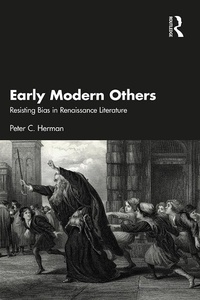
Early Modern Others
Resisting Bias in Renaissance Literature
1st Edition
Published on 25. October 2023
164 pages
978-1-000-96754-8 (ISBN)
Description

Early Modern Others highlights instances of challenges to misogyny, racism, atheism, and antisemitism in the early modern period. Through deeply historicizing early modern literature and looking at its political and social contexts, Peter C. Herman explores how early modern authors challenged the biases and prejudices of their age.
By examining the works of Thomas More, William Shakespeare, Christopher Marlowe, John Fletcher, and Philip Massinger amongst others, Herman reveals that for every "-ism" in early modern English culture there was an "anti-ism" pushing back against it. The book investigates "others" in early modern literature through indigenous communities, women, religion, people of color, and class.
This innovative book shows that the early modern period was as complicated and as contradictory as the world today. It will offer valuable insight for anyone studying early modern literature and culture, as well as social justice and intersectionality.
By examining the works of Thomas More, William Shakespeare, Christopher Marlowe, John Fletcher, and Philip Massinger amongst others, Herman reveals that for every "-ism" in early modern English culture there was an "anti-ism" pushing back against it. The book investigates "others" in early modern literature through indigenous communities, women, religion, people of color, and class.
This innovative book shows that the early modern period was as complicated and as contradictory as the world today. It will offer valuable insight for anyone studying early modern literature and culture, as well as social justice and intersectionality.
Reviews / Votes
"This compact yet wide-ranging book is fundamentally concerned with how early modern literature is inherently dialogic, and Herman is invested in the ways in which issues of gender, race, religion, and status are always in a continual process of negotiation both in and beyond the theatres. The book is remarkable in terms of the inverse relationship between the text's size and the topics it attempts to cover. . . . This, in the end, is an ambitious book that makes us conscious of the perils of a univocal reading of literature, and which ultimately provides a very different voice in the context of current critical debates in higher education and academic scholarship around issues of racism, identity, prejudice, and discrimination."-Bethan Davies, The Spenser Review
[T]his is a valuable and timely work, one that offers a perspective on early modern literature and society rarely discussed'.
-Patrick J. McGrath, Milton Quarterly
More details
Edition
1. Auflage
Language
English
Place of publication
London
United Kingdom
Publishing group
Taylor & Francis Ltd
Target group
College/higher education
Illustrations
1 Line drawings, black and white; 6 Halftones, black and white; 7 Illustrations, black and white
ISBN-13
978-1-000-96754-8 (9781000967548)
Copyright in bibliographic data and cover images is held by Nielsen Book Services Limited or by the publishers or by their respective licensors: all rights reserved.
Schweitzer Classification
Other editions
Additional editions

Book
11/2023
Routledge
Unfortunately, price unknown
Available (delivery time upon request)
Book
10/2023
1st Edition
Routledge
€53.50
Shipment within 10-20 days
Book
10/2023
1st Edition
Routledge
€193.50
Shipment within 10-20 days
Person
Peter C. Herman is Professor of English Literature at San Diego State University. He is the author of Unspeakable: Literature and Terrorism from the Gunpowder Plot to 9/11 (2020), Destabilizing Milton: "Paradise Lost" and the Poetics of Incertitude (2005), and Royal Poetrie: Monarchic Verse and the Political Imaginary of Early Modern England (2010), among other books.
Content
Acknowledgments
Introduction
Chapter 1: Thomas More's Utopia and the "New World"
Chapter 2: "I am no child, no babe": The Shrew Plays
Chapter 3: "That's More than We Know": The Crisis of the 1590s in Deloney, Dekker, and Shakespeare
Chapter 4: The Circulation of Atheism in Early Modern England: Tamburlaine, Selimus, and King Lear
Chapter 5: The Religious "Other" in Early Modern England: The Jew of Malta, The Merchant of Venice, and The Renegado
Chapter 6: Othello and London's Africans
Works Cited
Index
Introduction
Chapter 1: Thomas More's Utopia and the "New World"
Chapter 2: "I am no child, no babe": The Shrew Plays
Chapter 3: "That's More than We Know": The Crisis of the 1590s in Deloney, Dekker, and Shakespeare
Chapter 4: The Circulation of Atheism in Early Modern England: Tamburlaine, Selimus, and King Lear
Chapter 5: The Religious "Other" in Early Modern England: The Jew of Malta, The Merchant of Venice, and The Renegado
Chapter 6: Othello and London's Africans
Works Cited
Index
