

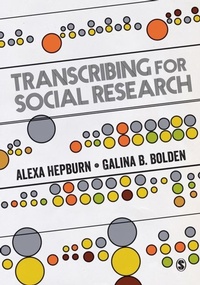
Transcribing for Social Research
1st Edition
Published on 1. May 2017
224 pages
978-1-5264-2168-5 (ISBN)
Description

How can we capture the words, gestures and conduct of study participants? How do we transcribe what happens in social interactions in analytically useful ways? How could systematic and detailed transcription practices benefit research?
This book demonstrates how best to represent talk and interaction in a manageable and academically credible way that enables analysis. It describes and assesses key methodological and epistemological debates about the status of transcription research while also setting out best practice for handling different types of data and forms of social interaction.
Featuring transcribing basics as well as important recent developments, this book guides you through:
Time and sequencing
Speech delivery and patterns
Non-vocal conduct
Emotive displays like laughter, tears, or pain
Talk in non-English languages
Helpful technological resources
As the first book-length exposition of the Jeffersonian transcription conventions, this well-crafted balance of theory and practice is a must-have resource for any social scientist looking to produce high quality transcripts.
This book demonstrates how best to represent talk and interaction in a manageable and academically credible way that enables analysis. It describes and assesses key methodological and epistemological debates about the status of transcription research while also setting out best practice for handling different types of data and forms of social interaction.
Featuring transcribing basics as well as important recent developments, this book guides you through:
Time and sequencing
Speech delivery and patterns
Non-vocal conduct
Emotive displays like laughter, tears, or pain
Talk in non-English languages
Helpful technological resources
As the first book-length exposition of the Jeffersonian transcription conventions, this well-crafted balance of theory and practice is a must-have resource for any social scientist looking to produce high quality transcripts.
Reviews / Votes
The authors' calm and well-organised coverage pays tribute to a generous variety of transcription styles in the Conversation Analysis tradition. The book is an invaluable source of techniques for capturing the words, whoops, gulps, sighs, eyebrow-flashes and head-nods of language in all the complexity of its performance. -- Charles Antaki An excellent, clear and comprehensive guide to the transcription of talk-in-interaction from the perspective of conversation analysis, demonstrating the continuing 50 year influence, relevance and productivity of Gail Jefferson's ground-breaking initiatives. -- Charles Goodwin The authors argue that standard orthography is unable to represent the 'words, gestures and conduct of the people being studied'. Drawing on insights from conversation analysis which show how social phenomena are 'realised through talk in interaction', as well as discursive psychology and ethnomethodology, Hepburn and Bolden show the reader, in ten succinct and well written chapters, how to capture words and interactions and record them accurately on paper[...]
Transcribing for Social Research his an invaluable contribution to the methodological literature which will appeal to researchers across a range of disciplines who wish to successfully capture speech in all its complexity. -- Paul Webb * SRA Research Matters * Transcription is often be viewed as merely recording what people have said in written form. Simple. In contrast, this book emphasises both the importance and complexity of this element of research..
[..]
..it is pitched at a level which is appropriate for those with a wide range of experiences. Ultimately, this book is likely to become the go-to text for transcription in the social sciences, for both novice and expert researchers alike. -- Claire Melia * QMiP Bulletin, British Psychological Society *
All prices
More details
Edition
First Edition
Language
English
Place of publication
London
United Kingdom
Target group
College/higher education
Professional and scholarly
Product notice
Reflowable
File size
5,16 MB
ISBN-13
978-1-5264-2168-5 (9781526421685)
Copyright in bibliographic data and cover images is held by Nielsen Book Services Limited or by the publishers or by their respective licensors: all rights reserved.
Schweitzer Classification
Other editions
Additional editions
Alexa Hepburn
Transcribing for Social Research
Book
06/2017
1st Edition
SAGE Publications Ltd
€85.20
Shipment within 15-20 days
Alexa Hepburn
Transcribing for Social Research
Book
06/2017
1st Edition
SAGE Publications Ltd
€158.10
Shipment within 15-20 days
Person
Alexa Hepburn is a research professor in the Department of Communication at Rutgers University. Her research is focused on the use and development of conversation analytic methods, in particular, emotional expressions, parents' strategies for managing children's behavior, and techniques for giving advice and responding empathically to distress. Analytic insights are then applied in professional-client encounters, such as medical consultations, therapeutic environments, and helpline interactions.
Content
Foreword: Emanuel A Schegloff
Chapter 1: Introduction
Chapter 2: Getting Started with Transcription
Chapter 3: Timing and Sequencing in Transcription
Chapter 4: Transcribing Speech Delivery
Chapter 5: Transcribing Aspiration and Laughter
Chapter 6: Transcribing Crying, Expressions of Pain and Other Non-Speech Sounds
Chapter 7: Transcribing Visible Conduct
Chapter 8: Transcribing for Languages Other than English
Chapter 9: Technological Resources for Transcription
Chapter 10: Comparisons, Concerns and Conclusions
Chapter 1: Introduction
Chapter 2: Getting Started with Transcription
Chapter 3: Timing and Sequencing in Transcription
Chapter 4: Transcribing Speech Delivery
Chapter 5: Transcribing Aspiration and Laughter
Chapter 6: Transcribing Crying, Expressions of Pain and Other Non-Speech Sounds
Chapter 7: Transcribing Visible Conduct
Chapter 8: Transcribing for Languages Other than English
Chapter 9: Technological Resources for Transcription
Chapter 10: Comparisons, Concerns and Conclusions
