

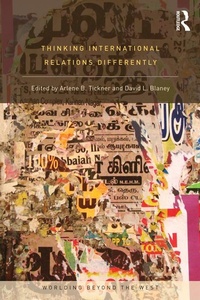
Thinking International Relations Differently
1st Edition
Published on 1. March 2013
368 pages
978-1-136-47382-1 (ISBN)
Description

A host of voices has risen to challenge Western core dominance of the field of International Relations (IR), and yet, intellectual production about world politics continues to be highly skewed. This book is the second volume in a trilogy of titles that tries to put the "international" back into IR by showing how knowledge is actually produced around the world.
The book examines how concepts that are central to the analysis of international relations are conceived in diverse parts of the world, both within the disciplinary boundaries of IR and beyond them. Adopting a thematic structure, scholars from around the world issues that include security, the state, authority and sovereignty, globalization, secularism and religion, and the "international" - an idea that is central to discourses about world politics but which, in given geocultural locations, does not necessarily look the same.
By mapping global variation in the concepts used by scholars to think about international relations, the work brings to light important differences in non-Western approaches and the potential implications of such differences for the IR discipline and the study of world politics in general. This is essential reading for anyone who is concerned about the history, development and future of International Relations.
The book examines how concepts that are central to the analysis of international relations are conceived in diverse parts of the world, both within the disciplinary boundaries of IR and beyond them. Adopting a thematic structure, scholars from around the world issues that include security, the state, authority and sovereignty, globalization, secularism and religion, and the "international" - an idea that is central to discourses about world politics but which, in given geocultural locations, does not necessarily look the same.
By mapping global variation in the concepts used by scholars to think about international relations, the work brings to light important differences in non-Western approaches and the potential implications of such differences for the IR discipline and the study of world politics in general. This is essential reading for anyone who is concerned about the history, development and future of International Relations.
Reviews / Votes
Arlene Tickner and David Blaney explore how knowledge of the international is produced in different parts of the world in this important edited volume. They challenge the boundaries, expand the definition of the subject, and create space for a de-centering of the field of IR. They are sensitive to the diversity of ways in which theoretical knowledge is socially and historically situated and explore how concepts become rearticulated in different parts of the world. They argue that recognizing multiple traditions is necessary for a genuinely global dialogue and present a "world of worlds" in which diversity flourishes.Thomas Biersteker, The Graduate Institute, Geneva.
This book is an immense achievement. For a discipline that claims to research and teach 'the international', IR has always been a provincial place. Unthinking traditional conceptions of world politics is a steep challenge, yet meeting it has now become possible with Thinking International Relations Differently.
Tim Dunne, University of Queensland.
IR theorists in the Anglophone world mostly (but not entirely) outside North America have often celebrated the diversity and critical edge of their contributions-and not without significant cause. Yet this enterprise in International Relations theory has singularly and spectacularly failed to attend to the European-modern episteme upon which most of the many fascinating manifestations of theory of the international claim their authority to speak of global order in general terms. Is this failure born of reticence, blindness or ignorance? Whatever the case, such a phenomenon provokes a more fundamental question: is International Relations theory an impossibility?
If you apprehend this question with some urgency, or, if you simply find it an interesting provocation, then Thinking International Relations Differently is obligatory reading.
Robbie Shilliam, Queen Mary, University of London
More details
Series
Language
English
Place of publication
London
United Kingdom
Publishing group
Taylor & Francis Ltd
Target group
Professional and scholarly
Illustrations
3 s/w Abbildungen, 1 s/w Tabelle, 3 s/w Zeichnungen
1 Tables, black and white; 3 Line drawings, black and white; 3 Illustrations, black and white
File size
2,69 MB
ISBN-13
978-1-136-47382-1 (9781136473821)
Copyright in bibliographic data and cover images is held by Nielsen Book Services Limited or by the publishers or by their respective licensors: all rights reserved.
Schweitzer Classification
Other editions
Additional editions
Arlene Tickner | David L. Blaney
Thinking International Relations Differently
Worlding Beyond the West
Book
02/2012
Routledge
€242.70
Shipment within 15-20 days
Arlene Tickner | David L. Blaney
Thinking International Relations Differently
Worlding Beyond the West
Book
02/2012
1st Edition
Routledge
€74.30
Shipment within 15-20 days
Persons
Arlene B. Tickner is Professor of International Relations in the Political Science Department at the Universidad de los Andes, Bogota, Colombia. Her main areas of research include IR in non-core settings, Latin American security and Colombian foreign policy. She is the co-editor (with Ole Waever) of Global Scholarship in International Relations, (2009).
?
David L. Blaney is Professor of Political Science at Macalester College, USA. He works on the social and political theory of IR and IPE and questions of culture and identity. His recent books (both with Naeem Inayatullah) include International Relations and the Problem of Difference (2004) and Savage Economics: Wealth, Poverty and the Temporal Walls of Capitalism (2010).
?
David L. Blaney is Professor of Political Science at Macalester College, USA. He works on the social and political theory of IR and IPE and questions of culture and identity. His recent books (both with Naeem Inayatullah) include International Relations and the Problem of Difference (2004) and Savage Economics: Wealth, Poverty and the Temporal Walls of Capitalism (2010).
Content
1. Introduction Arlene B. Tickner and David L. Blaney Section 1: Security 2. Security in the Arab World and Turkey: Differently Different Pinar Bilgin 3. Aberystwyth, Paris, Copenhagen. The Europeanness of New "Schools" of Security Theory in an American Field Ole Waever 4. Security Theorizing in China: Culture, Evolution and Social Practice Liu Yongtao 5. No Room for Theory? Security Studies in Latin America Arlene B. Tickner and Monica Herz Section 2: State, Sovereignty and Authority 6. The State of the African State and Politics: Ghosts and Phantoms in the Heart of Darkness Siba Grovogui 7. Contextualizing Rule in South Asia Siddharth Mallavarapu 8. The Latin American Nation-State and the International Fernando Lopez-Alves Section 3: Globalization 9. Reading the Global in the Absence of Africa Isaac Kamola 10. Globalization: A Russian Perspective Andrei P. Tsygankov 11. Arab Scholars' Take on Globalization Wafaa Hasan and Bessma Momani Section 4:Secularism and Religion 12. Religion, Secularism and the State in Southeast Asia Ahmad Fauzi Abdul Hamid 13. Western Secularisms: Variation in a Doctrine and its Practice Mona Kanwal Sheikh and Ole Waever Section 5:The International 14. Contrived Boundaries, Kinship and Ubuntu: A (South) African View of "the International" Karen Smith 15. Social Science Research and Engagement in Pakistan Ayesha Khan
