

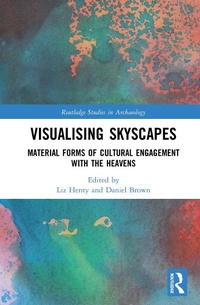
Visualising Skyscapes
Material Forms of Cultural Engagement with the Heavens
1st Edition
Published on 19. August 2019
268 pages
978-1-351-39879-4 (ISBN)
Description

Above the land and its horizon lies the celestial sphere, that great dome of the sky which governs light and darkness, critical to life itself, yet its influence is often neglected in the archaeological narrative. Visualising Skyscapes captures a growing interest in the emerging field of skyscape archaeology.
This powerful and innovative book returns the sky to its rightful place as a central consideration in archaeological thought and can be regarded as a handbook for further research. Bookended by a foreword by archaeologist Gabriel Cooney and an afterword by astronomer Andrew Newsam, its contents have a wide-reaching relevance for the fields of archaeology, anthropology, ethnography, archaeoastronomy, astronomy, heritage and cultural studies. The volume balances six chapters on theory and methodology which elaborate on the history and practice of the field with six other chapters focused on case studies from around the world.
Visualising Skyscapes captures the growing interest in the multidisciplinary study of skyscapes and will be of interest to academics, students and the general public, as well as having international appeal. It is topical, timely and relevant to current debates and will hopefully stimulate further interest in this exciting and relatively new area of investigation. The contributions showcase the work of distinguished academics in the field and the chapters are all enhanced by numerous photographs and images.
This powerful and innovative book returns the sky to its rightful place as a central consideration in archaeological thought and can be regarded as a handbook for further research. Bookended by a foreword by archaeologist Gabriel Cooney and an afterword by astronomer Andrew Newsam, its contents have a wide-reaching relevance for the fields of archaeology, anthropology, ethnography, archaeoastronomy, astronomy, heritage and cultural studies. The volume balances six chapters on theory and methodology which elaborate on the history and practice of the field with six other chapters focused on case studies from around the world.
Visualising Skyscapes captures the growing interest in the multidisciplinary study of skyscapes and will be of interest to academics, students and the general public, as well as having international appeal. It is topical, timely and relevant to current debates and will hopefully stimulate further interest in this exciting and relatively new area of investigation. The contributions showcase the work of distinguished academics in the field and the chapters are all enhanced by numerous photographs and images.
Reviews / Votes
"Visualising Skyscapes provides a stimulating and rich collection of papers that will appeal to a wide range of scholars. The volume encapsulates the interdisciplinary nature of the skyscapes approach and shows the value in bringing together disparate case studies and examples from across the globe under the umbrella of cultural astronomy." - Susan Greaney, Journal of Skyscape ArchaeologyMore details
Series
Edition
1. Auflage
Language
English
Place of publication
London
United Kingdom
Publishing group
Taylor & Francis Ltd
Target group
College/higher education
Illustrations
2 Tables, black and white; 20 Line drawings, color; 11 Line drawings, black and white; 49 Halftones, color; 4 Halftones, black and white; 69 Illustrations, color; 15 Illustrations, black and white
ISBN-13
978-1-351-39879-4 (9781351398794)
Copyright in bibliographic data and cover images is held by Nielsen Book Services Limited or by the publishers or by their respective licensors: all rights reserved.
Schweitzer Classification
Other editions
Additional editions
Liz Henty | Daniel Brown
Visualising Skyscapes
Material Forms of Cultural Engagement with the Heavens
Book
03/2021
1st Edition
Routledge
€55.70
Shipment within 15-20 days
Liz Henty | Daniel Brown
Visualising Skyscapes
Material Forms of Cultural Engagement with the Heavens
Book
08/2019
1st Edition
Routledge
€215.41
Shipment within 10-20 days
Persons
Liz Henty MA is examining the relationship between the histories of archaeology and archaeoastronomy for her doctoral thesis at the University of Wales Trinity Saint David. Her many publications include a contribution to Skyscapes (Silva and Campion, Oxford: Oxbow, 2015). In 2015 she co-founded and is co-editor of the Journal of Skyscape Archaeology.
Daniel Brown has a doctorate in astrophysics and is an Associate Professor in Astronomy and Science Communication at Nottingham Trent University. His work combines heritage, light pollution and archaeoastronomy. He organises skyscapes sessions at National Astronomy Meetings and edited the 2014 session proceedings for the Journal of Physics: Conference Series (Vol. 685, 2016).
Daniel Brown has a doctorate in astrophysics and is an Associate Professor in Astronomy and Science Communication at Nottingham Trent University. His work combines heritage, light pollution and archaeoastronomy. He organises skyscapes sessions at National Astronomy Meetings and edited the 2014 session proceedings for the Journal of Physics: Conference Series (Vol. 685, 2016).
Content
Foreword: Facing the Sky
Professor Gabriel Cooney
Introduction
Daniel Brown and Liz Henty
Part I. Skyscapes: Theory and Methodology
1. Skyscape Archaeology: the place of the sky in the academy
Liz Henty
2. Visualising Skyscapes: GIS-based 3D modelling and astronomical simulation
Georg Zotti
3. On measurement, uncertainty and maximum likelihood in skyscape archaeology
Fabio Silva
4. The Dark Sky Character of Archaeological Landscapes: Cultural Meaning and Conservation Strategies
Frank Prendergast
5. The phenomenology of star phases and their role in considering skyscapes
Bernadette Brady
6. Toads turning time: verifying visualisations of the Sanctuary (Avebury, Wiltshire) by inter-disciplinary method.
Lionel Sims
Part II. Skyscapes: Case Studies
7. Linsmeau Early Bronze Age structure showing a possible astronomical intent
Frederic Heller, Frederic Broes and Georg Zotti
8. Time pursued by a Bear: Ursa Major and stellar time-telling in the Paduan Salone
Darrelyn Gunzburg
9. Visualisation of the sky in traditional cultures of Eurasia and its ancient representations
Emilia Pasztor
10. The Square Kilometre Array Art Exhibition
Jarita Holbrook
11. A Brief Account of Three Millennia of Chinese Preoccupation with the Skyscape
David W. Pankenier
12. The Science of Seeing Skyscapes - A photographic documentary of watching
Deborah Harty, Daniel Brown, Amanda Reyes Asturias, Kieran Simcox, Phillip Johnson
Afterword
Andrew Newsam
Professor Gabriel Cooney
Introduction
Daniel Brown and Liz Henty
Part I. Skyscapes: Theory and Methodology
1. Skyscape Archaeology: the place of the sky in the academy
Liz Henty
2. Visualising Skyscapes: GIS-based 3D modelling and astronomical simulation
Georg Zotti
3. On measurement, uncertainty and maximum likelihood in skyscape archaeology
Fabio Silva
4. The Dark Sky Character of Archaeological Landscapes: Cultural Meaning and Conservation Strategies
Frank Prendergast
5. The phenomenology of star phases and their role in considering skyscapes
Bernadette Brady
6. Toads turning time: verifying visualisations of the Sanctuary (Avebury, Wiltshire) by inter-disciplinary method.
Lionel Sims
Part II. Skyscapes: Case Studies
7. Linsmeau Early Bronze Age structure showing a possible astronomical intent
Frederic Heller, Frederic Broes and Georg Zotti
8. Time pursued by a Bear: Ursa Major and stellar time-telling in the Paduan Salone
Darrelyn Gunzburg
9. Visualisation of the sky in traditional cultures of Eurasia and its ancient representations
Emilia Pasztor
10. The Square Kilometre Array Art Exhibition
Jarita Holbrook
11. A Brief Account of Three Millennia of Chinese Preoccupation with the Skyscape
David W. Pankenier
12. The Science of Seeing Skyscapes - A photographic documentary of watching
Deborah Harty, Daniel Brown, Amanda Reyes Asturias, Kieran Simcox, Phillip Johnson
Afterword
Andrew Newsam
