

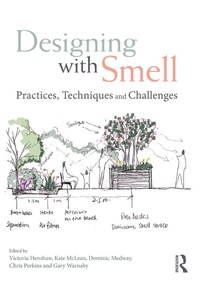
Designing with Smell
Practices, Techniques and Challenges
Published on 5. October 2017
312 pages
978-1-317-35462-8 (ISBN)
Description

Designing with Smell aims to inspire readers to actively consider smell in their work through the inclusion of case studies from around the world, highlighting the current use of smell in different cutting-edge design and artistic practices. This book provides practical guidance regarding different equipment, techniques, stages and challenges which might be encountered as part of this process.
Throughout the text there is an emphasis on spatial design in numerous forms and interpretations - in the street, the studio, the theatre or exhibition space, as well as the representation of spatial relationships with smell. Contributions, originate across different geographical areas, academic disciplines and professions. This is crucial reading for students, academics and practitioners working in olfactory design.
Throughout the text there is an emphasis on spatial design in numerous forms and interpretations - in the street, the studio, the theatre or exhibition space, as well as the representation of spatial relationships with smell. Contributions, originate across different geographical areas, academic disciplines and professions. This is crucial reading for students, academics and practitioners working in olfactory design.
More details
Language
English
Place of publication
London
United Kingdom
Publishing group
Taylor & Francis Ltd
Target group
College/higher education
Professional and scholarly
Illustrations
7 Tables, black and white; 6 Line drawings, black and white; 71 Halftones, black and white
File size
4,64 MB
ISBN-13
978-1-317-35462-8 (9781317354628)
Copyright in bibliographic data and cover images is held by Nielsen Book Services Limited or by the publishers or by their respective licensors: all rights reserved.
Schweitzer Classification
Other editions
Additional editions
Victoria Henshaw | Kate McLean | Dominic Medway
Designing with Smell
Practices, Techniques and Challenges
Book
10/2017
1st Edition
Routledge
€101.83
Shipment within 10-20 days
Victoria Henshaw | Kate McLean | Dominic Medway
Designing with Smell
Practices, Techniques and Challenges
Book
10/2017
1st Edition
Routledge
€297.61
Shipment within 10-20 days
Persons
The late Victoria Henshaw's last post was as a Lecturer in Urban Design and Planning at the University of Sheffield, UK. Her research focused upon experiences and design of cities and buildings according to the senses, and smell in particular. Victoria led smellwalks in cities around the world, wrote the blog Smell and the City, and was author of Urban Smellscapes: Understanding and Designing City Smell Environments (2013). Victoria's work featured in broadcast, print and electronic media including BBC Radio 4, The New York Times, New Scientist, The Guardian, The Times, The Independent and Wired magazine amongst others.
Kate McLean is a Programme Director for Graphic Design at Canterbury Christ Church University, UK, and a part-time PhD candidate in Information Experience Design at the RCA, London. Her research through design investigates possibilities for rendering 'eye-visible' and communicating the space between a smell's source and the human nose through practices of smellwalking and smellscape mapping in cities around the world. She has published in Leornardo and Communication Design and her smellmap research has received international coverage, most recently in the New Yorker, BBC Radio 4 and the Australian Broadcasting Corporation.
Dominic Medway is a Professor of Marketing in the Institute of Place Management at Manchester Metropolitan University, UK. Dominic's work is primarily concerned with the complex interactions between places, spaces, and those who manage and consume them, reflecting his academic training as a geographer. He has published extensively in a variety of leading academic journals, including: Environment & Planning A, Tourism Management, Journal of Environmental Psychology, Cities, European Journal of Marketing and Marketing Theory.
Chris Perkins is Reader in Geography at the University of Manchester, UK, where he has taught since 1998, having previously run the university's map libraries. His research interests lie at the interface between mapping technologies and social and cultural practices, with ongoing research into performative aspects of contemporary mapping behaviour, an interest in sensory mapping, and an emerging interest in play. Chris was Chair of the International Cartographic Association Maps and Society Research Commission and is the author of numerous books and academic articles.
Gary Warnaby is Professor of Retailing and Marketing in the Institute of Place Management at Manchester Metropolitan University, UK. His research interests focus on the marketing of places and retailing. Results of this research have been published in various academic journals in both the management and geography disciplines, including Environment and Planning A, Journal of Business Research, Journal of Marketing Management and European Journal of Marketing. He was co-author of Relationship Marketing: A Consumer Experience Approach, co-editor of Rethinking Place Branding, and has contributed to numerous edited books.
Kate McLean is a Programme Director for Graphic Design at Canterbury Christ Church University, UK, and a part-time PhD candidate in Information Experience Design at the RCA, London. Her research through design investigates possibilities for rendering 'eye-visible' and communicating the space between a smell's source and the human nose through practices of smellwalking and smellscape mapping in cities around the world. She has published in Leornardo and Communication Design and her smellmap research has received international coverage, most recently in the New Yorker, BBC Radio 4 and the Australian Broadcasting Corporation.
Dominic Medway is a Professor of Marketing in the Institute of Place Management at Manchester Metropolitan University, UK. Dominic's work is primarily concerned with the complex interactions between places, spaces, and those who manage and consume them, reflecting his academic training as a geographer. He has published extensively in a variety of leading academic journals, including: Environment & Planning A, Tourism Management, Journal of Environmental Psychology, Cities, European Journal of Marketing and Marketing Theory.
Chris Perkins is Reader in Geography at the University of Manchester, UK, where he has taught since 1998, having previously run the university's map libraries. His research interests lie at the interface between mapping technologies and social and cultural practices, with ongoing research into performative aspects of contemporary mapping behaviour, an interest in sensory mapping, and an emerging interest in play. Chris was Chair of the International Cartographic Association Maps and Society Research Commission and is the author of numerous books and academic articles.
Gary Warnaby is Professor of Retailing and Marketing in the Institute of Place Management at Manchester Metropolitan University, UK. His research interests focus on the marketing of places and retailing. Results of this research have been published in various academic journals in both the management and geography disciplines, including Environment and Planning A, Journal of Business Research, Journal of Marketing Management and European Journal of Marketing. He was co-author of Relationship Marketing: A Consumer Experience Approach, co-editor of Rethinking Place Branding, and has contributed to numerous edited books.
Content
Foreword 1. Introduction Part I Preface 2. Smell the City: A Participatory Art Installation 3. An Olfactory Space 4. The Smell of Snow: Experiencing Wonderland through Multisensory Art Part II Preface 5. The GhostFood Project: Enhancing Flavor through Personalized Smellscapes 6. Smellscape Narratives: Designing Olfactory Spaces as Infrastructure for Embodied Storytelling 7. Communicating and Mediating Smellscapes: The Design and Exposition of Olfactory Mappings Part III Preface 8. The Design of Urban Smellscapes with Fragrant Plants and Water Features 9. Stop and Smell the Flowers: Plant Scent in a Healing Forest Garden for Patients with Stress-Related Illness 10. The Creation of Seoul Scent: Invisible Beauty 11. Design with Smells: The Environmental Scientist's Perspective Part IV Preface 12. Designing Smell into the Consumer Experience 13. The Use of Scent in Out of Home (OOH) Advertising 14. Scent and Brand Storytelling 15. Olfactory Control, Aroma Power and Organizational Smellscapes Part V Preface 16. Experiential Learning and Olfactory Architectures: Accommodating Smell in Teaching Practices in the Built Environment 17. Culturalizing Scent: Current Steps towards Integrating the Sense of Smell in Art and Design Education 18. Olfactory Education in Art and Design 19. Situating Olfactory Literacies: An Intersensory Pedagogy by Design Part VI Preface 20. Inhaling Futurism: On the Use of Olfaction in Futurism and Olfactory (Re)constructions 21. A Dead Man's Nose: Using Smell to Explore the Battlefield of Waterloo 22. Olfactory Design Element in Theatre: The Practical Considerations 23. The Nose Onstage: Olfactory Perceptions and Theatrical Dimension Part VII Preface 24. A DIY Guide for Extracting Scent in Your Kitchen 25. Scenting the Antiseptic Institution 26. Indeterminate Ecologies of Scent 27. Afterword
