

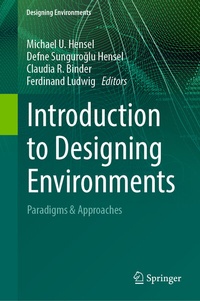
Introduction to Designing Environments
Description

The Designing Environments book series addresses questions regarding necessary environmental transformation in the context of the fast-unfolding environmental crisis. This is done from a broad interdisciplinary perspective, examining the negative impact of human transformations of the environment and providing different inroads towards sustainable environmental transformation with net positive impact.
Volume one of the Designing Environments book series brings together experts from different disciplines and often inter- and transdisciplinary contexts, who discuss specific approaches to overcoming the negative impact of the transformation of environments by humans. Across the 12 chapters of volume one, specific keywords recur that are indicative of shared insights and concerns. These include Anthropocene , climate change , complexity , critical zone, ecosystem services , and sustainability . Furthermore, interdisciplinary approaches to human-environment interactions , sustainability transitions , and socio-ecological systems take center stage and are discussed in relation to conceptual and methodological as well as societal and technological challenges and opportunities.
More details
Other editions
Additional editions
Persons
Prof. Dr. Michael U. Hensel is an Architect, University Professor and Head of Research Department of Digital Architecture and Planning at the Faculty of Architecture and Planning at TU Wien.
Dr. Defne Sunguroglu Hensel is an Architect, Associate Professor for Landscape Architecture and Urban Ecology at Southeast University in Nanjing, China, and senior researcher at Technical University Munich.
Prof. Dr. Claudia R. Binder is the Dean of EPFL ENAC, University Professor and Head of the Human-Environment Relations in Urban Systems Laboratory
Prof. Dr. Ferdinand Ludwig is an Architect, University Professor and Head of Green Technologies in Landscape Architecture at the Faculty of Architecture at Technical University Munich.
