

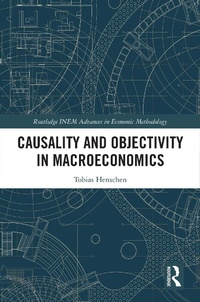
Causality and Objectivity in Macroeconomics
1st Edition
Published on 29. September 2023
218 pages
978-1-000-96182-9 (ISBN)
Description

Central banks and other policymaking institutions use causal hypotheses to justify macroeconomic policy decisions to the public and public institutions. These hypotheses say that changes in one macroeconomic aggregate (e.g. aggregate demand) cause changes in other macroeconomic aggregates (e.g. in inflation). An important (perhaps the most important) goal of macroeconomists is to provide conclusive evidence in support of these hypotheses. If they cannot provide any conclusive evidence, then policymaking institutions will be unable to use causal hypotheses to justify policy decisions, and then the scientific objectivity of macroeconomic policy analysis will be questionable.
The book analyzes the accounts of causality that have been or can be proposed to capture the type of causality that underlies macroeconomic policy analysis, the empirical methods of causal inference that contemporary macroeconomists have at their disposal, and the conceptions of scientific objectivity that traditionally play a role in economics. The book argues that contemporary macroeconomists cannot provide any conclusive evidence in support of causal hypotheses, and that macroeconomic policy analysis doesn't qualify as scientifically objective in any of the traditional meanings. The book also considers a number of steps that might have to be taken in order for macroeconomic policy analysis to become more objective.
The book addresses philosophers of science and economics as well as (macro-) economists, econometricians and statisticians who are interested in causality and macro-econometric methods of causal inference and their wider philosophical and social context.
The book analyzes the accounts of causality that have been or can be proposed to capture the type of causality that underlies macroeconomic policy analysis, the empirical methods of causal inference that contemporary macroeconomists have at their disposal, and the conceptions of scientific objectivity that traditionally play a role in economics. The book argues that contemporary macroeconomists cannot provide any conclusive evidence in support of causal hypotheses, and that macroeconomic policy analysis doesn't qualify as scientifically objective in any of the traditional meanings. The book also considers a number of steps that might have to be taken in order for macroeconomic policy analysis to become more objective.
The book addresses philosophers of science and economics as well as (macro-) economists, econometricians and statisticians who are interested in causality and macro-econometric methods of causal inference and their wider philosophical and social context.
Reviews / Votes
There is a set of questions at the heart of both philosophy of science and macroeconomics that relate to the issue of causality. What is a causal relationship? How can we learn about it from data? How can we use it for policy analysis? In Causality and objectivity in macroeconomics, Tobias Henschen guides the reader in this fascinating but difficult territory with analytical rigour and deep knowledge of both the philosophical debate and macroeconomic practice. The reader may be hurt when learning that macroeconomics with its causal inference tools is fragile but will also find many inspirations for the challenges ahead.Alessio Moneta, Sant'Anna School of Advanced Studies, Pisa
The Ukraine War? The pandemic? The interruption of supply chains? The massive expansion of central bank balances? The recent surge in inflation has made abundantly clear that our understanding of causation in macroeconomics is wanting. Tobias Henschen's wonderful new book goes a long way towards explaining our predicament and makes valuable suggestions for improvements. No macroeconomic analyst, policy maker or methodologist interested in the foundations of economic policy can afford to miss it.
Julian Reiss, Institute for Philosophy and Scientific Method, Johannes Kepler University Linz
Tobias Henschen has written the go-to work on the crucial issues for causality in macroeconomics raised by the new classical modelers' insistence on micro-foundations and the endogeneity of expectations. Anyone relying on DSGE economic models for objective policy guidance needs to read this book.
Alex Rosenberg, R. Taylor Cole Professor of Philosophy, Duke University
Henschen's very interesting book sheds new light on why the effectiveness of macroeconomic policies is unremittingly challenged both within and outside the discipline. The author's well argued answer, to put it abruptly, is that this is the consequence of the missing scientific objectivity of the causal mechanisms supposedly at work.
Andrea Salanti, University of Bergamo
More details
Series
Edition
1. Auflage
Language
English
Place of publication
London
United Kingdom
Publishing group
Taylor & Francis Ltd
Target group
College/higher education
Product notice
Reflowable
Illustrations
9 Line drawings, black and white; 9 Illustrations, black and white
ISBN-13
978-1-000-96182-9 (9781000961829)
Copyright in bibliographic data and cover images is held by Nielsen Book Services Limited or by the publishers or by their respective licensors: all rights reserved.
Schweitzer Classification
Other editions
Additional editions
Tobias Henschen
Causality and Objectivity in Macroeconomics
Book
06/2025
1st Edition
Routledge
€67.20
Shipment within 15-20 days
Tobias Henschen
Causality and Objectivity in Macroeconomics
Book
09/2023
1st Edition
Routledge
€206.20
Shipment within 15-20 days
Person
Tobias Henschen is a principal investigator in a research project that is hosted by the University of Cologne, funded by the German Research Foundation (DFG), and devoted to an investigation of the philosophical foundations of complexity economics. Previously, he had been holding temporary positions of full professor for epistemology and philosophy of science at University College Freiburg (2018-2020) and of assistant professor at the Philosophy Department at the University of Konstanz (2013-2018). From 2011 to 2013 he was a postdoctoral researcher at the Hebrew University of Jerusalem, and from 2009 to 2011 a postdoctoral research and teaching fellow at the Philosophy and Economics Departments of the University of Heidelberg. He holds degrees in economics and philosophy: a Licence (or BSc) in economics from the University of Toulouse 1 (2000), an MA in philosophy and economics (2001) and a PhD in philosophy from the University of Heidelberg (2009). He published a book on Heidegger's philosophy of science and language in 2010 and various articles in the fields of general philosophy of science, philosophy of economics, and the philosophy of Kant.
Content
Preface 1 Introduction Part I: Causality 2 What is macroeconomic causality? 3 The ontology of macroeconomic aggregates 4 The in-principle inconclusiveness of causal evidence in macroeconomics 5 Causality and probability Part II: Objectivity 6 Scientific realism in macroeconomics 7 The role of non-scientific values in macroeconomics 8 Macroeconomic expertise 9 Macroeconomics in a democratic society
