

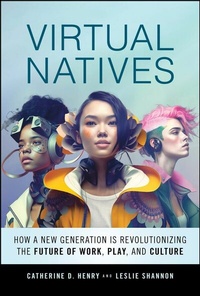
Virtual Natives
Description

We're living through what is arguably one of the most exciting, confusing, and powerful social moments in the history of humanity, the shift from the Digital Age to the Virtual Age. This shift is being driven by technology, and the people who are leading it are the ones who know it best: the Virtual Natives, made up of Gen Alpha and Z. This book will introduce you to the Virtual Native cohort and mindset, decipher their socio-cultural and economic experiences, and unpack their expectations of companies looking to engage, market, or employ them.
In this book, we explore:
* How Virtual Natives are deploying the new technologies driving the virtualized world
* How relationships and work habits are being virtualized
* Identify ten main Virtual Native-led behaviors that are upending work and culture
* How Virtual Natives are evolving their expertise into a full-blown economy
This is nothing short of a cultural revolution. Virtual Natives are the driving force behind a seismic change that is redefining the world through technology and virtual worlds: this book tells you how they are navigating everything from AI to Augmented and virtual reality, gaming, blockchain and Web3 in easy, accessible language.
To understand the future, read Virtual Natives.
More details
Other editions
Additional editions
Persons
LESLIE SHANNON is a Silicon Valley-based futurist and corporate advisor focusing on connectivity-related tech disruptions and opportunities, including robotics, drones, visual analytics, cloud gaming, AR, and VR. She is the author of Interconnected Realities.
Content
Part 1 A Generation Unlike Any Other 1
Chapter 1 Virtual Is the New Digital 3
Chapter 2 What Is Reality, Anyway? 13
Chapter 3 Fluid Identities 25
Chapter 4 Radical Acceptance 39
Chapter 5 Putting on the "Rizz" 53
Chapter 6 From Apprentice to Expert 63
Chapter 7 Create, Consume, and Own 73
Chapter 8 Autonomous Agents 89
Chapter 9 Send Pics 107
Chapter 10 The First Cyborgs 119
Part 2 The Revolution Starts Here 131
Chapter 11 Meet the Degens 133
Chapter 12 You're Not the Boss of Me 145
Chapter 13 Love, Sex, and Algorithms 157
Chapter 14 Web3 and the Culture 169
Chapter 15 Life Is Games 181
Chapter 16 The Charismatics 191
Chapter 17 Main Character Energy 211
Chapter 18 Future Forward: Virtual Natives and the New Tech Landscape 225
Epilogue: Invisible Architecture 237
Notes 243
Acknowledgments 279
About the Authors 281
Index 283
Preface
Welcome to the Dawn of the Virtual Natives
Today, we find ourselves in a period of technological acceleration the likes of which we have not seen since the dawn of the internet itself, and we're greeting it with the same cocktail of awe, inspiration, confusion, cynicism, astonishment, and disbelief. If you've felt this and wondered if you're the only one reacting this way - you're not.
Since the onset of the global pandemic, we have found ourselves caught in a moment that has demanded new solutions for an unprecedented era that has come to affect society permanently. Driven by the necessities of lockdown, multiple virtualized solutions - like using QR codes for tickets, and menus, or having food delivered to your door by people whom you never even see - became the new normal.
But it was more than just using technology to keep us a safe distance apart from each other. Suddenly, and out of nowhere, we found ourselves bombarded from all sides by terms like metaverse, VR, AR, NFTs, and digital assets and collectibles. Crypto, DeFI, Web3, ChatGPT, Midjourney, and DALL-E came to dominate the common lexicon. Technology is suddenly at the core of conversations around the world, an issue of burning intensity.
Blink, blink. What just happened?
We're living through what is arguably one of the most exciting, confusing, and powerful social moments in the history of humanity. The 2020 pandemic drove a great acceleration in the development of multiple forms of technology. The urgent need for "contact free" tech solutions radically changed how we use digital tools to achieve virtual results. We used digital tools to deliver personal virtual "presence" in lieu of face-to-face meetings. We used QR codes to generate virtual menus and expanded digital payment systems to send each other virtual forms of currency. Today, these virtual experiences have multiplied exponentially across industries and businesses, and have come to permeate our lives and our culture. What began as a series of "temporary" adjustments have now become permanent. This Covid-driven shift in technology use has been matched by the simultaneous rise of new, Web3 technologies. The people who are leading both charges are the ones who were already using them before 2020 and today know them best: the Virtual Natives.
This book will introduce you to the Virtual Native cohort and mindset. As builders and creators in these new spaces, we aim to decipher their sociocultural and economic experiences and unpack their expectations of companies looking to engage, market, or employ them.
Whether for work, gaming, or social life, Virtual Natives are driving how we use emerging Web3 and virtual technologies, and evolving culture in the process. They're creating and inhabiting playgrounds for exploration, exchange, connection, and personal expression. And their economic activities are forging a bold new marketplace that is evolving in real time.
Virtual Natives use their devices like appendages to perform multiple tasks, simultaneously. Rather than escape the world through their devices, however, VNs are taking control of their lives by using them to their advantage. They are arming themselves with the tools and knowledge they need to hack their own futures, while discarding old rules, habits, and expectations that no longer serve them. From fax machines and long daily commutes to even standard business hours, Virtual Natives are reassessing their lifestyle, education, and workplaces, and optimizing everything in real time to better suit their individual needs.
This is nothing short of a cultural revolution, and it's happening now.
In writing this book, we have followed in the venerable footsteps of digital anthropologists such as Neil Postman, Marshall McLuhan, Sherry Turkle, and Don Tapscott, all of whom explored the birth of the digital era some 25 years ago.
Now we enter a new period of change, an inflection point with profound technological, cultural, and historical implications, and it's time for reassessment.
Let's go!
A Revolutionary Shift
First there were the Baby Boomers (born 1945-1964), then Generation X (1965-1980), followed by the Millennials (1981-1995), then Gen Z (1996-2009), and the latest group - the Alphas, born 2010 or later. While the level of digital familiarity and expertise has increased with each subsequent group, it's with Gen Z and the Alphas that we begin to identify a cohort, the Virtual Natives (VNs for short), that are using digital tools not just to get the job done, but rather to deconstruct traditional ways of approaching tasks, and to pick and choose only the angles and activities that make sense to them. They're questioning the way things have always been done, going against expectations from previous generations, and using the massive power of computing that has surrounded them their entire lives to rebuild processes and systems to match their own expectations and desires. Virtual Natives are not just the kids who hang out in various virtual realities, as the term might suggest on its surface; they're the kids and young adults who were born into a world where virtualization is increasingly central to their existence, experiences, and expectations.
It sounds like a big shift, and it is. But hold on - are Virtual Natives different from the Digital Natives we've been talking about for the last 25 years? Yes, they are, and in significant ways.
The term "Digital Natives" was originally coined by educator Marc Prensky in 2001.i He used the phrase to describe the late Millennial generation who "are used to the instantaneity of hypertext, downloaded music, phones in their pockets, a library on their laptops, beamed messages and instant messaging." These were kids who laughed at their elders who printed out their emails and bought books from a brick-and-mortar bookstore. Instead, they were happy to leave their emails online and order their books from a little (at the time) company named after a big river. They spoke "technology" fluently and adapted to digital formats quickly and almost effortlessly. By the time they were college graduates, Prensky said, they had spent "less than 5,000 hours of their lives reading, but over 10,000 hours playing video games" and more than 20,000 hours watching TV, which was their main cultural influence.
This was all a big shift from what had gone before. Prensky's accurate description and catchy title caught on and entered general usage.
While the Digital Natives moved happily and effortlessly in the newly digitized world, the online world of 2001 was still very much a digitized version of the original analog world. Almost all the online functions that anyone could perform back in 2001 were computerized versions of existing physical-world processes that replicated the original process but did little to change or improve it. Most of those were one-way transfers of information, or transactions, made slightly faster and easier by virtue of being accessible through a computer. For example, annual reports were no longer printed but posted on corporate websites as PDFs, still looking exactly as they had when they were mailed out in envelopes. College students back then may have played video games for more hours than they read books, but they still did read the books that they ordered on Amazon, and watch broadcast TV. Digital Natives no longer asked each other for turn-by-turn directions, but got them from Google Maps on their computer at home, and then printed them out to take along with them in the car.
What has changed, and made the new Virtual Native cohort possible, is that technology has advanced to the point that it is now possible to achieve many goals in ways that no longer bear any resemblance to the original non-digital process that preceded them. Where a pre-Digital Native would have sent a physical letter, and a Digital Native of the early 2000s would have sent an email whose format still mimicked that of a business letter (and was still called "mail" and would land in the recipient's "inbox"), a Virtual Native has abandoned all links with the postal past and will have a video call, send an emoji-laden What's App message, or will create and post a video and tag their friends. The objective of sending another person a message has been reached by all three methods; but the Virtual Native approach is so far removed from the original process that Virtual Natives today likely have no idea or interest in posting an envelope.
This is the heart of the difference between Digital Natives and Virtual Natives. Both groups use digital tools, but Digital Natives tended to use those tools in a way that replicated the physical process that preceded it. If you, dear reader, are a Digital Native, chances are high that you're still using email, and probably using it more at work than you use group chat tools like Slack or Yammer. You probably haven't realized that what you're doing is just a computerized version of the previous process of writing on a piece of paper and sending it to your colleague via an interoffice envelope. Virtual Natives, on the other hand, completely lack the experience of the original, pre-digitized past, and are free to entirely reimagine how things can be done, using the extremely powerful digital tools at their disposal. Why waste time sending one message to one person once via email when...
