

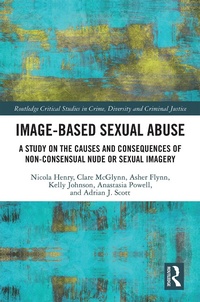
Image-based Sexual Abuse
A Study on the Causes and Consequences of Non-consensual Nude or Sexual Imagery
1st Edition
Published on 11. June 2020
200 pages
978-1-351-13513-9 (ISBN)
Description

This book investigates the causes and consequences of image-based sexual abuse in a digital era. Image-based sexual abuse refers to the taking or sharing of nude or sexual photographs or videos of another person without their consent. It includes a diversity of behaviours beyond that of "revenge porn", such as the secret trading of nude or sexual images online; "upskirting", "downblousing" and other "creepshots"; blackmail or "sextortion" scams; the use of artificial intelligence to construct "deepfake" pornographic videos; threats to distribute photographs and videos without consent; and the taking or sharing of sexual assault imagery. This book investigates the pervasiveness and experiences of these harms, as well as the raft of legal and non-legal measures that have been introduced to better respond to and prevent image-based sexual abuse.
The book draws on groundbreaking empirical research, including surveys in three countries with over 6,000 respondents and over 100 victim-survivor and stakeholder interviews. Guided by theoretical frameworks from gender studies, sociology, criminology, law and psychology, the authors argue that image-based sexual abuse is more commonly perpetrated by men than women, and that perpetration is higher among some groups, including younger and sexuality minority men. Although the motivations of perpetrators vary, a dominant theme to emerge was that of power and control. The gendered nature of the abuse means that it is best understood as a "continuum of sexual violence" because victim-survivors often experience it as part of a broader pattern of gendered harassment, violence and abuse.
Written in a clear and direct style, this book will appeal to students and scholars of criminology, sociology, law and psychology. Image-based Sexual Abuse is also an essential resource for activists, legal and policy practitioners, technology companies and victim-survivors seeking to understand the deeply complex nature of intimate-image sharing in a digital era.
The book draws on groundbreaking empirical research, including surveys in three countries with over 6,000 respondents and over 100 victim-survivor and stakeholder interviews. Guided by theoretical frameworks from gender studies, sociology, criminology, law and psychology, the authors argue that image-based sexual abuse is more commonly perpetrated by men than women, and that perpetration is higher among some groups, including younger and sexuality minority men. Although the motivations of perpetrators vary, a dominant theme to emerge was that of power and control. The gendered nature of the abuse means that it is best understood as a "continuum of sexual violence" because victim-survivors often experience it as part of a broader pattern of gendered harassment, violence and abuse.
Written in a clear and direct style, this book will appeal to students and scholars of criminology, sociology, law and psychology. Image-based Sexual Abuse is also an essential resource for activists, legal and policy practitioners, technology companies and victim-survivors seeking to understand the deeply complex nature of intimate-image sharing in a digital era.
Reviews / Votes
"This book is essential reading for students, researchers, teachers, practitioners, and policy makers seeking a rich social scientific understanding of image-based sexual abuse. It is destined to become a classic piece of scholarship that significantly advances the study of the ways in which new technologies are used by men to abuse women."Professor Walter S. DeKeseredy, West Virginia University
"This book draws on original survey and interview data to provide a compelling account of how 'new' forms of abuse confront us yet again with the familiar challenges stemming from living in a world still shaped by gendered and patriarchal legacies."
Professor Jan Jordan, Victoria University of Wellington
More details
Series
Edition
1. Auflage
Language
English
Place of publication
London
United Kingdom
Publishing group
Taylor & Francis Ltd
Target group
College/higher education
Product notice
Reflowable
Illustrations
8 Tables, black and white
ISBN-13
978-1-351-13513-9 (9781351135139)
Copyright in bibliographic data and cover images is held by Nielsen Book Services Limited or by the publishers or by their respective licensors: all rights reserved.
Schweitzer Classification
Other editions
Additional editions
Nicola Henry | Clare McGlynn | Asher Flynn
Image-based Sexual Abuse
A Study on the Causes and Consequences of Non-consensual Nude or Sexual Imagery
Book
04/2022
1st Edition
Routledge
€65.60
Shipment within 15-20 days
Nicola Henry | Clare McGlynn | Asher Flynn
Image-based Sexual Abuse
A Study on the Causes and Consequences of Non-consensual Nude or Sexual Imagery
Book
07/2020
1st Edition
Routledge
€206.10
Shipment within 15-20 days
Persons
Nicola Henry is an Associate Professor and Vice-Chancellor's Principal Research Fellow in the Social and Global Studies Centre at RMIT University (Melbourne, Australia). She has published widely in the sexual field, and is the author of War and Rape: Law, Memory and Justice (2011) and Sexual Violence in a Digital Age (2017, co-authored with Anastasia Powell).
Clare McGlynn QC (Hon) is a Professor of Law at Durham University (UK), whose research and collaborations with politicians, policymakers and the voluntary sector has shaped new laws relating to pornography, sexual violence and image-based sexual abuse.
Asher Flynn is an Associate Professor of Criminology at Monash University (Melbourne, Australia). She has written on a wide range of issues and is lead researcher on several research projects examining gendered violence, AI-facilitated abuse, technology-facilitated sexual violence and image-based sexual abuse
Kelly Johnson is an Assistant Professor of Criminology at Durham University (UK). Her research focuses on sexual and domestic violence, particularly in areas related to image-based sexual abuse and policing.
Anastasia Powell is an Associate Professor of Criminology & Justice Studies at RMIT University (Melbourne, Australia). She is the author of several books addressing both technology and sexual violence including: Digital Criminology (2019, co-authored with Gregry Stratton and Robin Cameron), Sexual Violence in a Digital Age (2017, co-authored with Nicola Henry), and Sex, Power and Consent (2010).
Adrian J. Scott is a Senior Lecturer at Goldsmiths, University of London (UK), where he is a member of the Forensic Psychology Unit and the Co-Director of an accredited MSc programme in Forensic Psychology. He has a broad interest in forensic psychology, specialising in the areas of stalking and image-based sexual abuse.
Clare McGlynn QC (Hon) is a Professor of Law at Durham University (UK), whose research and collaborations with politicians, policymakers and the voluntary sector has shaped new laws relating to pornography, sexual violence and image-based sexual abuse.
Asher Flynn is an Associate Professor of Criminology at Monash University (Melbourne, Australia). She has written on a wide range of issues and is lead researcher on several research projects examining gendered violence, AI-facilitated abuse, technology-facilitated sexual violence and image-based sexual abuse
Kelly Johnson is an Assistant Professor of Criminology at Durham University (UK). Her research focuses on sexual and domestic violence, particularly in areas related to image-based sexual abuse and policing.
Anastasia Powell is an Associate Professor of Criminology & Justice Studies at RMIT University (Melbourne, Australia). She is the author of several books addressing both technology and sexual violence including: Digital Criminology (2019, co-authored with Gregry Stratton and Robin Cameron), Sexual Violence in a Digital Age (2017, co-authored with Nicola Henry), and Sex, Power and Consent (2010).
Adrian J. Scott is a Senior Lecturer at Goldsmiths, University of London (UK), where he is a member of the Forensic Psychology Unit and the Co-Director of an accredited MSc programme in Forensic Psychology. He has a broad interest in forensic psychology, specialising in the areas of stalking and image-based sexual abuse.
Content
1. Image-Based Sexual Abuse: Beyond "Revenge Pornography" 2. Victim-Survivor Experiences of Image-Based Sexual Abuse 3. The Harms of Image-Based Sexual Abuse (with Erika Rackley and Nicola Gavey) 4. Image-Based Sexual Abuse Perpetration: Power and Control 5. Visual Criminality: A Theory of Image-Based Sexual Abuse 6. The Missing Culture of Consent: Shifting Social Norms on Image-Sharing, Sexual Autonomy and Harm 7. Seeking Justice for Victim-Survivors of Image-Based Sexual Abuse (with Erika Rackley) 8. Preventing Image-Based Sexual Abuse: Ethics, Consent and Respectful Relationships 9. Conclusion
