

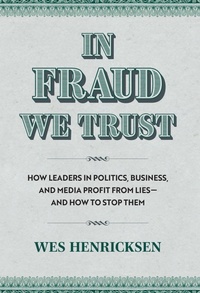
In Fraud We Trust
Description

Winner: Scribes Book Award
Telling lies, and falling for them, is one of the things that makes us human. The vast majority of these falsehoods are harmless and perfectly legal. But when someone deceives another for material gain or profit, inflicting injury in the process, we give this kind of lie a special label: fraud.
Most people are familiar with the concept and understand that fraud is prohibited by law. What many fail to appreciate, however, is that the law does not treat all frauds equally. If you defraud an individual, you might end up in prison. On the other hand, if you defraud millions of people?what Wes Henricksen calls ?fraud on the public??you might end up wealthy or powerful, or even get elected president. In a perverse sense, the bigger the fraud, the more likely it is protected by the First Amendment and therefore legal. As a result, many of the largest and most destructive fraud schemes are allowed, encouraged, and richly rewarded.
Examples of fraud on the public are everywhere. The fossil fuel industry long used PR firms and lobbyists to spread disinformation about oil's role in climate change. Sugar companies misled the public about the dangers of high-fructose corn syrup, redirecting the public's attention to fat. Cigarette manufacturers famously lied about the risks of tobacco, and opioid makers lied about the effects of the drug. Social media influencers and fringe media outlets promoted false claims about the COVID-19 pandemic being a government hoax. Others claimed that vaccines were part of a sinister plot. Politicians on both sides of the aisle lie with such regularity that people have become deeply cynical about whether to believe anything they say. Henricksen shows that large-scale fraud is carried out for many reasons beyond financial profit, including political gain, the prevention of justice, and the falsification of history.
In addition to exposing the depths of the problem, Henricksen gives readers a way forward. He proposes we call these massive deceit campaigns by their proper name; that we ?de-weaponize? the First Amendment, which was never meant to shield swindlers; and that we enact new laws that protect the public from fraud. By revealing for the first time the root legal cause of the misinformation crisis and presenting novel solutions, In Fraud We Trust speaks to the present moment as it offers answers for the future.
More details
Other editions
Additional editions
Person
Wes Henricksen is associate professor of law at Barry University School of Law. He is the author of Making Law Review: A Guide to the Write-On Competition.
Content
Acknowledgments
Introduction
Part I?The Disinformation Age: The Problem
1. The Liar's Advantage: Why Falsehoods Area a Bigger Problem than Ever Before
2. When Dishonesty Crsses the Line: How Failing to Understand Fraud Resulted in Laws to Weak to Fight It
3. Defrauding the Public: How and Why Leaders Do It
4. The Price of Disinformation: Counting the Harms of Fraud on the Public
5. Fraud Law Paradox: How It Works, Where It Comes from, What We Can Do about It
Part II?Truth From Power: Solutions
6. Call It Fraud: Other Labels Protect Those Who Perpetrate It
7. De-weaponize the First Amendment: It Was Not Meant to Shield Those Who Defraud
8. Prohibit Fraud on the Public: By Passing Laws?and Enforcing Them
Conclusion
Notes
Selected Bibliography
Index
