

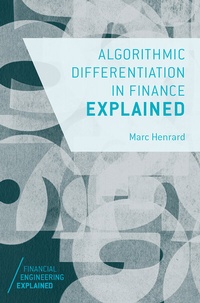
Algorithmic Differentiation in Finance Explained
Description

This book provides the first practical guide to the function and implementation of algorithmic differentiation in finance. Written in a highly accessible way, Algorithmic Differentiation Explained will take readers through all the major applications of AD in the derivatives setting with a focus on implementation.
Algorithmic Differentiation (AD) has been popular in engineering and computer science, in areas such as fluid dynamics and data assimilation for many years. Over the last decade, it has been increasingly (and successfully) applied to financial risk management, where it provides an efficient way to obtain financial instrument price derivatives with respect to the data inputs. Calculating derivatives exposure across a portfolio is no simple task. It requires many complex calculations and a large amount of computer power, which in prohibitively expensive and can be time consuming. Algorithmic differentiation techniques can be very successfully in computing Greeks and sensitivities of a portfolio with machine precision.
Written by a leading practitioner who works and programmes AD, it offers a practical analysis of all the major applications of AD in the derivatives setting and guides the reader towards implementation. Open source code of the examples is provided with the book, with which readers can experiment and perform their own test scenarios without writing the related code themselves.
More details
Other editions
Additional editions
Person
Marc Henrard is Head of Quantitative Research and Advisory Partner at OpenGamma, a provider of derivatives risk analytics solutions. Marc is also an Visiting Professor at University College London. He has over 15 years' experience in finance, including senior positions in risk management, trading, and quantitative analysis. Prior to joining OpenGamma, Marc was in charge of researching and implementing interest rate models as the Head of Interest Rate Modelling for the Dexia Group. Previously he held various management positions at the Bank for International Settlements as Deputy Head of Treasury Risk, Deputy Head of Interest Rate Trading and Head of Quantitative Research. Marc holds a PhD in Mathematics from the University of Louvain, Belgium. Prior to his career in finance he was a research scientist and university lecturer for 8 years.
Marc's research focuses on interest rate modelling, risk management and market infrastructure. He publishes on a regular basis in international finance journals and is a regular speaker at practitioner and academic conferences.
Content
Chapter1 Introduction.- Chapter2 The Principles of Algorithmic Differentiation.- Chapter3 Applications to Finance.- Chapter4 Automated Algorithmic differentiation.- Chapter5 Derivatives to Non-inputs and Non-derivatives to Inputs.- Chapter 6 Calibration.
