

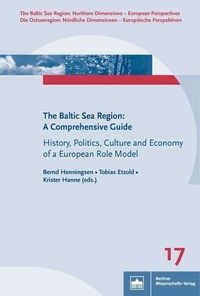
The Baltic Sea Region: A Comprehensive Guide
History, Politics, Culture and Economy of a European Role Model
1st Edition
Published on 19. September 2017
364 pages
978-3-8305-1748-1 (ISBN)
Description

The Baltic Sea Region, at the crossroads between East and West, North and South, has long been marked by cultural, ethnical and ideological borders. Overcoming a history of conflict and separation, since the end of the Cold War the countries surrounding the Baltic Sea established widely valued formats of regional cooperation based on shared challenges and opportunities. In comparison with larger regions, however, the Baltic Sea Area is still a blank spot on the global map. This volume's intention is to fill this spot with colour and facts. It provides students, young researchers and other interested parties with basic knowledge of the region. The volume offers a comprehensive introduction into its history, politics, economy and culture, taking into account the various countries' commonalities and differences. By introducing concepts of regionalism and region-building, as well as analysing the structures of regional cooperation the authors and editors demonstrate the Baltic Sea Area's model function as a European macro-region.
More details
Other editions
Additional editions
Bernd Henningsen | Tobias Etzold | Krister Hanne
The Baltic Sea Region: A Comprehensive Guide
History, Politics, Culture and Economy of a European Role Model
Book
09/2017
1st Edition
Berliner Wissenschafts-Verlag
€29.00
Shipment within 7-9 days
Persons
Content
- Intro
- Preface
- Introduction: Emergence of a European Model Region
- 2 Defining the Baltic Sea Region
- 2.1 The Baltic Sea
- 2.2 The Baltic Sea Region
- 3 The Contexts of the Emerging Baltic Sea Region
- 3.1 The Geopolitical Context
- 3.2 The European Context
- 3.3 The Impact of Regionalism
- 4 Region-building in the Baltic Sea Area
- 4.1 Actors and Ideas in the Early Phase, 1988-1992
- 4.2 History
- 4.3 Culture
- 4.4 Economy
- 4.5 Security
- 5 Summary and Conclusion
- References
- 1 The Baltic Sea Region: A European Model Region
- History
- 1 The Baltic Sea Region: A History of Interaction and Multiculturalism in Europe
- 2 Religion and Politics: The Arrival of Christianity in the North
- 2.1 The Viking Influence
- 2.2 The Arrival of Christianity
- 2.3 The Crusades of the East Baltic
- 2.4 Lithuania - The Rise of a Great Empire
- 2.5 Monarchical Unions: Poland-Lithuania and Kalmar
- 3 Territorial Expansion and the Creation of Multicultural Empires
- 3.1 The Livonian Wars and the Rise of Sweden
- 3.2 The Thirty Years' War and the Growth of Brandenburg-Prussia
- 3.3 Absolutism
- 3.4 The Great Northern War and Russia's Acquisition of the Baltic Provinces
- 3.5 The Violent 18th Century and Russian Territorial Expansion
- 4 Revolution, War, and Reform: the 19th Century
- 4.1 Napoleonic Wars
- 4.2 Political Reform
- 4.3 Agrarian Reform
- 4.4 State Rationalising and Centralisation
- 4.5 The impact of 1848: Abandonment of Absolutism or Imperial Reform
- 4.6 Reforms in Russia
- 4.7 The Remapping of Europe - Unification of Germany
- 5 The Effects of Nationalism in the Russian Empire: Separatist Thought and Russification
- 5.1 Finland
- 5.2 Poland and Lithuania
- 5.3 The Baltic Provinces
- 5.4 Industrialisation
- 6 Towards Baltic and Finnish Independence
- 6.1 Political Voice and Overtures of Independence: 1905
- 6.2 World War I and Revolution
- 6.3 Independent States
- 7 The Second World War
- 7.1 Territorial and Political Changes
- 7.2 The Human Cost of War and Occupation
- 8 The Coming Cold War and Division of the Baltic Sea Region
- 8.1 The Consolidation of Soviet Power
- 8.2 The Neutrality Debate in the North
- 8.3 Cold War Regional Cooperation
- References
- Politics
- 1 Introduction
- 2 The Modern Political History of the Baltic Sea Region
- 2.1 The Cold War Division of Europe
- 2.2 The Fall of Communism and the Integration of Europe
- 3 Political Developments in the Baltic Sea Region: A Comparative Overview
- 3.1 Democratic Development
- 3.2 Press Freedom
- 3.3 Corruption
- 3.4 Gender Equality
- 3.5 Socio-Economic Development
- 3.6 Government and Political Parties
- 4 The Baltic Sea Region and the EU
- 4.1 Reluctant Nordics
- 4.2 Unifi ed Germany and the Identity Issue
- 4.3 Post-Communist Countries and EU Membership
- 4.4 Diversity or Similarity?
- 5 Baltic Sea Region Cooperation: Opportunities and Obstacles
- 6 Future Trends in the Baltic Sea Region
- References
- Structures and Modes of Regional Cooperation
- 1 Introduction
- 2 Main Structures of Regional Cooperation
- 2.1 The Council of the Baltic Sea States (CBSS)
- 2.2 Baltic 21
- 2.3 The Helsinki Commission (HELCOM)
- 2.4 Other Baltic Sea Regional Organisations
- 2.5 The Baltic Sea Dimension of Nordic Cooperation
- 3 EU-Steered Regional Cooperation
- 3.1 The Northern Dimension (ND)
- 3.2 The EU Strategy for the Baltic Sea Region (EUSBSR)
- 4 Evaluation and Conclusions: Challenges and Perspectives of Regional Cooperation in the Baltic Sea Region
- References
- Economy
- 1 Introduction
- 2 Economic Development
- 3 Institutions Framing Economic Developmentof Regions
- 3.1 International Organizations Framing International Trade
- 3.2 The European Union Strategy for the Baltic Sea Region and its Impact on Economic Development
- 3.3 EU-Russia Relations
- 4 International Trade
- 4.1 Reasons for International Trade
- 4.2 Geographical Patterns
- 4.3 Foreign Trade Within the Baltic Sea Region
- 4.4 Commodity Patterns
- 5 Foreign Direct Investments
- 5.1 Theories and Concepts
- 5.2 Impact of FDI in the BSR
- 5.3 Patterns of FDI in the BSR
- 6 Labour Market Developments and Employment
- 6.1 Employment
- 6.2 Part-Time Work
- 6.3 Unemployment
- 7 Conclusion
- References
- Culture
- 1 Preliminary Notes
- 1.1 Definitions of the Region and its Consequences for 'Culture'
- 1.2 Names and Terminological Constructions
- 1.3 A Political-Functional Definition of the Region
- 1.4 The Dialectical Construction of a Regional Community
- 2 'Identity' and 'Culture' - Created by Nature
- 2.1 The Sea
- 2.2 Longing for the Sea
- 2.3 The Sea and the Longing for Freedom
- 2.4 'The Gold of the North'
- 2.5 Landscape and Climate
- 2.6 Forests as National Landscapes
- 3 'Identity' and 'culture' - Created by Man
- 3.1 History
- 3.2 'Death Always Swims Alongside the Ship'
- 3.3 Economy and Society
- 3.4 'Balticness'
- 3.5 Language(s)
- 3.6 City and Architecture
- 3.7 Art and Culture
- 3.8 The Organ as the Bearer of Culture
- 3.9 Literature
- 3.10 Education and Science
- 3.11 Eating and Drinking
- 3.12 Leisure
- 4 Conclusion
- References
- Annex: Basic Facts about the Countriesof the Baltic Sea Region
- DENMARK
- ESTONIA
- FINLAND
- GERMANY
- ICELAND
- LATVIA
- LITHUANIA
- NORWAY
- POLAND
- RUSSIA
- SWEDEN
- Note on the Authors
