

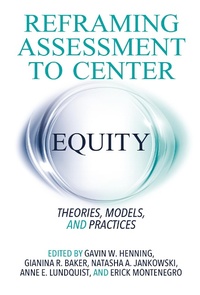
Reframing Assessment to Center Equity
Theories, Models, and Practices
1st Edition
Published on 3. July 2023
380 pages
978-1-000-97248-1 (ISBN)
Description

This book makes the case for assessment of student learning as a vehicle for equity in higher education. The book proceeds through a framework of "why, what, how, and now what." The opening chapters present the case for infusing equity into assessment, arguing that assessment professionals can and should be activists in advancing equity, given the historic and systemic use of assessment as an impediment to the educational access and attainment of historically marginalized populations. The "what" chapters offer definitions of emerging terms, discuss the narratives of equity in evidence of student learning, present models and approaches to promoting equity, and explore the relationship between knowledge systems and assessment practice. The "how" chapters begin by progressively moving from the classroom to the program, then beyond the program level to share examples from student affairs. Subsequent chapters address the problem of equitable access to STEM fields; culturally responsive practices within the context of community colleges; the ongoing work of culturally situated assessment practices in Historically Black Colleges and Universities; and the role of technology-enabled assessment as a possible tool for equitable assessment. The final two chapters in the book address the "now what", providing a way for assessment professional to develop individual awareness within their practice as a next step in the equity journey, and a conceptual framework to anchor equity in their work.
Reviews / Votes
"We often lament the paucity of thoughtful, research-informed pedagogical strategies that meet the needs of our diverse student population. Diversity of thought and practical solutions are noticeably absent and often lead to inequitable student outcomes. Reframing Assessment to Center Equity: Theories, Models, and Practices strategically infuses equity into the assessment conversation. As a college President, I recommend this book to all practitioners who are sincere about using the assessment of student learning as a vehicle for equity in higher education."Roslyn Clark Artis
President and CEO, Benedict College
"Reframing Assessment to Center Equity offers a bold vision coupled with a rich collection of practical perspectives and approaches to transform assessment into a device for dismantling systemic inequities in higher education. The authors skillfully invite assessment professionals into a dialogue about equity-centered practice. Then offer resources to engage in self-awareness, principles and models for practice, and the encouragement to act, to turn the belief that 'equitable assessment is what good assessment looks like' into reality."
Jillian Kinzie
Associate Director of the Center for Postsecondary Research, Indiana University Bloomington
"This is a must-read for anyone grappling with the connections between assessment and equity/social justice. This substantial volume provides a range of insights that beautifully move between the philosophical and the practical. It is like a fantastic road trip with amazingly committed people through the ideas, practices and challenges facing assessment and equity/social justice. The richness emerges from engaging with diverse voices and perspectives and the rich landscape of ideas and possibilities made possible."
Jan McArthur
Senior Lecturer in Education and Social Justice, Department of Educational Research, Lancaster University
"Much of the richness of this well-researched volume comes from the diverse perspectives offered by the editors and authors. They bring their personal and professional lives to the work. The "why, what, how, and now what" organization of the material allows readers to gain historical perspective, appreciate the current state of affairs, consider strategies to support equity in assessment, and most importantly, to reflect on how we can individually influence positive change."
Jane Marie Souza
Associate Provost for Academic Administration, University of Rochester
"Never before have we faced such an urgent need to make sure every college student receives the best possible education-a truly equitable education. And equity in assessment is essential to equity in education. In Reframing Assessment to Center Equity, some of our most distinguished assessment scholars and practitioners offer compelling thinking and practical suggestions on how to ensure equity and fairness in our higher education practices, with a particular focus on equity in assessment."
Linda Suskie
Higher Education Assessment Consultant
"Assessment practitioners are change agents. The very design of assessing for learning implies that what is learned from the process will create a need for change and improvement. But what if the assessment work is not fair and equitable? What if we unintentionally create or continue a system that works against fairness and inclusivity? Reframing Assessment to Center Equity is foundational to how we think about assessment as a tool for positive and responsible change."
Catherine M. Wehlburg
Provost and VPAA at Athens State University
More details
Edition
1. Auflage
Language
English
Place of publication
London
United Kingdom
Publishing group
Taylor & Francis Ltd
Target group
College/higher education
Professional and scholarly
ISBN-13
978-1-000-97248-1 (9781000972481)
Copyright in bibliographic data and cover images is held by Nielsen Book Services Limited or by the publishers or by their respective licensors: all rights reserved.
Schweitzer Classification
Other editions
Additional editions
Gavin W. Henning | Gianina R. Baker | Natasha A. Jankowski
Reframing Assessment to Center Equity
Theories, Models, and Practices
Book
05/2022
1st Edition
Stylus Publishing
€54.10
Shipment within 3-4 weeks
Gavin W. Henning | Gianina R. Baker | Natasha A. Jankowski
Reframing Assessment to Center Equity
Theories, Models, and Practices
Book
04/2022
1st Edition
Stylus Publishing
€207.30
Shipment within 3-4 weeks
Persons
Gavin W. Henning is Professor of Higher Education at New England College in New Hampshire where he directs the Master of Science in Higher Education Administration and Doctorate of Education programs. Gavin is a past president of ACPA - College Student Educators International as well as a past president of the Council for the Advancement of Standards in Higher Education (CAS). He has over 20 years' experience in higher education assessment and institutional research and frequently consults and presents regionally, nationally, and internationally on the topic. His scholarship includes over 90 peer-reviewed presentations and over 90 invited presentations and keynotes regarding assessment. In addition, he has published articles and books on assessment including Student Affairs Assessment: Theory and Practice with Darby Roberts that serves as the foundational text for assessment courses in many higher education graduate programs. Gavin earned his Ph.D. in Leadership and Policy Studies from the University of New Hampshire.
Gianina R. Baker, PhD, is the acting director of the National Institute for Learning Outcomes Assessment (NILOA), providing leadership and direction on research specific to the assessment of student learning at colleges and universities. Her main research interests include student learning outcomes assessment at minority serving institutions, access and equity issues for underrepresented administrators and students, assessment in athletics, and higher education policy. She holds a PhD in educational organization and leadership with a higher education concentration from the University of Illinois, an MA in human development counseling from Saint Louis University, and a BA in psychology from Illinois Wesleyan University.
Natasha A. Jankowski serves as the Executive Director of the National Institute for Learning Outcomes Assessment (NILOA) and Associate Professor with the department of Education Policy, Organization and Leadership at the University of Illinois Urbana-Champaign. She is co-author, along with her NILOA colleagues, Degrees That Matter: Moving Higher Education to a Learning Systems Paradigm and the book Using Evidence of Student Learning to Improve Higher Education. She loves all things assessment.
Anne E. Lundquist, PhD, is the managing director for learning and innovation at The Hope Center for College, Community, and Justice at the Lewis Katz School of Medicine at Temple University. She is a White, cisgender, third-generation educated poet, yogi, and social justice advocate who draws on her 30-year career in higher education to help transform higher education into a more effective and equitable sector through research and educational training and services to address student basic needs insecurity. Previously, Lundquist served as assistant vice president for campus strategy at Anthology, director of strategic planning and assessment for the Division of Student Affairs at Western Michigan University, as well as senior student affairs officer at four liberal arts colleges. She holds an MFA in creative writing and a PhD in educational leadership, higher education, from Western Michigan University. She earned her BA in religious studies and English from Albion College.
Erick Montenegro, PhD, is a fellow with the National Institute for Learning Outcomes Assessment (NILOA) focused on equity-minded assessment practice. Montenegro currently is the senior research associate for The Pell Institute for the Study of Opportunity in Higher Education. Montenegro serves on the board of directors for the Quality Assurance Commons for Higher and Postsecondary Education (QA Commons). As a research analyst for NILOA Montenegro helped launch the national conversation on equity-minded assessment in 2017. He holds a PhD in education policy, organization, and leadership from the University of Illinois at Urbana-Champaign.
Gianina R. Baker, PhD, is the acting director of the National Institute for Learning Outcomes Assessment (NILOA), providing leadership and direction on research specific to the assessment of student learning at colleges and universities. Her main research interests include student learning outcomes assessment at minority serving institutions, access and equity issues for underrepresented administrators and students, assessment in athletics, and higher education policy. She holds a PhD in educational organization and leadership with a higher education concentration from the University of Illinois, an MA in human development counseling from Saint Louis University, and a BA in psychology from Illinois Wesleyan University.
Natasha A. Jankowski serves as the Executive Director of the National Institute for Learning Outcomes Assessment (NILOA) and Associate Professor with the department of Education Policy, Organization and Leadership at the University of Illinois Urbana-Champaign. She is co-author, along with her NILOA colleagues, Degrees That Matter: Moving Higher Education to a Learning Systems Paradigm and the book Using Evidence of Student Learning to Improve Higher Education. She loves all things assessment.
Anne E. Lundquist, PhD, is the managing director for learning and innovation at The Hope Center for College, Community, and Justice at the Lewis Katz School of Medicine at Temple University. She is a White, cisgender, third-generation educated poet, yogi, and social justice advocate who draws on her 30-year career in higher education to help transform higher education into a more effective and equitable sector through research and educational training and services to address student basic needs insecurity. Previously, Lundquist served as assistant vice president for campus strategy at Anthology, director of strategic planning and assessment for the Division of Student Affairs at Western Michigan University, as well as senior student affairs officer at four liberal arts colleges. She holds an MFA in creative writing and a PhD in educational leadership, higher education, from Western Michigan University. She earned her BA in religious studies and English from Albion College.
Erick Montenegro, PhD, is a fellow with the National Institute for Learning Outcomes Assessment (NILOA) focused on equity-minded assessment practice. Montenegro currently is the senior research associate for The Pell Institute for the Study of Opportunity in Higher Education. Montenegro serves on the board of directors for the Quality Assurance Commons for Higher and Postsecondary Education (QA Commons). As a research analyst for NILOA Montenegro helped launch the national conversation on equity-minded assessment in 2017. He holds a PhD in education policy, organization, and leadership from the University of Illinois at Urbana-Champaign.
Content
Table of Contents Preface Part One. Why? 1. Why the Intersection of Assessment and Equity?-Erick Montenegro and Gavin Henning 2. The Assessment Activist. A Revolutionary Call to Action - DivyaSamuga_Gyaanam+Bheda 3. Equity and Assessment. A Storied Past-Natasha A. Jankowski and Anne E. Lundquist Part Two. What? 4. Current State of Scholarship on Assessment-Gianina Baker and Gavin Henning 5. The Varied Roles of Narratives and Stories in Assessment-Natasha A. Jankowski and Lesley D'Souza 6. Models and Approaches to Increasing Equity in Higher Education-Karen Singer-Freeman, Linda Bastone, and Erick Montenegro 7. Equity-Centered Assessment. Varying Approaches and Lenses-Stephanie Waterman, Gianina Baker, Gavin Henning, and Anne E. Lundquist Part Three. How? 8. Assessment in Class Meetings. Transparency Reduces Systemic Inequities-Many-Anne Winklemes 9. Culturally Relevant Assessment. Examining Equity Gaps in Assignment Types-Harriet Hobbs and Chrisine Robinson 10. Centering 'Aina in Assessment. Striving for Equity and Social Justice-Monica Stitt-Bergh, Charmaine Mangram, Eunice Leung Brekke, Kara Plamann Wagoner, Monique Chyba, Kaiwipunikauikawekiu Lipe, & Siobhan Ni Dhonacha 11. Culturally Relevant Assessment 2.0 Through Faculty and Students' Voices-Chiara Logli 12. The Need for Equity-Minded Assessment and Evaluation Outside of the Classroom-Juan G. Berumen 13. Advancing Equity in Student Affairs Through Assessment Practice-Ciji A. Heiser and Joseph D. Levy 14. Assessing Equitable Access to STEM Fields of Study-Alicia C. Dowd, Leticia Oseguera, and Royel M. Johnson 15. Equitable Assessment in Community Colleges. A Call for Collaboration and Culturally Responsive Practices-Raina Dyer-Barr, Kaylan Baxter, and Eboni M. Zamani-Gallaher 16. Cultural Awareness and Praxis. The Aesthetic of Teaching and Learning at HBCUs-Verna F. Orr Part Four. Now What? 17. Leveraging Technology-Enabled Assessment Capabilities to Advance Students' Achievement of Equitable Learning Outcomes for Equitable Assessment-Peggy L. Maki 18. Developing Individual Awareness. The Role of the Assessor-Danielle Acheampong, Marilee Bresciani Ludvik, and Anne E. Lundquist 19. An Invitation to a Beginning Rather Than the End-Divya Samuga_Gyaanam+Bheda , Natasha A. Jankowski, and Peter Felten Editors and Contributors Index
