

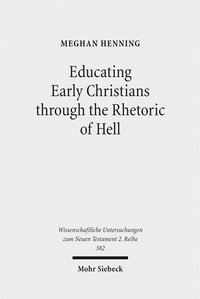
Educating Early Christians through the Rhetoric of Hell
"Weeping and Gnashing of Teeth" as Paideia in Matthew and the Early Church
1st Edition
Published on 10. December 2019
294 pages
978-3-16-157505-1 (ISBN)
Description

Meghan Henning untersucht in diesem Buch die rhetorische Funktion des frühchristlichen Höllenkonzepts. Sie baut auf den Erkenntnissen zu klassischen rhetorischen Techniken und der Beschreibung des Hades in der griechischen und der römischen Literatur auf und behauptet, dass das antike christliche Konzept der Hölle Teil ausgeprägt christlicher
Paideia
war. Sie vollzieht die Geschichte dieses interpretativen Prozesses nach und stellt dar, wie frühe Christen sich auf das griechische und römische System der ethischen und kulturellen Bildung stützten, um ihre eigene Kultur zu bilden und zu pflegen. Dadurch zeigt die Autorin, dass das Matthäusevangelium der Nexus ist, in dem sich die frühchristliche Vorstellung der Höllenstrafe entwickelt und in den Blickpunkt späterer apokalyptischer und patristischer Autoren rückt, die Matthäus' "Heulen und Zähneklappern" in verschiedenen pädagogischen Kontexten interpretieren und umformen.
More details
Other editions
Additional editions
Meghan Henning
Educating Early Christians through the Rhetoric of Hell
"Weeping and Gnashing of Teeth" as Paideia in Matthew and the Early Church
Book
11/2014
1st Edition
Mohr Siebeck
€104.00
Article exhausted; check different version
Person
Author
Born 1982; 2004 BA from Denison University; 2007 MA from Yale Divinity School; 2013 PhD in New Testament from Emory University; currently teacher at several colleges and universities in the Boston area, and Faculty Religion Fellow at the Boston University School of Theology and the Institute on Religion, Culture and World Affairs.
ISNI:
ISNI:
Content
- Cover
- Titel
- Preface
- Table of Contents
- Chapter 1. The History of Hellish Rhetoric
- I. Why Hell?: The Historical Relevance of the Rhetoric of Eternal Punishment
- II. Hell and the History of Religions
- III. Beyond Genesis: Ideology, Fluidity, and the History of Interpretation
- IV. A Word about the Terminology for Eternal Punishment
- V. Plan of the Book
- Chapter 2. Death, Judgment, and the Abode of the Dead as Malleable Rhetorical Tools in the Hebrew Bible
- I. Introduction
- II. Concepts of the Abode of the Dead in the Hebrew Bible
- a. All Dead Travel to a Common Place
- b. The Place of the Dead as a Descriptor
- i. Dark, Dusty and Generally Undesirable Place
- ii. A Poetic Marker for Depth, or a Remote Place
- iii. The Opposite of the Heavens
- III. The Abode of the Dead as a Rhetorical Tool in the Hebrew Bible
- a. Vivid or Dramatic Imagery: The Abode of the Dead as Spectacle or Metaphor
- b. Sorting the Dead: The Abode of the Dead Signifying Judgment or Punishment
- c. The Abode of the Dead as a Tool for Moral Formation in the Hebrew Bible
- i. The Life and Death Contrast in the Hebrew Bible
- ii. The Abode of the Dead as Ethical Motivation
- IV. Conclusion
- Chapter 3. Learning from the Dead: Hades as an Expression of Paideia in Greek and Latin Literature
- I. Introduction
- II. Greek and Roman Rhetoric and Education: The Role of Ethical Instruction within Greek and Roman Paideia
- a. Paideia as Rhetorical Training
- b. Paideia and Early Christianity
- c. Paideia as Cultural and Ethical Education
- d. Ekphrasis: The Pedagogical use of Rhetoric in Transmitting Cultural Values
- III. Greek and Roman Examples of Hell as Paideia
- a. Prevalence of Homer and Virgil in Ancient School Texts
- b. Visualizing Punishment: The Use of Ekphrasis in Depictions of Hades
- i. The Katabasis
- ii. Evidence of Ekphrasis: The Language of Perception
- iii. Evidence of Ekphrasis: The Presence of Enargeia or "Vividness"
- iv. Explicit Communication of the Didactic Function of the Ekphrasis
- c. The Spectacle of Punishment as Paideia
- IV. Conclusion
- Chapter 4. Periegesis?: The Journey through the Places of the Dead in Jewish Apocalyptic Literature
- I. Introduction
- II. The Genre of Geographic "Tours" in Jewish Apocalyptic Literature
- III. The Rhetorical Function of "Tours": Parallel to Periegesis of Greek and Latin Literature?
- a. Spatial Differentiation: Directional Cues and Geographic Descriptions
- b. Order and Meaning: Implicit Paideia in the Jewish Apocalypses
- IV. Conclusion
- Chapter 5. A Choice Between Two Ways: The Rhetoric of Eternal Punishment in the New Testament
- I. Introduction
- II. Ekphrasis or Enargeia?: Analyzing the Rhetoric of Description in the NT
- III. The Pedagogical Function of Eternal Punishment in the NT
- a. Mark 9:42-50
- b. Q 10,15 and 12, 4-5
- c. Luke
- d. James
- e. 2 Peter
- f. Revelation
- IV. Conclusion
- Chapter 6. The Pedagogical Role of Eschatological Judgment, Eternal Punishment, and the Afterlife in Matthew
- I. Introduction
- II. Education in Matthew: An Exercise in Community Formation
- a. Matthew's Audience
- b. Matthew's Interest in Paideia and the Formation of Ecclesia
- III. The Role of Apocalyptic Eschatology within Matthew's "Curriculum"
- IV. The Pedagogical Function of Eternal Punishment in Matthew
- a. Matthew's Use of Terminology
- b. Evidence of Ekphrasis: The Presence of Enargeia or "Vividness"
- c. Explicit Communication of the Didactic Function of the Ekphrasis
- d. The Description of Punishment as Paideia: Rhetoric of Ethical and Cultural Education
- V. Conclusion
- Chapter 7. The Pedagogical Function of Hell in the Early Christian Apocalypses and the Early Church
- I. Introduction
- II. Dating and Reception of Tours of Hell
- III. Interpreting and Expanding the New Testament Picture of "Hell" in Early Christian Apocalypses
- a. Interpreting Matthew in the Apocalypse of Peter
- b. Reading Matthew and Paul together in the Apocalypse of Paul
- c. Pleading for Mercy and Reinventing the Beatitudes in the Latin Vision of Ezra and the Greek Apocalypse of Ezra
- d. "Biblical Theology" in the Greek Apocalypse of Mary
- IV. The Pedagogical Function of Hell in the Early Christian Apocalypses
- a. Evidence of Ekphrasis: Periegesis
- b. Evidence of Ekphrasis: Language of Perception
- c. Evidence of Ekphrasis: Enargeia or "Vividness"
- d. The Spectacle of Punishment as Paideia: Explicit Communication of the Didactic Function of Ekphrasis
- V. The Pedagogical Function of Hell in the Early Church Fathers
- a. Chrysostom: Zeal in Appropriating Hell as the Heart of Christian Paideia
- b. Augustine: Distinguishing Christian Paideia from the Tools of the Empire
- VI. Conclusion
- Chapter 8. Conclusion: The Landscape of Hell and the Cultivation of Early Christianity
- I. How did "Hell" Emerge as an Educational Tool for Early Christians?
- II. Hell, What is it Good For?: Damnation and the Cultivation of Culture
- III. Dante's Spell: Reflections on Our Hellish Inheritance
- Appendix A: Concepts of the Abode of the Dead in the Hebrew Bible
- Appendix B: The Abode of the Dead as a Rhetorical Tool in the Hebrew Bible
- Appendix C: Ekphrasis in Greek and Latin Texts that Deal with Hades extensively
- Appendix D: Enargeia of "Hell" in the New Testament (apart from Matthew)
- Appendix E: Enargeia of Eternal Punishment in Matthew
- Appendix F: Eschatological Fire in Matthew
- Appendix G: "Weeping and Gnashing of Teeth" in Matthew
- Bibliography
- Index of Ancient Sources
- Index of Modern Authors
- Subject Index
