

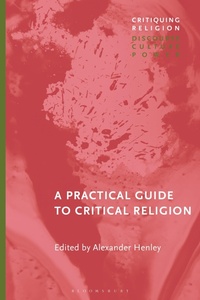
A Practical Guide to Critical Religion
1st Edition
Published on 5. March 2026
264 pages
978-1-350-25648-4 (ISBN)
Description

Making critical theory on 'religion' accessible to students and skeptics, this Practical Guide showcases its relevance and usefulness for research and teaching on all sorts of contemporary subjects.
Why do many scholars now doubt that 'religion' is a useful concept for understanding aspects of our world? What's wrong with describing things as 'religious' or 'non-religious'? Why does it matter, and what can we do about it?
The book begins with a toolkit of concepts and methods for doing Critical Religion. Part I provides a roadmap to navigate this critical turn in religious studies and its implications across disciplines. In Part II, we hear from three influential theorists on the importance of being critical about 'religion' and the 'secular', and what it means to them. Then in Part III we see these insights put into practice: eight pioneering scholars present case studies that show how they have applied critical approaches in their own fields. Each case highlights ways in which Critical Religion has enriched their empirical research or how they think about teaching.
Through a diverse sample of cutting-edge scholarship, this book demonstrates what Critical Religion means in action. It includes perspectives on history, anthropology, sociology, political science and education, with cases representing research in contexts from Japan to the Middle East to Europe and North America.
Why do many scholars now doubt that 'religion' is a useful concept for understanding aspects of our world? What's wrong with describing things as 'religious' or 'non-religious'? Why does it matter, and what can we do about it?
The book begins with a toolkit of concepts and methods for doing Critical Religion. Part I provides a roadmap to navigate this critical turn in religious studies and its implications across disciplines. In Part II, we hear from three influential theorists on the importance of being critical about 'religion' and the 'secular', and what it means to them. Then in Part III we see these insights put into practice: eight pioneering scholars present case studies that show how they have applied critical approaches in their own fields. Each case highlights ways in which Critical Religion has enriched their empirical research or how they think about teaching.
Through a diverse sample of cutting-edge scholarship, this book demonstrates what Critical Religion means in action. It includes perspectives on history, anthropology, sociology, political science and education, with cases representing research in contexts from Japan to the Middle East to Europe and North America.
More details
Series
Edition
1. Auflage
Language
English
Place of publication
London
United Kingdom
Publishing group
Bloomsbury Publishing PLC
Target group
College/higher education
File size
1,98 MB
ISBN-13
978-1-350-25648-4 (9781350256484)
Copyright in bibliographic data and cover images is held by Nielsen Book Services Limited or by the publishers or by their respective licensors: all rights reserved.
Schweitzer Classification
Other editions
Additional editions
Alexander Henley
A Practical Guide to Critical Religion
Book
approx. 04/2026
Bloomsbury Academic
€27.50
Not yet published
Person
Alexander Henley leads a graduate programme in Islamic Studies at the Institute of Ismaili Studies in London, UK, and is an associate member of The Faculty of Theology & Religion, University of Oxford, UK.
Content
Preface: 'Critical religion' and the purpose of this book, Alexander Henley (Institute of Ismaili Studies, UK)
Notes on Contributors
Acknowledgements
Part 1: Introducing critical religion: A toolkit of critiques, methods and trajectories
1. What is wrong with the category 'religion' and what can we do about it?, Alexander Henley (Institute of Ismaili Studies, UK)
2. What is critical religion? Past, present and future of critical scholarship, Alexander Henley (Institute of Ismaili Studies, UK)
Part 2: Perspectives on being critical about 'religion' and the 'secular'
3. The Reluctant Genealogist: Why it matters where our terms come from, Aaron W. Hughes (University of Rochester, UK)
4. Classification matters: Why you should care about scholarship on the category religion, Russell T. McCutcheon (University of Alabama, USA)
5. The Ideology of Religious Studies then and now: The author's view, Timothy Fitzgerald (University of Kent, UK)
Part 3: Applying critical approaches in the field
6. The projection of 'religion' upon Japan by the United States since the 1850s, Mitsutoshi Horii (Shumei University, Japan)
7. Religionization of minorities and culturalization of Christianity in Europe: How to study boundary cases?, Teemu Taira (University of Helsinki, Finland)
8. Researching 'religion' in Indigenous cultures, Suzanne Owen (Leeds Trinity University, UK)
9. Managing 'faith' in a late modern state: 'Time for Reflection' in the Scottish Parliament, Steven J. Sutcliffe (University of Edinburgh, UK)
10. Thinking outside of the 'religion and politics' duality: The Jewish-Israeli case, Yaacov Yadgar (University of Oxford, UK)
11. The category of religion in the technology of governance: An argument for understanding religions as vestigial states, Naomi Goldenberg (University of Ottawa, Canada)
12. The implications of critical religion for (gendered) Religious Education,
Alison Jasper (Independent scholar, UK) and John I'Anson (University of Stirling, UK)
Index
Notes on Contributors
Acknowledgements
Part 1: Introducing critical religion: A toolkit of critiques, methods and trajectories
1. What is wrong with the category 'religion' and what can we do about it?, Alexander Henley (Institute of Ismaili Studies, UK)
2. What is critical religion? Past, present and future of critical scholarship, Alexander Henley (Institute of Ismaili Studies, UK)
Part 2: Perspectives on being critical about 'religion' and the 'secular'
3. The Reluctant Genealogist: Why it matters where our terms come from, Aaron W. Hughes (University of Rochester, UK)
4. Classification matters: Why you should care about scholarship on the category religion, Russell T. McCutcheon (University of Alabama, USA)
5. The Ideology of Religious Studies then and now: The author's view, Timothy Fitzgerald (University of Kent, UK)
Part 3: Applying critical approaches in the field
6. The projection of 'religion' upon Japan by the United States since the 1850s, Mitsutoshi Horii (Shumei University, Japan)
7. Religionization of minorities and culturalization of Christianity in Europe: How to study boundary cases?, Teemu Taira (University of Helsinki, Finland)
8. Researching 'religion' in Indigenous cultures, Suzanne Owen (Leeds Trinity University, UK)
9. Managing 'faith' in a late modern state: 'Time for Reflection' in the Scottish Parliament, Steven J. Sutcliffe (University of Edinburgh, UK)
10. Thinking outside of the 'religion and politics' duality: The Jewish-Israeli case, Yaacov Yadgar (University of Oxford, UK)
11. The category of religion in the technology of governance: An argument for understanding religions as vestigial states, Naomi Goldenberg (University of Ottawa, Canada)
12. The implications of critical religion for (gendered) Religious Education,
Alison Jasper (Independent scholar, UK) and John I'Anson (University of Stirling, UK)
Index
