

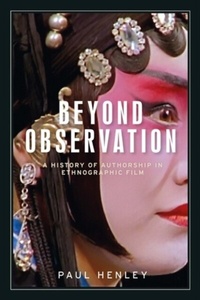
Beyond observation
A history of authorship in ethnographic film
1st Edition
Published on 20. January 2020
568 pages
978-1-5261-3137-9 (ISBN)
Description

This electronic version has been made available under a Creative Commons (BY-NC-ND) open access license. Beyond Observation is structured by the argument that the 'ethnographicness' of a film should not be determined by the fact that it is about an exotic culture - the popular view - nor because it has apparently not been authored - a long-standing academic view - but rather because it adheres to the norms of ethnographic practice more generally. On these grounds, the book covers a large number of films made in a broad range of styles across a 120-year period, from the Arctic to Africa, from the cities of China to rural Vermont.
Paul Henley discusses films made within reportage, exotic melodrama and travelogue genres in the period before the Second World War, as well as more conventionally ethnographic films made for academic or state-funded educational purposes. The book explores the work of film-makers such as John Marshall, Asen Balikci, Ian Dunlop and Timothy Asch in the post-war period, considering ideas about authorship developed by Jean Rouch, Robert Gardner and Colin Young. It also discusses films authored by indigenous subjects themselves using the new video technology of the 1970s and the ethnographic films that flourished on British television until the 1990s. In the final part of the book, Henley examines the recent work of David and Judith MacDougall and the Harvard Sensory Ethnography Lab, before concluding with an assessmentof a range of films authored in a participatory manner as possible future models.
An electronic edition of this book is freely available under a Creative Commons (CC BY-NC-ND) licence. -- .
Paul Henley discusses films made within reportage, exotic melodrama and travelogue genres in the period before the Second World War, as well as more conventionally ethnographic films made for academic or state-funded educational purposes. The book explores the work of film-makers such as John Marshall, Asen Balikci, Ian Dunlop and Timothy Asch in the post-war period, considering ideas about authorship developed by Jean Rouch, Robert Gardner and Colin Young. It also discusses films authored by indigenous subjects themselves using the new video technology of the 1970s and the ethnographic films that flourished on British television until the 1990s. In the final part of the book, Henley examines the recent work of David and Judith MacDougall and the Harvard Sensory Ethnography Lab, before concluding with an assessmentof a range of films authored in a participatory manner as possible future models.
An electronic edition of this book is freely available under a Creative Commons (CC BY-NC-ND) licence. -- .
More details
Series
Language
English
Place of publication
United Kingdom
Target group
College/higher education
Professional and scholarly
Illustrations
201 black & white illustrations
File size
5,54 MB
ISBN-13
978-1-5261-3137-9 (9781526131379)
Copyright in bibliographic data and cover images is held by Nielsen Book Services Limited or by the publishers or by their respective licensors: all rights reserved.
Schweitzer Classification
Other editions
Additional editions
Book
02/2020
Manchester University Press
€136.80
Shipment within 15-20 days
Book
01/2020
Manchester University Press
€43.10
Shipment within 15-20 days
Person
Paul Henley
Content
Introduction: Authorship, Praxis, Observation, Ethnography
PART I: HISTORIES: ETHNOGRAPHIC FILM IN THE TWENTIETH CENTURY
Introduction
1 The long prehistory of ethnographic film
2 Expeditions, melodrama and the birth of ethnofiction
3 The invisible Author: films of re-enactment in the postwar period
4 Records, not movies: the early films of John Marshall and Timothy Asch
5 Reflexivity and participation: the films of David and Judith MacDougall in Africa and Australia
6 Entangled voices: the complexities of collaborative authorship
7 The subject as Author: indigenous media and the Video nas Aldeias project
PART II: AUTHORS: THREE KEY FIGURES
Introduction
8 Jean Rouch: sharing anthropology
9 Robert Gardner: beyond the burden of the real
10 Colin Young: the principles of Observational Cinema
PART III: TELEVISION AS META-AUTHOR: ETHNOGRAPHIC FILM IN BRITAIN
Introduction
11 Ways of doing ethnographic film on British television
12 Beyond the 'disappearing world' - and back again
13 The decline of ethnographic film on British television
PART IV: BEYOND OBSERVATION: ETHNOGRAPHIC FILM IN THE TWENTY-FIRST CENTURY
Introduction
14 The evolution of Observational Cinema: recent films of David and Judith MacDougall
15 Negative capability and the flux of life: films of the Sensory Ethnography Lab
16 Participatory perspectives
AN EPILOGUE: Return to Kiriwina: the ethnographic film-maker as Author
APPENDIX: British Television Documentaries produced in collaboration with Ethnographic Researchers
Textual references
Film references
PART I: HISTORIES: ETHNOGRAPHIC FILM IN THE TWENTIETH CENTURY
Introduction
1 The long prehistory of ethnographic film
2 Expeditions, melodrama and the birth of ethnofiction
3 The invisible Author: films of re-enactment in the postwar period
4 Records, not movies: the early films of John Marshall and Timothy Asch
5 Reflexivity and participation: the films of David and Judith MacDougall in Africa and Australia
6 Entangled voices: the complexities of collaborative authorship
7 The subject as Author: indigenous media and the Video nas Aldeias project
PART II: AUTHORS: THREE KEY FIGURES
Introduction
8 Jean Rouch: sharing anthropology
9 Robert Gardner: beyond the burden of the real
10 Colin Young: the principles of Observational Cinema
PART III: TELEVISION AS META-AUTHOR: ETHNOGRAPHIC FILM IN BRITAIN
Introduction
11 Ways of doing ethnographic film on British television
12 Beyond the 'disappearing world' - and back again
13 The decline of ethnographic film on British television
PART IV: BEYOND OBSERVATION: ETHNOGRAPHIC FILM IN THE TWENTY-FIRST CENTURY
Introduction
14 The evolution of Observational Cinema: recent films of David and Judith MacDougall
15 Negative capability and the flux of life: films of the Sensory Ethnography Lab
16 Participatory perspectives
AN EPILOGUE: Return to Kiriwina: the ethnographic film-maker as Author
APPENDIX: British Television Documentaries produced in collaboration with Ethnographic Researchers
Textual references
Film references
