

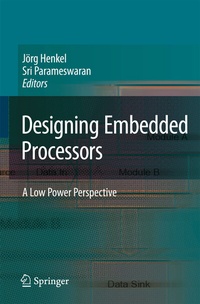
Designing Embedded Processors
Description

As we embrace the world of personal, portable, and perplexingly complex digital systems, it has befallen upon the bewildered designer to take advantage of the available transistors to produce a system which is small, fast, cheap and correct, yet possesses increased functionality.
Increasingly, these systems have to consume little energy. Designers are increasingly turning towards small processors, which are low power, and customize these processors both in software and hardware to achieve their objectives of a low power system, which is verified, and has short design turnaround times.
Designing Embedded Processors examines the many ways in which processor based systems are designed to allow low power devices. It looks at processor design methods, memory optimization, dynamic voltage scaling methods, compiler methods, and multi processor methods. Each section has an introductory chapter to give a breadth view, and have a few specialist chapters in the area to give a deeper perspective. The book provides a good starting point to engineers in the area, and to research students embarking upon the exciting area of embedded systems and architectures.
More details
Other editions
Additional editions
Persons
Dr. Sri Parameswaran received his B.Eng Degree from Monash University and his Ph.D degree from the University of Queensland in Australia. He has held visiting appointments at University of California, Kyushu University and Australian National University. He has also worked as a consultant to the NEC Research laboratories at Princeton, USA and to the Asian Development Bank in Philippines.
Currently Dr Parameswaran is at the University of New South Wales and is the Program Director of Computer Engineering. He has served on several program committees such as ICCAD, Euro-DAC, DATE, Codes-ISSS, CASES, APCHDL etc. He has given full day tutorials at ICCAD, Euro DAC and VLSI Design Conference. In 2002, he served as the program committee chair for the IEEE/ACM Codes Hardware/Software Co-design Symposium. Dr Parameswaran's research interests are in Application Specific Instruction Set Processors and Low power Design for Embedded systems. He leads a group of fifteen researchers, and holds grants from Australian Research Council and Industry.
Dr. Joerg Henkel received his Master and Ph.D ("cum laude") degrees both from the Technical University of Braunschweig, Germany. He then joined the Computer & Communication Research Laboratories CCRL (now NEC Laboratories America) in Princeton, NJ, where he led various projects in the areas of low power system level design and advanced embedded architectures. In between, he had an appointment as a visiting professor at the Univ. of Notre Dame, IN.
Dr. Henkel is currently with Karlsruhe University (TH), Germany, where he is directing the Chair for Embedded Systems CES. He has served or is serving as a program committee member for major conferences in electronic design automation and embedded system design like ICCAD, DATE, ASP-DAC, ISLPED, Codes-ISSS, CASES, RTSS, RSP. He has given full-day tutorials at conferences like DAC, ICCAD, DATE and others in the area of embedded system design. In 2001 he served asa Program Chair for the IEEE/ACM Codes Hardware/Software Co-design Symposium and was a General of the same convention in 2002. Furthermore, he was a Program Chair for the 2002 IEEE Workshop on Rapid System Prototyping. He has guest-edited special issues on hardware/software co-design in the IEEE Computer Magazine and on rapid system prototyping with Kluwer. Dr. Henkel holds five patents. He is a Senior Member of the IEEE.
