

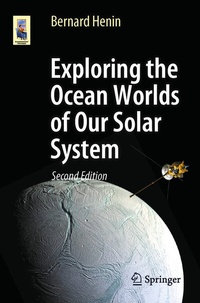
Exploring the Ocean Worlds of Our Solar System
Description

In the past 25 years, planetary science has undergone a revolution with the discovery of vast oceans of liquid water within the icy moons of our Solar System. These subsurface oceans are concealed beneath thick ice layers. We refer to these moons and similar ocean-bearing planetary objects as ocean worlds.
In this 2nd edition, we delve into and compare the latest scientific discoveries on 22 confirmed or potential ocean worlds, ranging from the giant asteroid Ceres and the icy moons Europa and Enceladus to the distant dwarf planets of the outer Solar System such as Pluto, Sedna, and Eris. Along the way, we explore the contributions of multiple spacecraft, such as the Pioneers, the Voyagers, Galileo, Cassini-Huygens, and many others, which have provided much of our current knowledge about these worlds, as well as the latest scientific research on this subject.
This book also explores the potential for life on each of the confirmed ocean worlds evaluating their habitability. Ultimately, these might hold the key to answering fundamental questions about life: How did life begin? Is there life beyond Earth? Where do we come from? With contributions from leading planetary scientists at NASA, ESA, and other institutions, this book aims to be the definitive reference for anyone interested in this captivating subject.
More details
Other editions
Additional editions
Person
Bernard fell in love with planetary science when, as a teenager reading National Geographic, he came across images of Neptune taken from Nasa's spacecraft Voyager 2. He was mesmerized by the giant blue planet, and found it both exhilarating and liberating to think that entire new worlds could be explored. Since then, Bernard has closely followed humanity's continued exploration of our Solar System. Henin is a professional science writer working for organizations throughout the world and has been a member of the Sherwood Observatory in the United Kingdom, home to the second largest telescope in the country that is freely accessible for public viewing. Originally from Belgium, Bernard has also lived in the USA, the United Kingdom, and Hong Kong. His previous books with Springer includes the first edition of the 'Exploring the Ocean Worlds of our Solar System' and 'Imaging our Solar System'.
Content
Part 1: Water and Life.- Chapter 1: The Voyagers' Tale.- Chapter 2: The Frost Line.- Chapter 3: Life on Earth and in Space.- Part 2: Confirmed Ocean Worlds.- Chapter 4: Ganymede.- Chapter 5: Callisto.- Chapter 6: Europa.- Chapter 7: Titan.- Chapter 8: Enceladus.- Part 3: Potential New Ocean Worlds.- Chapter 9: Ceres, Ariel, and Dione.- Chapter 10: Triton and Pluto.- Chapter 11: The Possible Others.- Part 4: Future Missions to the Ocean Worlds.- Chapter 12: Confirmed and Proposed Missions to the Ocean Worlds.
