

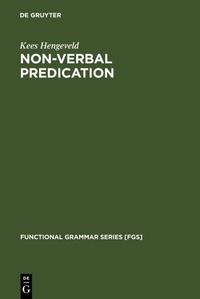
Non-Verbal Predication
Theory, Typology, Diachrony
1st Edition
Published on 2. May 2011
XXIII, 321 pages
978-3-11-088328-2 (ISBN)
Description

No detailed description available for "Non-Verbal Predication".
More details
Series
Edition
Reprint 2010
Language
English
Place of publication
Berlin/Boston
Germany
Publishing group
de Gruyter Mouton
Target group
Professional and scholarly
US School Grade: College Graduate Student
Illustrations
64 Abbildungen, 48 s/w Tabellen
64 ill., 48 tbl.
File size
41,12 MB
ISBN-13
978-3-11-088328-2 (9783110883282)
Schweitzer Classification
Other editions
Additional editions
Book
08/1992
1st Edition
De Gruyter Mouton
€119.95
Shipment within 7-9 days
Book
01/1992
1st Edition
De Gruyter Mouton
€169.95
Article exhausted; check different version
Content
- Intro
- List of maps, tables, and figures
- Abbreviations
- 0. Introduction
- 1. Some basic principles of Functional Grammar
- 1.0. Introduction
- 1.1. Predicate frames
- 1.2. Term formation
- 1.3. The representation of states of affairs
- 1.4. Syntactic and pragmatic functions
- 1.5. The representation of utterances
- 1.6. Terms and entities
- 1.7. Operators
- 1.8. Satellites
- 1.9. Clause structure
- 1.10. Subordination
- 1.11. Expression rules
- 2. The sample
- 2.0. Introduction
- 2.1. Sampling method
- 2.2. Description of the sample
- 2.3. Matters of presentation
- 3. Non-verbal predication
- 3.0. Introduction
- 3.1. Predication
- 3.2. Non-verbal predication
- 3.3. Non-verbal predicates
- 3.4. Copula, semi-copula, pseudo-copula
- 3.5. Summary
- 4. Parts of speech
- 4.0. Introduction
- 4.1. Previous approaches
- 4.2. Variables for predicates
- 4.3. New definitions
- 4.4. The identification of classes of predicates
- 4.5. Parts-of-speech systems
- 4.6. Preview
- 5. A classification of non-verbal predications
- 5.0. Introduction
- 5.1. Predicate types
- 5.2. Argument types
- 5.3. Predicability
- 5.4. Semantic relations in non-verbal predication
- 5.5. Presentativity
- 5.6. Control
- 5.7. Summary
- 5.8. Key examples
- 6. Non-verbal predicability
- 6.0. Introduction
- 6.1. Predicability and predicate type
- 6.2. Predicability and predication type
- 6.3. Predicability and deixis
- 6.4. Predicability and quantification
- 6.5. Summary
- 7. Alternatives for non-verbal predications
- 7.0. Introduction
- 7.1. Alternative predication types
- 7.2. The distribution of alternative predication types
- 7.3. Summary
- 8. The expression of non-verbal predications
- 8.0. Introduction
- 8.1. Expression formats
- 8.2. The distribution of expression formats
- 8.3. Copula triggers
- 9. Systems of non-verbal predication
- 9.0. Introduction
- 9.1. Expression patterns
- 9.2. Discussion
- 9.3. The status of adjectives
- 9.4. Summary
- 10. Copularization
- 10.0. Introduction
- 10.1. Positional verbs and localizing copulas
- 10.2. Pronouns
- 10.3. Semi-copulas
- 10.4. Existential verbs
- 10.5. Summary
- 11. Auxiliarization
- 11.0. Introduction
- 11.1. Auxiliary predication types
- 11.2. Basic and auxiliary predication
- 11.3. Summary
- 12. Conclusion
- References
- Index of languages
- Index of names
- Index of subjects
