

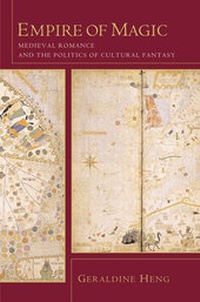
Empire of Magic
Medieval Romance and the Politics of Cultural Fantasy
1st Edition
Published on 13. July 2003
536 pages
978-0-231-50067-8 (ISBN)
Description

Empire of Magic offers a genesis and genealogy for medieval romance and the King Arthur legend through the history of Europe's encounters with the East in crusades, travel, missionizing, and empire formation. It also produces definitions of "race" and "nation" for the medieval period and posits that the Middle Ages and medieval fantasies of race and religion have recently returned.
Drawing on feminist and gender theory, as well as cultural analyses of race, class, and colonialism, this provocative book revises our understanding of the beginnings of the nine hundred-year-old cultural genre we call romance, as well as the King Arthur legend. Geraldine Heng argues that romance arose in the twelfth century as a cultural response to the trauma and horror of taboo acts--in particular the cannibalism committed by crusaders on the bodies of Muslim enemies in Syria during the First Crusade. From such encounters with the East, Heng suggests, sprang the fantastical episodes featuring King Arthur in Geoffrey of Monmouth's chronicle The History of the Kings of England, a work where history and fantasy collide and merge, each into the other, inventing crucial new examples and models for romances to come.
After locating the rise of romance and Arthurian legend in the contact zones of East and West, Heng demonstrates the adaptability of romance and its key role in the genesis of an English national identity. Discussing Jews, women, children, and sexuality in works like the romance of Richard Lionheart, stories of the saintly Constance, Arthurian chivralic literature, the legend of Prester John, and travel narratives, Heng shows how fantasy enabled audiences to work through issues of communal identity, race, color, class and alternative sexualities in socially sanctioned and safe modes of cultural discussion in which pleasure, not anxiety, was paramount. Romance also engaged with the threat of modernity in the late medieval period, as economic, social, and technological transformations occurred and awareness grew of a vastly enlarged world beyond Europe, one encompassing India, China, and Africa. Finally, Heng posits, romance locates England and Europe within an empire of magic and knowledge that surveys the world and makes it intelligible--usable--for the future.
Empire of Magic is expansive in scope, spanning the eleventh to the fifteenth centuries, and detailed in coverage, examining various types of romance--historical, national, popular, chivalric, family, and travel romances, among others--to see how cultural fantasy responds to changing crises, pressures, and demands in a number of different ways. Boldly controversial, theoretically sophisticated, and historically rooted, Empire of Magic is a dramatic restaging of the role romance played in the culture of a period and world in ways that suggest how cultural fantasy still functions for us today.
Drawing on feminist and gender theory, as well as cultural analyses of race, class, and colonialism, this provocative book revises our understanding of the beginnings of the nine hundred-year-old cultural genre we call romance, as well as the King Arthur legend. Geraldine Heng argues that romance arose in the twelfth century as a cultural response to the trauma and horror of taboo acts--in particular the cannibalism committed by crusaders on the bodies of Muslim enemies in Syria during the First Crusade. From such encounters with the East, Heng suggests, sprang the fantastical episodes featuring King Arthur in Geoffrey of Monmouth's chronicle The History of the Kings of England, a work where history and fantasy collide and merge, each into the other, inventing crucial new examples and models for romances to come.
After locating the rise of romance and Arthurian legend in the contact zones of East and West, Heng demonstrates the adaptability of romance and its key role in the genesis of an English national identity. Discussing Jews, women, children, and sexuality in works like the romance of Richard Lionheart, stories of the saintly Constance, Arthurian chivralic literature, the legend of Prester John, and travel narratives, Heng shows how fantasy enabled audiences to work through issues of communal identity, race, color, class and alternative sexualities in socially sanctioned and safe modes of cultural discussion in which pleasure, not anxiety, was paramount. Romance also engaged with the threat of modernity in the late medieval period, as economic, social, and technological transformations occurred and awareness grew of a vastly enlarged world beyond Europe, one encompassing India, China, and Africa. Finally, Heng posits, romance locates England and Europe within an empire of magic and knowledge that surveys the world and makes it intelligible--usable--for the future.
Empire of Magic is expansive in scope, spanning the eleventh to the fifteenth centuries, and detailed in coverage, examining various types of romance--historical, national, popular, chivalric, family, and travel romances, among others--to see how cultural fantasy responds to changing crises, pressures, and demands in a number of different ways. Boldly controversial, theoretically sophisticated, and historically rooted, Empire of Magic is a dramatic restaging of the role romance played in the culture of a period and world in ways that suggest how cultural fantasy still functions for us today.
All prices
More details
Other editions
Additional editions
Book
10/2004
Columbia University Press
€43.40
Article not available at the moment
Book
07/2003
Columbia University Press
€165.89
Article not available at the moment
Person
Geraldine Heng is director of medieval studies at the University of Texas at Austin and associate professor of English and Comparative Literature. Her articles have appeared in PMLA, differences, Genders, and the Yale Journal of Criticism.
Content
Introduction: In the Beginning Was Romance
History as Romance: The Genesis of a Medieval Genre
1. Cannibalism, the First Crusade, and the Genesis of Medieval Romance: Geoffrey of Monmouth's History of the Kings of Britain
Popular Romance: A National Fiction
2. The Romance of England: Richard Coer de Lyon and the Politics of Race, Religion, Sexuality, and Nation
Chivalric/Heroic Romance: Defending Elite Men and Bodies
3. Warring Against Modernity: Masculinity and Chivalry in Crisis; or, The Alliterative Morte Arthure's Romance Anatomy of the Crusades
Family Romance/Hagiographic Romance: A Matter of Women (and Children)
4. Beauty and the East, a Modern Love Story: Women, Children, and Imagined Communities in The Man of Law's Tale and Its Others
Travel Romance/Ethnographic Romance: Mapping the World and Home
5. Eye on the World: Mandeville's Pleasure Zones; or, Cartography, Anthropology, and Medieval Travel Romance
History as Romance: The Genesis of a Medieval Genre
1. Cannibalism, the First Crusade, and the Genesis of Medieval Romance: Geoffrey of Monmouth's History of the Kings of Britain
Popular Romance: A National Fiction
2. The Romance of England: Richard Coer de Lyon and the Politics of Race, Religion, Sexuality, and Nation
Chivalric/Heroic Romance: Defending Elite Men and Bodies
3. Warring Against Modernity: Masculinity and Chivalry in Crisis; or, The Alliterative Morte Arthure's Romance Anatomy of the Crusades
Family Romance/Hagiographic Romance: A Matter of Women (and Children)
4. Beauty and the East, a Modern Love Story: Women, Children, and Imagined Communities in The Man of Law's Tale and Its Others
Travel Romance/Ethnographic Romance: Mapping the World and Home
5. Eye on the World: Mandeville's Pleasure Zones; or, Cartography, Anthropology, and Medieval Travel Romance
