

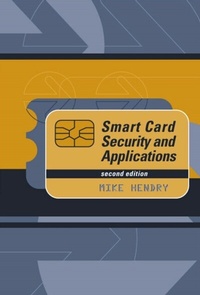
Smart Card Security And Applications, Second Edition
1st Edition
Published on 1. January 2000
328 pages
978-1-58053-408-6 (ISBN)
Description

This extensively updated, second edition of the popular Artech House book, Smart Card Security and Applications, offers you a current overview of the ways smart cards address the computer security issues of today's distributed applications. Brand new discussions on multi-application operating systems, computer networks, and the Internet are included to keep you abreast of the very latest developments in this field.
More details
Other editions
Additional editions
Michael Hendry
Smart Card Security and Applications, Second Edition
Book
04/2001
Artech House Publishers
€104.18
Shipment within 10-20 days
Content
- Smart Card Security and Applications Second Edition
- Contents v
- Foreword xvii
- Part I Background 1
- 1 Introduction 3
- The march of the card 3
- What is a chip card? 4
- Systems and procedures 5
- Market issues 6
- Organization of this book 7
- Reference 9
- 2 Problem Definition 11
- Perceptions 11
- ... and reality 12
- Calculating the risks: probabilities and odds 13
- Technical communication obstacles 15
- Reference 15
- 3 Specifying the Requirements 17
- Security criteria 17
- Quantifying the threat 22
- Standards 27
- Documenting the specification 30
- Reference 31
- Part II Technology 33
- 4 Card Technology 35
- Visual features 35
- Magnetic stripe 37
- Enhancing security using complementary technologies 40
- Optical 41
- Smart cards 42
- Hybrids 45
- PCMCIA cards 46
- Others 46
- 5 Encryption 49
- Cryptology overview and terminology 49
- Algorithms 50
- Keys 54
- Key management 62
- Public key infrastructures 65
- Computational requirements 66
- Cryptography export controls 67
- Summary 67
- References 68
- 6 Passwords and Biometrics 71
- Personal identification types 71
- Requirements 73
- Components 75
- Passwords and PINs 76
- Behavioral 76
- Physiometric 78
- Biometrics and cards 82
- 7 Chip Card Types and Characteristics 83
- Memory cards 84
- Microprocessor cards 85
- Contact and contactless 88
- Form factors 92
- 8 Chip Card Security Features 97
- Carrier 97
- External security features 98
- Chip 99
- Contacts 105
- Antenna 106
- Mask 108
- Attacks and countermeasures 109
- Reliability factors 112
- Sample card specifications 113
- References 116
- 9 Multiapplication Operating Systems 117
- Objectives 118
- Functions 119
- Products 120
- References 124
- 10 System Components 125
- Reader 125
- Terminal 131
- Network 138
- Host systems 140
- References 142
- 11 Processes and Procedures 143
- Chip design 144
- Manufacture 145
- Personalization 147
- Issuance 149
- Loading/validation 149
- Use 150
- Lost, stolen, and misused cards 151
- Application loading and unloading 153
- End of life 155
- Part III Applications 157
- 12 Telephony and Broadcasting Applications 159
- Fixed telephones 159
- Mobile telephones 163
- Cable and satellite television 168
- References 172
- 13 Computer Networks and E-commerce 173
- Network security 174
- Internet browsing and e-mail 176
- E-commerce 179
- References 184
- 14 Financial Applications 185
- Bank cards 185
- Credit/debit cards 189
- Electronic purses 196
- On-line transactions 202
- Benefits payment 206
- Loyalty 208
- New delivery channels 208
- References 209
- 15 Health 211
- Insurance 211
- Medical records 212
- Prescriptions 217
- Patient monitoring 217
- References 218
- 16 Transport 219
- Local public transportation 219
- Taxis 223
- Trains 224
- Air travel 224
- Road tolling 226
- Parking 228
- References 229
- 17 Personal Identification 231
- Identity card requirements 231
- Issues 232
- Access control 233
- Universities and schools 235
- Government cards 235
- "White cards" 236
- Reference 237
- 18 Commercial Structures for Multiapplication Cards 239
- Functions and applications 239
- Downloading 241
- Hybrid card types 243
- Card and application control 243
- Issuer responsibilities 244
- Consumer issues 245
- Interchange and compatibility with existing card systems 246
- 19 Designing for Security 247
- Aims 247
- Criteria 249
- Model 250
- Analysis 253
- 20 Looking Forward 259
- Market forecasts 259
- Cards 261
- Application downloading 263
- Card and terminal standards 264
- Chip cards and the mainstream 265
- Conclusions 266
- Appendix A: Standards 269
- Appendix B: Glossary 277
- Appendix C: Bibliography (Smart Card Security References) 287
- About the Author 291
- Index 293
