

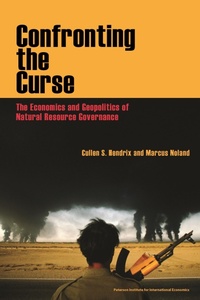
Confronting the Curse
Description

Countries blessed with abundant natural resources often seek financial and political power from their supposedly lucky status. But the potentially negative impact of natural resources on development of poor countries is captured in the phrase "the resource curse." Instead of success and prosperity, producers of gold, oil, rubber, sugar, and other commodities-many in the least developed parts of Africa and Asia-often remain mired in poverty and plagued by economic mismanagement, political authoritarianism, foreign exploitation, and violent conflict.
These difficulties and the many challenges they pose for American foreign policy are the focus of this important new book. Marcus Noland and Cullen S. Hendrix review recent developments as poor countries struggle to avoid the "resource curse" but fall too often into that trap. They call for support for international efforts to encourage greater transparency and improved management of natural resource wealth and for new partnerships between the West and the developing world to "confront the curse."
More details
Other editions
Additional editions
Persons
Marcus Noland, executive vice president and director of studies, has been associated with the Institute since 1985. From 2009 through 2012, he served as the Institute's deputy director. His research addresses a wide range of topics at the interstice of economics, political science, and international relations. His areas of geographical knowledge and interest include Asia and Africa where he has lived and worked, and the Middle East. In the past he has written extensively on the economies of Japan, Korea, and China, and is unique among American economists in having devoted serious scholarly effort to the problems of North Korea and the prospects for Korean unification. He won the 2000-01 Ohira Memorial Award for his book Avoiding the Apocalypse: The Future of the Two Koreas.
Cullen S. Hendrix, nonresident senior fellow at the Peterson Institute for International Economics, is assistant professor at the Josef Korbel School of International Studies at the University of Denver. He has published widely on the relationships between international markets, natural resources, and conflict, as well as the economic and security implications of climate change. He has consulted for the US Department of Defense, Food and Agriculture Organization, Political Instability Task Force, and World Food Programme. He is coauthor of Science and the International Politics of Climate Change (2010).
Content
- Cover
- Table of Contents
- Preface
- Acknowledgments
- Introduction
- Natural Resources and Economic Performance
- Declining Terms of Trade
- Commodity Price Volatility
- Resource Pulls and Crowding Out
- Dutch Disease
- Assessing the Resource Curse
- Conclusion
- Natural Resources and Domestic Politics
- Resource Curse and Political Democracy
- Resource Curse and State Capacity
- Resource Curse and Political Instability
- Attributes of the Resource
- Social, Political, and Economic Contexts
- Conclusion
- Natural Resources andInternational Affairs
- Institutional Integration
- Conflict Behavior
- Conclusion
- China as a Major Importerand Investor
- Outward Foreign Direct Investment
- Development Assistance
- Arms Transfers
- Conclusion
- Good Governance Initiatives
- Conflict Diamonds and the Kimberley Process Certification Scheme
- Diamond Development Initiative
- Extractive Industries Transparency Initiative
- Conflict Minerals
- Conclusion
- Conclusion
- What Is to Be Done?
- Microeconomic Approaches to Managing Instability
- Risk-Sharing Approaches
- Macroeconomic Approaches to Managing Instability
- Final Thoughts
- Appendices
- Appendix A
- Appendix B
- References
- Index
- Other Publications from the Peterson Institute for International Economics
- Working Papers
- Policy Briefs
- Policy Analyses in International Economics Series
- Books
- Special Reports
- Works in Progress
- Distributors Outside the US
