

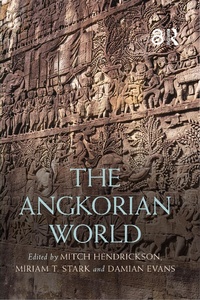
The Angkorian World
1st Edition
Published on 28. April 2023
686 pages
978-1-351-12893-3 (ISBN)
Description

The Angkorian World explores the history of Southeast Asia's largest ancient state from the first to mid-second millennium CE. Chapters by leading scholars combine evidence from archaeology, texts, and the natural sciences to introduce the Angkorian state, describe its structure, and explain its persistence over more than six centuries.
Comprehensive and accessible, this book will be an indispensable resource for anyone studying premodern Asia. The volume's first of six sections provides historical and environmental contexts and discusses data sources and the nature of knowledge production. The next three sections examine the anthropogenic landscapes of Angkor (agrarian, urban, and hydraulic), the state institutions that shaped the Angkorian state, and the economic foundations on which Angkor operated. Part V explores Angkorian ideologies and realities, from religion and nation to identity. The volume's last part reviews political and aesthetic Angkorian legacies in an effort to explain why the idea of Angkor remains central to its Cambodian descendants. Maps, graphics, and photographs guide readers through the content of each chapter. Chapters in this volume synthesise more than a century of work at Angkor and in the regions it influenced.
The Angkorian World will satisfy students, researchers, academics, and the knowledgeable layperson who seeks to understand how this great Angkorian Empire arose and functioned in the premodern world.
The Prologue and Chapters 2, 10, 15, 23, 30 and 32 of this book are freely available as a downloadable Open Access PDF at http://www.taylorfrancis.com under a Creative Commons (CC-BY-NC-ND) 4.0 license.
Comprehensive and accessible, this book will be an indispensable resource for anyone studying premodern Asia. The volume's first of six sections provides historical and environmental contexts and discusses data sources and the nature of knowledge production. The next three sections examine the anthropogenic landscapes of Angkor (agrarian, urban, and hydraulic), the state institutions that shaped the Angkorian state, and the economic foundations on which Angkor operated. Part V explores Angkorian ideologies and realities, from religion and nation to identity. The volume's last part reviews political and aesthetic Angkorian legacies in an effort to explain why the idea of Angkor remains central to its Cambodian descendants. Maps, graphics, and photographs guide readers through the content of each chapter. Chapters in this volume synthesise more than a century of work at Angkor and in the regions it influenced.
The Angkorian World will satisfy students, researchers, academics, and the knowledgeable layperson who seeks to understand how this great Angkorian Empire arose and functioned in the premodern world.
The Prologue and Chapters 2, 10, 15, 23, 30 and 32 of this book are freely available as a downloadable Open Access PDF at http://www.taylorfrancis.com under a Creative Commons (CC-BY-NC-ND) 4.0 license.
Reviews / Votes
"From the urban sprawl of the ancient city to the minutiae of pottery and temple bas-reliefs, The Angkorian World succeeds in offering a multi-dimensional, polyvocal account of this South East Asian polity. While this volume is a dense and comprehensive insight into the state of Angkorian studies at present, prospective readers, be they scholars of premodern Asia or lay enthusiasts, need not be daunted. This important collection makes the intricate tapestry of Angkor an accessible and rewarding read." Joanna Wolfarth - South East Asia ResearchMore details
Series
Edition
1. Auflage
Language
English
Place of publication
London
United Kingdom
Publishing group
Taylor & Francis Ltd
Target group
Professional and scholarly
Illustrations
20 Tables, black and white; 161 Halftones, black and white; 161 Illustrations, black and white
ISBN-13
978-1-351-12893-3 (9781351128933)
Copyright in bibliographic data and cover images is held by Nielsen Book Services Limited or by the publishers or by their respective licensors: all rights reserved.
Schweitzer Classification
Other editions
Additional editions
Mitch Hendrickson | Miriam T. Stark | Damian Evans
The Angkorian World
Book
12/2024
1st Edition
Routledge
€74.46
Shipment within 10-20 days
Mitch Hendrickson | Miriam T. Stark | Damian Evans
The Angkorian World
Book
04/2023
1st Edition
Routledge
€284.50
Shipment within 15-20 days
Persons
Mitch Hendrickson is Associate Professor of Anthropology at the University of Illinois at Chicago, USA. He worked as an archaeologist in northwest Mexico, the Canadian Plains, and High Arctic before shifting his focus to Cambodia in 2001. His initial research on the development and role of the Angkorian road system enabled him to develop two ongoing projects in collaboration with the Ministry of Culture and Fine Arts on the technological transformation that enabled expansions of the Khmer Empire and understanding religious transition at the site of Preah Khan of Kompong Svay.
Miriam T. Stark is Professor of Anthropology and Director of the Center for Southeast Asian Studies at the University of Hawai'i at Manoa, USA. Her 40-year career includes fieldwork in North America, the Near East, and Southeast Asia; she launched her first field project in Cambodia in 1996. Her Cambodian research, through multiple projects in collaboration with Cambodia's Ministry of Culture and Fine Arts, focuses on protohistoric to Angkorian period urbanism, early state formation, and political economy.
Damian Evans is Senior Research Fellow at the Ecole francaise d'Extreme-Orient in Paris and an Honorary Associate in the Department of History, School of Philosophical and Historical Inquiry at the University of Sydney. He is involved in a diverse array of projects across Southeast Asia encompassing archaeology, heritage, and the earth sciences, and he has initiated and overseen archaeological projects in Cambodia since the late 1990s. His work focuses on using earth observation technologies such as satellite imagery, radar, and lidar to understand the relationship between humans and their environments from the deep past to the present day.
Miriam T. Stark is Professor of Anthropology and Director of the Center for Southeast Asian Studies at the University of Hawai'i at Manoa, USA. Her 40-year career includes fieldwork in North America, the Near East, and Southeast Asia; she launched her first field project in Cambodia in 1996. Her Cambodian research, through multiple projects in collaboration with Cambodia's Ministry of Culture and Fine Arts, focuses on protohistoric to Angkorian period urbanism, early state formation, and political economy.
Damian Evans is Senior Research Fellow at the Ecole francaise d'Extreme-Orient in Paris and an Honorary Associate in the Department of History, School of Philosophical and Historical Inquiry at the University of Sydney. He is involved in a diverse array of projects across Southeast Asia encompassing archaeology, heritage, and the earth sciences, and he has initiated and overseen archaeological projects in Cambodia since the late 1990s. His work focuses on using earth observation technologies such as satellite imagery, radar, and lidar to understand the relationship between humans and their environments from the deep past to the present day.
Content
Prologue: An Introduction to the Angkorian World; PART I: CONTEXTS; 1 An Environmental History of Angkor: Beginning and End; 2 Texts and Objects: Exploiting the Literary Sources in Mediaeval Cambodia; 3 'Invisible Cambodians': Knowledge Production in the History of Angkorian Archaeology; 4 The Mekong Delta Before the Angkorian World; 5 The Early Capitals of Angkor; 6 Angkor's Multiple Southeast Asia Overland Connections; 7 Angkor and China: 9th-15th Centuries; PART II: LANDSCAPES; 8 Forests, Palms, and Paddy Fields: The Plant Ecology of Angkor; 9 Angkor and the Mekong River: Settlement, Resources, Mobility, and Power; 10 Trajectories of Urbanism in the Angkorian World; 11 Angkor's Temple Communities and the Logic of Its Urban Landscape; 12 Angkor as a "Cite Hydraulique"?; PART III: STATE INSTITUTIONS; 13 Angkorian Law and Land; 14 Warfare and Defensive Architecture in the Angkorian World; 15 Asramas, Shrines, and Royal Power; 16 Education and Medicine at Angkor; PART IV: ECONOMIES; 17 Angkor's Economy: Implications of the Transfer of Wealth; 18 The Temple Economy of Angkor; 19 Angkor's Agrarian Economy: A Socio-Ecological Mosaic; 20 From Quarries to Temples: Stone Procurement, Materiality, and Spirituality in the Angkorian World; 21 Crafting With Fire: Stoneware and Iron Pyrotechnologies in the Angkorian World; 22 Food, Craft, and Ritual: Plants From the Angkorian World; PART V: IDEOLOGIES AND REALITIES; 23 Gods and Temples: The Nature(s) of Angkorian Religion; 24 Bodies of Glory: The Statuary of Angkor; 25 'Of Cattle and Kings': Bovines in the Angkorian World; 26 An Angkor Nation? Identifying the Core of the Khmer Empire; 27 The Angkorian House; 28 Vogue at Angkor: Dress, Decor, and Narrative Drama; 29 Gender, Status, and Hierarchy in the Age of Angkor; PART VI: AFTER ANGKOR; 30 Perspectives on the 'Collapse' of Angkor and the Khmer Empire; 31 Uthong and Angkor: Material Legacies in the Chao Phraya Basin, Thailand; 32 Mainland Southeast Asia after Angkor: On the Legacies of Jayavarman VII; 33 Early Modern Cambodia and Archaeology at Longvek; 34 Yama, the God Closest to the Khmers; 35 Inarguably Angkor
