

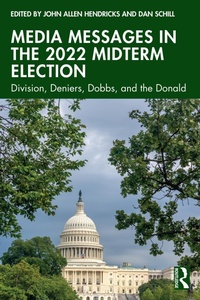
Media Messages in the 2022 Midterm Election
Division, Deniers, Dobbs, and the Donald
Published on 29. April 2025
322 pages
978-1-040-34513-9 (ISBN)
Description

The 2022 midterms marked a transformative moment in American politics, as the combined influence of legacy media and social platforms reached new heights. Traditional outlets like television news and print journalism set the stage, while a vast digital ecosystem-spanning Facebook, TikTok, YouTube, and more-enabled campaigns to amplify messages on issues like abortion rights, the economy, and immigration. As these platforms shaped the voter experience in a fragmented and often- polarized media environment, campaigns and citizens harnessed their power to reach diverse audiences and build momentum across both established and emerging channels.
This book offers a compelling, scholarly exploration of these dynamics, revealing how communication across traditional and digital media shaped an election forecasted as a Republican "red wave" but instead delivered unexpected, narrower results. Through detailed analyses, data- driven research, and case studies from high- profile races, this book uncovers how media strategies influenced voter behavior, shaped public discourse, and framed electoral outcomes. Essential for academics, political analysts, and media professionals, this work provides crucial insights into the evolving role of media in U.S. elections and the weighty implications for future democratic engagement.
This book offers a compelling, scholarly exploration of these dynamics, revealing how communication across traditional and digital media shaped an election forecasted as a Republican "red wave" but instead delivered unexpected, narrower results. Through detailed analyses, data- driven research, and case studies from high- profile races, this book uncovers how media strategies influenced voter behavior, shaped public discourse, and framed electoral outcomes. Essential for academics, political analysts, and media professionals, this work provides crucial insights into the evolving role of media in U.S. elections and the weighty implications for future democratic engagement.
Reviews / Votes
There is a paucity of research on communication and midterm elections in the field of political communication, pointing up a lack of knowledge of the agenda dynamics of midterms, the impact of media frames, and how media and politics intersect to influence voter choices in Congressional elections. In this edited volume, John Allen Hendricks and Dan Schill help redress this imbalance by focusing on the critical 2022 midterm elections, with chapters organized around how conspiracy theories, media frames, and news narratives influenced the campaign trajectory. Given the political importance of the 2022 midterms, this book goes a long way toward illuminating our knowledge of how media messages - based on both legitimate issues and conspiratorial ideation - influenced the contours of the campaign.Richard M. Perloff, Distinguished Professor of Communication and Political Science, Cleveland State University
The 2022 Midterm Election was something of a puzzle - until this book came along. In its pages, accomplished and promising scholars offer fascinating studies regarding political communication via traditional and new media channels. This book offers vital findings regarding the continuing evolution of campaign discourse in our highly volatile political era.
Stephen J. Farnsworth, Ph.D, Professor of Political Science and International Affairs, University of Mary Washington
The book's lineup of distinguished scholars illuminate the complex interplay between candidate strategies, traditional media, new media, and voter preferences. A must-read for anyone - scholar, student, practitioner, or citizen - seeking to understand the media's evolving election role.
Thomas E. Patterson, Bradlee Professor of Government & the Press, Harvard University
More details
Language
English
Place of publication
London
United Kingdom
Publishing group
Taylor & Francis Ltd
Target group
College/higher education
Illustrations
32 Tables, black and white; 8 Line drawings, color; 7 Line drawings, black and white; 1 Halftones, black and white; 8 Illustrations, color; 8 Illustrations, black and white
File size
29,57 MB
ISBN-13
978-1-040-34513-9 (9781040345139)
Copyright in bibliographic data and cover images is held by Nielsen Book Services Limited or by the publishers or by their respective licensors: all rights reserved.
Schweitzer Classification
Other editions
Additional editions

Media Messages in the 2022 Midterm Election
Division, Deniers, Dobbs, and the Donald
Book
06/2025
Routledge
Unfortunately, price unknown
Available (delivery time upon request)
John Allen Hendricks | Dan Schill
Media Messages in the 2022 Midterm Election
Division, Deniers, Dobbs, and the Donald
Book
04/2025
1st Edition
Routledge
€230.80
Shipment within 10-20 days
John Allen Hendricks | Dan Schill
Media Messages in the 2022 Midterm Election
Division, Deniers, Dobbs, and the Donald
Book
04/2025
1st Edition
Routledge
€87.60
Shipment within 10-20 days
Persons
John Allen Hendricks is Chair of the Department of Media & Communication and Professor at Stephen F. Austin State University, a member of the University of Texas System, where he teaches courses in communication theory, research methods, First Amendment law, and media and politics. He is the recipient of book awards from the National Communication Association (NCA) and the Broadcast Education Association (BEA).
Dan Schill is Professor in the School of Communication Studies and Affiliate Professor in Political Science at James Madison University, where he teaches courses in advocacy, political communication, research methods, and media and politics. His research focuses on communication, politics, media, and technology.
Dan Schill is Professor in the School of Communication Studies and Affiliate Professor in Political Science at James Madison University, where he teaches courses in advocacy, political communication, research methods, and media and politics. His research focuses on communication, politics, media, and technology.
Content
Chapter 1: Media, Messaging, and the Midterms: Communication Dynamics in the 2022 U.S. Elections SECTION I: AMPLIFIED DOUBTS: CONSPIRACY THEORIES, COMMUNICATION, AND THE 2022 MIDTERM ELECTIONS Chapter 2: Conspiratorial Ideation, Election Denial, and Voter Choice Chapter 3: 2000 Mules: A Story of Consequences and Conspiracy SECTION II: FRAMING THE DEBATE: HOW ISSUES SHAPED 2022 CANDIDATE COMMUNICATION Chapter 4: Post-Roe Politics: Priming, Framing, and the Dynamics of Abortion Discourse in Congressional Campaigns Chapter 5: Winning Stories Amid Partisanship: Narratives in Political Advertisements and Overperforming Candidates in the 2022 U.S. Midterm Election Chapter 6: How Congress Managed Social Media Agenda Fracture and Inversion during the 2022 Election SECTION III: NEWS NARRATIVES: 2022 MEDIA COVERAGE AND PUBLIC PERCEPTION Chapter 7: The Impact of Digital Partisan News Algorithms in the 2022 Midterm Election Chapter 8: Reply "STOP": Dominant Media Frames of SMS-Based Political Communication as a Consumer Problem Chapter 9: Of Red Waves, Election Deniers, Candidate Quality and Other Issues: Political Cartoons during the 2022 Midterm Elections SECTION IV: MIDTERM COMMUNICATION IN THE STATES: CASE STUDIES FROM ARIZONA, NEVADA, FLORIDA, TEXAS, AND KANSAS Chapter 10: The Limits of Being "100% Pro-Life:" Rhetorical Trajectory and Abortion in the American Southwest Chapter 11: Florida's 2022 Senate Race: Social Media, Social Justice, and Partisanship Chapter 12: The Centrality of Citizen-as-Consumer: A Study of the 2022 Texas Midterms and the Failing Concept of the Marketplace of Ideas in a Digital Era Chapter 13: Gendered Treatment in the Communication Strategy of a Female Gubernatorial Candidate
