

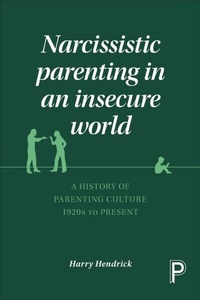
Narcissistic Parenting in an Insecure World
A History of Parenting Culture 1920s to Present
1st Edition
Published on 6. July 2016
336 pages
978-1-4473-2259-7 (ISBN)
Description

In this provocative history of parenting, Harry Hendrick analyses the social and economic reasons behind parenting trends. He shows how broader social changes, including neoliberalism, feminism, the collapse of the social-democratic ideal, and the 'new behaviourism', have led to the rise of the anxious and narcissistic parent.
The book charts the shift from the liberal and progressive parenting styles of the 1940s-70s, to the more 'behavioural', punitive and managerial methods of childrearing today, made popular by 'experts' such as Gina Ford and Supernanny Jo Frost, and by New Labour's parent education programmes.
This trend, Hendrick argues, is symptomatic of the sour, mean-spirited and vindictive social norms found throughout society today. It undermines the better instincts of parents and, therefore, damages parent-child relations. Instead, he proposes, parents should focus on understanding and helping their children as they work at growing up.
The book charts the shift from the liberal and progressive parenting styles of the 1940s-70s, to the more 'behavioural', punitive and managerial methods of childrearing today, made popular by 'experts' such as Gina Ford and Supernanny Jo Frost, and by New Labour's parent education programmes.
This trend, Hendrick argues, is symptomatic of the sour, mean-spirited and vindictive social norms found throughout society today. It undermines the better instincts of parents and, therefore, damages parent-child relations. Instead, he proposes, parents should focus on understanding and helping their children as they work at growing up.
Reviews / Votes
"Hendrick is an academic historian of medicine who pulls no punches in his analysis of the political and economic backcloth to zeitgeists like `authoritative' parenting, spawned of neo-liberalism and its narcissistic fixation with the self. This intensively-researched, well-written book is in five parts" Professional Social Work magazine. "Situating historical and social shifts in parenthood, Harry Hendrick's latest work is meticulously researched, vigorously argued, glitteringly provocative - and sure to spark robust debate." Alan Prout, University of Leeds "In progressive parenting, children came first. In market liberalism children became subordinate to parental self-interest. How and why is told here absorbingly, from the 1920s to the present." Avner Offer, University of Oxford, author of The Challenge of Affluence. "A richly contextualised and beautifully crafted book on the history of parenting in Britain and the United States. Hendrick offers a sensitively nuanced appraisal of the past, asks pertinent questions of the present, leaving us with a strong message for the future." Alison Haggett, University of ExeterMore details
Edition
First Edition
Language
English
Place of publication
Bristol
United Kingdom
Publishing group
Bristol University Press
Target group
Professional and scholarly
Illustrations
Not illustrated
File size
0,50 MB
ISBN-13
978-1-4473-2259-7 (9781447322597)
Copyright in bibliographic data and cover images is held by Nielsen Book Services Limited or by the publishers or by their respective licensors: all rights reserved.
Schweitzer Classification
Other editions
Additional editions
Harry Hendrick
Narcissistic Parenting in an Insecure World
A History of Parenting Culture 1920s to Present
Book
07/2016
1st Edition
Policy Press
€42.90
Shipment within 15-20 days
Harry Hendrick
Narcissistic Parenting in an Insecure World
A History of Parenting Culture 1920s to Present
Book
07/2016
1st Edition
Policy Press
€100.50
Shipment within 15-20 days
Harry Hendrick
Narcissistic Parenting in an Insecure World
A History of Parenting Culture 1920s to Present
E-Book
07/2016
1st Edition
Policy Press
€231.99
Available for download
Person
Since retiring in 2010 Harry Hendrick has been an Assoc Fellow in the History of Medicine Centre at the University of Warwick. He has been involved in the 'new' sociology of childhood since its beginning and has written widely on historical and contemporary aspects of social policy affecting children and childhood.
Content
Introduction;
PART 1: The origins of social democracy's family ideal: 1920s-1940s;
1. The re-imagining of adult-child relations between the wars;
2. Wartime influences: from the evacuation to the Children Act, 1948;
PART 2. Characteristics of the 'Golden Age': 1940s-early 1970s;
3. Re-building the family: 1940s-1950s;
4. The 'long sixties': 1958-1974;
PART 3. Influences and examples from the USA;
5. Social science and American liberalism;
PART 4. Parental narcissism in neoliberal times: 1970s to the present;
6. Aspects of neoliberalism: political, economic and social realignment;
7. Laying the foundations for parental narcissism;
8. The New Labour era, and beyond: narcissism comes of age;
PART 5. Therapeutic reflections;
9) Narcissism and the 'politics of recognition': concepts of the late-modern self.
PART 1: The origins of social democracy's family ideal: 1920s-1940s;
1. The re-imagining of adult-child relations between the wars;
2. Wartime influences: from the evacuation to the Children Act, 1948;
PART 2. Characteristics of the 'Golden Age': 1940s-early 1970s;
3. Re-building the family: 1940s-1950s;
4. The 'long sixties': 1958-1974;
PART 3. Influences and examples from the USA;
5. Social science and American liberalism;
PART 4. Parental narcissism in neoliberal times: 1970s to the present;
6. Aspects of neoliberalism: political, economic and social realignment;
7. Laying the foundations for parental narcissism;
8. The New Labour era, and beyond: narcissism comes of age;
PART 5. Therapeutic reflections;
9) Narcissism and the 'politics of recognition': concepts of the late-modern self.
