

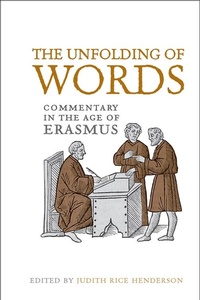
The Unfolding of Words
Commentary in the Age of Erasmus
1st Edition
Published on 22. January 2013
304 pages
978-1-4426-9596-2 (ISBN)
Description

Leading sixteenth-century scholars such as Martin Luther and Desiderius Erasmus used print technology to engage in dialogue and debate with authoritative contemporary texts. By what Juan Luis Vives termed 'the unfolding of words,' these humanists gave old works new meanings in brief notes and extensive commentaries, full paraphrases, or translations. This critique challenged the Middle Ages' deference to authors and authorship and resulted in some of the most original thought - and most violent controversy - of the Renaissance and Reformation.
The Unfolding of Words brings together international scholarship to explore crucial changes in writers' interactions with religious and classical texts. This collection focuses particularly on commentaries by Erasmus, contextualizing his Annotations and Paraphrases on the New Testament against broader currents and works by such contemporaries as Francois Rabelais and Jodocus Badius. The Unfolding of Words tracks humanist explorations of the possibilities of the page that led to the modern dictionary, encyclopedia, and scholarly edition.
The Unfolding of Words brings together international scholarship to explore crucial changes in writers' interactions with religious and classical texts. This collection focuses particularly on commentaries by Erasmus, contextualizing his Annotations and Paraphrases on the New Testament against broader currents and works by such contemporaries as Francois Rabelais and Jodocus Badius. The Unfolding of Words tracks humanist explorations of the possibilities of the page that led to the modern dictionary, encyclopedia, and scholarly edition.
Reviews / Votes
'The great value of present collection is the degree to which these essays demonstrate the indispensability of commentary in the Renaissance, how integral theories and practices of commentary were to a vibrant intellectual world.' - Russ Leo (Sixteenth Century Journal vol 65:02:2014) 'This is an excellent volume - an education for the novice and a provocation to further scholarship to the expert.' - R. Ward Holder (Renaissance Quarterly vol 66:04:2013)More details
Series
Language
English
Place of publication
Toronto
Canada
Target group
Professional and scholarly
Edition type
Digital original
File size
2,94 MB
ISBN-13
978-1-4426-9596-2 (9781442695962)
Copyright in bibliographic data and cover images is held by Nielsen Book Services Limited or by the publishers or by their respective licensors: all rights reserved.
Schweitzer Classification
Other editions
Additional editions
Book
12/2012
University of Toronto Press
€79.00
Article exhausted; check different version
Person
Judith Rice Henderson is a professor in the Department of English and is active in the Classical, Medieval, and Renaissance Studies Program at the University of Saskatchewan.
Content
Preface Acknowledgements
Part One: Genres of Sixteenth-Century Commentary
One: Theory and Practices of Commentary in the Renaissance
Jean Ceard, Universite Paris-Ouest Nanterre La Defense
Part Two: The Biblical Scholarship of Erasmus
Two: Erasmus's Paraphrases: A 'New Kind of Commentary'?
Jean-Francois Cottier, Universite Paris-7 Diderot and Universite de Montreal
Editor's Addendum: Translating an Erasmian Definition of Paraphrase
Judith Rice Henderson, University of Saskatchewan
Three: The Actor in the Story: Horizons of Interpretation in Erasmus's Annotations on Luke
Mark Vessey, University of British Columbia
Four: The Function of Ambrosiaster in Erasmus's Annotations on the Epistle to the Galatians
Riemer Faber, University of Waterloo, Ontario
Five: Erasmus's Biblical Scholarship in the Toronto Project
Robert D. Sider, Dickinson College, Carlisle, Pennsylvania and University of Saskatchewan
Part Three: Religious Contexts of Printed Commentary
Six: 'Virtual Classroom': Josse Bade's Commentaries for the Pious Reader
Mark Crane, Nipissing University, North Bay, Ontario
Seven: Embedded Commentary in Luther's Translation of Romans 3
Gordon A. Jensen, Lutheran Theological Seminary, Saskatoon
Eight: Commenting on Hatred of Commentaries: Les Censures des Theologiens Revised by Robert Estienne
Helene Cazes, University of Victoria, British Columbia
Part Four: Developments in Humanist Philology
Nine: Rabelais's Lost Stratagemata (ca. 1539): A Commentary on Frontinus?
Claude La Charite, Universite du Quebec a Rimouski
Ten: Commentaries on Tacitus by Justus Lipsius: Their Editing and Printing History
Appendix I: A Survey of Lipsius's Editions of Tacitus (Text and/or Commentary)
Appendix II: The Praenomen of Tacitus: Why Lipsius Preferred Caius to Publius
Appendix III: The Annotations in Leiden UL, 762 C 4 as Source of the Curae secundae
Appendix IV: Lipsius's Evolving Commentaries: Two Examples in the 1585 Edition, Curae secundae, and 1588 Edition
Jeanine De Landtsheer, Katholieke Universiteit Leuven, Belgium
Bibliography
List of Contributors
Index
Part One: Genres of Sixteenth-Century Commentary
One: Theory and Practices of Commentary in the Renaissance
Jean Ceard, Universite Paris-Ouest Nanterre La Defense
Part Two: The Biblical Scholarship of Erasmus
Two: Erasmus's Paraphrases: A 'New Kind of Commentary'?
Jean-Francois Cottier, Universite Paris-7 Diderot and Universite de Montreal
Editor's Addendum: Translating an Erasmian Definition of Paraphrase
Judith Rice Henderson, University of Saskatchewan
Three: The Actor in the Story: Horizons of Interpretation in Erasmus's Annotations on Luke
Mark Vessey, University of British Columbia
Four: The Function of Ambrosiaster in Erasmus's Annotations on the Epistle to the Galatians
Riemer Faber, University of Waterloo, Ontario
Five: Erasmus's Biblical Scholarship in the Toronto Project
Robert D. Sider, Dickinson College, Carlisle, Pennsylvania and University of Saskatchewan
Part Three: Religious Contexts of Printed Commentary
Six: 'Virtual Classroom': Josse Bade's Commentaries for the Pious Reader
Mark Crane, Nipissing University, North Bay, Ontario
Seven: Embedded Commentary in Luther's Translation of Romans 3
Gordon A. Jensen, Lutheran Theological Seminary, Saskatoon
Eight: Commenting on Hatred of Commentaries: Les Censures des Theologiens Revised by Robert Estienne
Helene Cazes, University of Victoria, British Columbia
Part Four: Developments in Humanist Philology
Nine: Rabelais's Lost Stratagemata (ca. 1539): A Commentary on Frontinus?
Claude La Charite, Universite du Quebec a Rimouski
Ten: Commentaries on Tacitus by Justus Lipsius: Their Editing and Printing History
Appendix I: A Survey of Lipsius's Editions of Tacitus (Text and/or Commentary)
Appendix II: The Praenomen of Tacitus: Why Lipsius Preferred Caius to Publius
Appendix III: The Annotations in Leiden UL, 762 C 4 as Source of the Curae secundae
Appendix IV: Lipsius's Evolving Commentaries: Two Examples in the 1585 Edition, Curae secundae, and 1588 Edition
Jeanine De Landtsheer, Katholieke Universiteit Leuven, Belgium
Bibliography
List of Contributors
Index
