

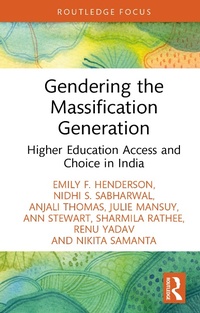
Gendering the Massification Generation
Higher Education Access and Choice in India
1st Edition
Published on 29. December 2023
128 pages
978-1-040-00961-1 (ISBN)
Description

Gendering the Massification Generation examines why young people from the same families and communities in India experience different decision-making processes regarding higher education access because of their gender. In India and other contexts where higher education is massifying, and gender parity of enrolment has been reached at undergraduate level, there are still many questions to be asked about gender and access to higher education. Based on an exploratory study of gendered higher education access and choice within the state of Haryana, India, the authors explore gender inequalities of higher education access and choice in the Indian context and connect this with the broader international phenomenon of widening participation.
Through an in-depth analysis of the 'massification generation', where young people from relatively disadvantaged backgrounds are accessing higher education, often for the first time in their families and communities, readers are encouraged to apply a lens of social disadvantage and gender, and to recognise the norms and transgressions of femininity and masculinity in relation to higher education access and choice.
With global implications for the ways in which gender is analysed and framed in widening participation research and policy, this is the ideal book for scholars, students and policy makers working on higher education, as well as researchers and NGOs specialising in gender, school-to-higher education transitions, international development, sociology and area studies.
Through an in-depth analysis of the 'massification generation', where young people from relatively disadvantaged backgrounds are accessing higher education, often for the first time in their families and communities, readers are encouraged to apply a lens of social disadvantage and gender, and to recognise the norms and transgressions of femininity and masculinity in relation to higher education access and choice.
With global implications for the ways in which gender is analysed and framed in widening participation research and policy, this is the ideal book for scholars, students and policy makers working on higher education, as well as researchers and NGOs specialising in gender, school-to-higher education transitions, international development, sociology and area studies.
Reviews / Votes
'This internationally co-authored book is such a valuable contribution to knowledge about gender in India's massive and massified higher education system. The book provides a sophisticated analysis of dominant codes of femininity and masculinity and explores the micro-level aspects of decision-making processes involved in access and participation in higher education in a rapidly changing and complex socio-cultural context. The focus moves beyond representational parity and examines the influence of social class, caste, community, and generational and gendered traditions on risks, choices, and constraints. This book is essential reading for all those involved in the study of equity internationally in higher education.'Emerita Professor Louise Morley, University of Sussex, UK
'A treasure trove, this book brilliantly coins the term 'massification generation' to denote the phenomenon of expanding higher education in India whereby the students from disadvantaged socio-economic background are accessing higher education in large numbers. The book portrays how gender dynamics influence higher education access and choice in the state of Haryana, where the prevalent gender norms are characteristic of 'classical' patriarchy. It is refreshing that the book provides captivating explanation about underlying social processes maintaining the codes of femininity and masculinity in the attainment of higher education.'
Professor Rajeshwari, Kurukshetra University, Haryana, India
'This book carefully applies layered techniques and new angles of gender analysis, to paint a richly textured picture of how gender shapes the choices and decisions young people in India make about pursuing higher education. The book challenges the idea that inequalities in higher education are solved through the achievement of gender parity, and presents evidence that is contextually specific to India, but theorised in ways that allow us to recognise the deeply gendered dynamics of higher education access in other parts of the world, particularly in global South contexts.'
Dr Mikateko Mathebula, University of the Free State, South Africa
More details
Edition
1. Auflage
Language
English
Place of publication
London
United Kingdom
Publishing group
Taylor & Francis Ltd
Target group
College/higher education
Professional and scholarly
Product notice
Reflowable
Illustrations
4 Tables, black and white; 4 Line drawings, black and white; 5 Halftones, black and white; 9 Illustrations, black and white
ISBN-13
978-1-040-00961-1 (9781040009611)
Copyright in bibliographic data and cover images is held by Nielsen Book Services Limited or by the publishers or by their respective licensors: all rights reserved.
Schweitzer Classification
Other editions
Additional editions
Emily F. Henderson | Nidhi S. Sabharwal | Anjali Thomas
Gendering the Massification Generation
Higher Education Access and Choice in India
Book
05/2025
1st Edition
Routledge
€32.90
Shipment within 10-20 days
Emily F. Henderson | Nidhi S. Sabharwal | Anjali Thomas
Gendering the Massification Generation
Higher Education Access and Choice in India
Book
12/2023
1st Edition
Routledge
€78.80
Shipment within 10-20 days
Persons
Emily F. Henderson is Reader in Gender and International Higher Education, Department of Education Studies, and Director of the Doctoral Education and Academia Research Centre, University of Warwick, UK. She is also Visiting Professor at the Centre for Policy Research in Higher Education, National Institute of Educational Planning and Administration, India.
Nidhi S. Sabharwal is Associate Professor at the Centre for Policy Research in Higher Education, National Institute of Educational Planning and Administration, India, and is an Honorary Associate Professor in the Department of Education Studies at the University of Warwick, UK.
Anjali Thomas is an early career researcher, recently holding post-doctoral roles at the University of Warwick on the 'Fair Chance for Education' project and University of Liverpool; she holds a PhD from Department of Education Studies, University of Warwick, UK (funded by WCPRS and Fair Chance Foundation).
Julie Mansuy is the Founder and Director of Active4Research Ltd., was the 'Fair Chance for Education' Project Research Coordinator and holds a PhD from the Law School, University of Warwick, UK.
Ann Stewart is Professor of Law in the Law School, University of Warwick, UK, and previously Visiting Research Professor, Centre for Law and Governance, Jawaharlal Nehru University, New Delhi, India.
Sharmila Rathee is Assistant Professor at the Department of Elementary Education, University of Delhi, India, and a Recipient of the American Disability Act Inclusive Education Fellowship.
Renu Yadav is Associate Professor in the Department of Teacher Education, Central University of Haryana, Mahendergarh, Haryana, India. She is also the Convenor of the Women's Empowerment Cell and Deputy Dean of Students' Welfare.
Nidhi S. Sabharwal is Associate Professor at the Centre for Policy Research in Higher Education, National Institute of Educational Planning and Administration, India, and is an Honorary Associate Professor in the Department of Education Studies at the University of Warwick, UK.
Anjali Thomas is an early career researcher, recently holding post-doctoral roles at the University of Warwick on the 'Fair Chance for Education' project and University of Liverpool; she holds a PhD from Department of Education Studies, University of Warwick, UK (funded by WCPRS and Fair Chance Foundation).
Julie Mansuy is the Founder and Director of Active4Research Ltd., was the 'Fair Chance for Education' Project Research Coordinator and holds a PhD from the Law School, University of Warwick, UK.
Ann Stewart is Professor of Law in the Law School, University of Warwick, UK, and previously Visiting Research Professor, Centre for Law and Governance, Jawaharlal Nehru University, New Delhi, India.
Sharmila Rathee is Assistant Professor at the Department of Elementary Education, University of Delhi, India, and a Recipient of the American Disability Act Inclusive Education Fellowship.
Renu Yadav is Associate Professor in the Department of Teacher Education, Central University of Haryana, Mahendergarh, Haryana, India. She is also the Convenor of the Women's Empowerment Cell and Deputy Dean of Students' Welfare.
Content
1. Introduction to Gendering the massification generation; 2. The Massification Generation; 3. Gendering the massification generation; 4. Honour and Marriage: Femininity and Higher Education Access and Choice; 5. Family Responsibility: Masculinity and Higher Education Access and Choice; 6. Conclusion
