

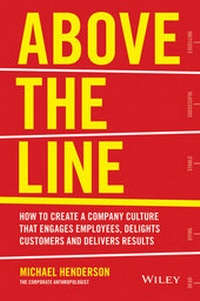
Above the Line
Description

Above the Line: How to Create a Company Culture that EngagesEmployees, Delights Customers and Delivers Results offers allleaders a handbook for leveraging an organisation's culture toengage staff, increase customer satisfaction and streamlinebusiness performance. A groundbreaking work, this book reveals whatit takes to achieve optimum results from your organisationalculture without employing the use of external consultants. Thisorganic, in-house approach to company culture transformation savesboth time and money. Step-by-step, author Michael Hendersonillustrates how to create a culture in which employees and leadersdelight those outside the company--customers, shareholder,employees' families, suppliers and the board of directors--andanyone else who may benefit from an association with theorganisation.
The book's proven models and ideas have been tried and testedwith a broad range of of high-profile international companies.Expert author, Michael Henderson, a.k.a. The CorporateAnthropologist, has more than 30 years' experience, and a proventrack record of working and consulting with organisations toenhance their workplace cultures.
* Reveals how to create an organisational culture that achievesdesired results
* Puts the cultural transformation process in the hands of thepeople directly effected
* Smashes some of the established and costly myths about cultureand how to work with culture
This important resource is written for leaders, managers andsupervisors at all levels and across industries.
More details
Other editions
Additional editions
Person
Content
Acknowledgements xiii
Introduction xv
Part I: Understanding culture 1
1 What is culture? 3
2 Why organisations should take culture seriously 19
3 Aligning culture and strategy 33
Part II: Above the line culture 65
4 Above and below the line cultures 67
5 Below the line stages: dead cultures 99
6 Below the line stages: dying cultures 103
7 Below the line stages: disabled cultures 109
8 Crossing the line: a shift in perspective 119
9 Above the line cultures: stable 125
10 Above the line cultures: successful 131
11 Above the line cultures: excelling 139
12 A glimpse behind the curtain: consciousness and culture 151
Part III: Elevating culture 157
13 Cultural buoyancy devices 159
14 Leaders worth following 165
15 Work worth doing 175
16 Cultures worth contributing to 187
Part IV: Culture planning 197
17 Preparing to plan 199
18 Culture plan 1: purpose 203
19 Culture plan 2: identity 205
20 Culture plan 3: values 209
21 Culture plan 4: capability 213
22 Culture plan 5: behaviour 215
23 Culture plan 6: environment 219
24 Culture plan example 227
25 A final word of encouragement 233
26 Next steps 235
Bibliography 237
Index 239
Introduction
This book, as you have no doubt grasped from the front and back covers, is about creating a powerful and high-performance organisational culture. Culture is something I not only find fascinating, but also believe to be one of humanity’s best inventions. Without culture, humanity would have failed to advance into civilisation. Culture is, for most of the billions of people on this planet, such a natural phenomenon that they could not imagine life without it. Culture offers humans a variety of powerful and inspiring enrichments to their daily lives. It is the source of human beings’ sense of belonging, connection, belief, identity, courage, collaboration, empathy, art, music, sport, recreation, charity, sharing, celebration and commiserations, traditions, symbols, rituals, myths and heroism, and, of course, stories. Culture is both the overarching framework of human connection with others and the underlying distinction of separateness from the surrounding environment. Given the pervasive and all-encompassing presence of culture in people’s lives, it surprises me how few companies really understand and work with their cultures. Why is this? Well, as you read through this book, you will discover many reasons for that.
Why I wrote this book
One reason is worth addressing immediately, as it explains the primary reason why I have written this book. I believe that, on the whole, organisations don’t like people! That sounds like a harsh assessment, doesn’t it? Maybe even a ridiculous statement as, of course, organisations are designed to serve people, aren’t they? People such as customers, shareholders — even employees. So is my assessment fair? Is it even true? I believe so and I shall explain why shortly. But for now let me explain why this observation has led to me writing a book about organisational culture.
When we don’t like something we seek to control it, or at least our relationship with it. We seek to limit our exposure to the things we do not like. Imagine you don’t like horror movies. You will seek to ensure you have limited or no exposure to horror movies. You might even avert your eyes when a trailer for a horror movie appears on your TV or cinema screen. Because, in my opinion, organisations do not actually like people, this results in them seeking to control people through the use of systems, processes, policies and the like. In seeking to control people, organisations often put a stranglehold on the culture and in doing so lose the most powerful and productive offering people can provide. I have written this book to remind organisations and leaders of the critical role people and culture play in contributing to an organisation’s performance.
Organisations and people
So, as promised, let me explain what I mean by the statement ‘Organisations don’t like people’.
My impression is that many organisations (even those that claim to be in service of people) would prefer to operate without having to employ people, or serve them if they could, as long as they could still make money. Organisations, you see, are designed to be organised, and as a result prefer things to run smoothly, reliably, efficiently, productively, predictably, logically, repetitively, mechanically and rationally. Organisations use a variety of systems, processes and methods to ensure they do.
People, on the other hand, tend to vary considerably from these desired organisational traits. People are often paradoxical — saying one thing but doing another. Changeable: they were committed, but now they’re not so sure. People are emotional: their moods can and do influence their behaviour and decisions. People prefer stories to numbers: they will often ask what story the numbers are telling them in order to put the numbers into perspective. People are philosophical and even metaphysical: they put as much emphasis on and interest in what is unseen or not measurable. They believe in luck, synchronicity, fate, karma, destiny — or they don’t, but the people working alongside them, and across the counter, do.
From an organisation’s perspective, human beings are messy. They are excitable or unsure, courageous or afraid, passionate or bored — in short, they are human.
To cope with the nature of people being human, organisations have developed a series of mechanisms to attempt to control the organic nature of people. They have implemented such things as human resource systems, people measurement, management roles, contracts and conditions, survey profiling, training and disciplinary procedures. All of which tend to achieve two distinct outcomes. First, they signal to employees that the organisation doesn’t really trust them. Second, they signal in a subtle manner that the organisation doesn’t really like them.
I’m not sure when organisations reached the point where they began to see and plan for people being a nuisance, but at some stage it happened. Is every organisation like this? No, of course not. Is your organisation like this? Hopefully not. But just to be sure, maybe you should check, as in my experience more organisations are like this than not. Next time you interact with an organisation, perhaps at your local supermarket, bank, petrol station, tax department, hospital, courier service or restaurant, pay attention to the extent to which these organisations seem to appreciate, enjoy or even celebrate people. I hope, I really hope, that some of them do. I expect, however, that many will not. Organisations don’t mean to be this way. They didn’t set out to not like people. ‘We don’t like people’ are not words you will find written into their vision or mission statement, or in any expression of their values. In fact, I’m sure you will find quite the opposite. But, in reality, in the act of delivering their service or employing their staff, or managing their business, somehow, the enjoyment and celebration of people is quickly forgotten under the demand for efficiency, effectiveness, timeliness and profits.
If you can begin to sense that not only is there some truth in this idea that organisations don’t like people, you also will realise that this is somewhat ironic, given that organisations are fundamentally here to employ and serve people. There are, of course, organisations that take people to their hearts and place them at the centre of their endeavours. Many of these organisations fully commit to working with their people to ensure the workplace is a positive experience, which in turn enables employees to be at their best for the customer’s sake. Often, however, despite the organisation’s best attempts to improve the workplace experience for employees, their approaches inadvertently work against getting the very outcome they are committed to achieving.
I value organisations
It might be worthwhile pausing at this stage to point out that I am not (as it may appear) anti-organisation. I’m just tired of seeing them failing to integrate effectively with human beings, whether as employees, customers, shareholders or stakeholders. I am, in fact, very pro-organisation, and I have written this book to support them, to more effectively inspire employees to create and sustain a culture that provides the organisation with increased performance. In the 21st century, it is the commercially oriented organisations with empowered and high-performance cultures that will so often have the necessary influence, capital, power and opportunity to serve people and really make a difference. When was the last time you saw a politician anywhere in the world make a bold, decisive, significant and positive change to the status quo? I can count them on one hand.
This need to reconnect with the idea that people matter to organisations is a key theme in this book. When you start with the premise that people matter, then you quickly begin to see that culture also matters. This is because, whenever a group of people spend regular time together in a location, a culture will emerge. This does not have to be planned, as it will happen organically. However, when a culture is deliberately developed and nurtured, it becomes stronger and more sustainable. If this strength of the culture is aligned to a business strategy then you can expect very high levels of performance to follow.
This book offers a tried and tested way of connecting the people in your organisation with its culture, which in turn can be aligned to your business strategy to generate maximum benefit for all.
Above the line culture
An above the line culture is one in which the people in the culture (employees and leaders) create for themselves a positive and inspiring environment. An above the line culture also provides delight to customers, shareholders, employees’ families, suppliers, and the board of directors.
A below the line culture is a culture that doesn’t work. By ‘doesn’t work’ I mean the culture is ineffective, toxic or even dead. Any of these conditions lead to people suffering. Cultures are all about people (by the people, for the people), and not delivering optimum experiences for people renders them not working or below the line. By the time we are through this book we shall of course come to understand above and below the line in depth, but for now just think of above the line as a positive, productive experience for people and below the line as not!
This book offers a...
