

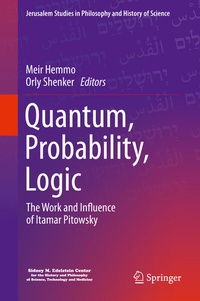
Quantum, Probability, Logic
Description

Chapter 1. Classical logic, classical probability, and quantum mechanics (Samson Abramsky)
Chapter 2. Why Scientific Realists Should Reject the Second Dogma of Quantum Mechanic (Valia Allori)
Chapter 3. Unscrambling Subjective and Epistemic Probabilities (Guido Bacciagaluppi)Chapter 4. Wigner's Friend as a Rational Agent (Veronika Baumann, C?aslav Brukner)
Chapter 5. Pitowsky's Epistemic Interpretation of Quantum Mechanics and the PBR Theorem (Yemima Ben-Menahem)
Chapter 6. On the Mathematical Constitution and Explanation of Physical Facts (Joseph Berkovitz)
Chapter 7. Everettian probabilities, the Deutsch-Wallace theorem and the Principal Principle (Harvey R. Brown, Gal Ben Porath)
Chapter 8. 'Two Dogmas' Redu (Jeffrey Bub)
Chapter 9. Physical Computability Theses (B. Jack Copeland, Oron Shagrir)
Chapter 10. Agents in Healey's Pragmatist Quantum Theory: A Comparison with Pitowsky's Approach to Quantum Mechanics (Mauro Dorato)
Chapter 11. Quantum Mechanics As a Theory of Observables and States and, Thereby, As a Theory of Probability (John Earman, Laura Ruetsche)
Chapter 12. The Measurement Problem and two Dogmas about Quantum Mechanic (Laura Felline)
Chapter 13. There Is More Than One Way to Skin a Cat: Quantum Information Principles In a Finite World(Amit Hagar)
Chapter 14. Is Quantum Mechanics a New Theory of Probability? (Richard Healey)Chapter 15. Quantum Mechanics as a Theory of Probability (Meir Hemmo, Orly Shenker)
Chapter 16. On the Three Types of Bell's Inequalities (Ga´bor Hofer-Szabo´)
Chapter 17. On the Descriptive Power of Probability Logic (Ehud Hrushovski)
Chapter 18. The Argument against Quantum Computers (Gil Kalai)Chapter 19. Why a Relativistic Quantum Mechanical World Must be Indeterministic (Avi Levy, Meir Hemmo)
Chapter 20. Subjectivists about Quantum Probabilities Should be Realists about Quantum States (Wayne C. Myrvold)
Chapter 21. The Relativistic Einstein-Podolsky-Rosen Argument (Michael Redhead)
Chapter 22. What price statistical independence? How Einstein missed the photon.(Simon Saunders)
Chapter 23. How (Maximally) Contextual is Quantum Mechanics? (Andrew W. Simmons)
Chapter 24. Roots and (Re)Sources of Value (In)Definiteness Versus Contextuality (Karl Svozil)
Chapter 25: Schrödinger's Reaction to the EPR Paper (Jos Uffink)
Chapter 26. Derivations of the Born Rule (Lev Vaidman)
Chapter 27. Dynamical States and the Conventionality of (Non-) Classicality (Alexander Wilce).
More details
Other editions
Additional editions
Persons
Meir Hemmo is Professor of Philosophy at the University of Haifa. He has received his Ph.D. from the University of Cambridge in 1996. He is co-author (with Orly Shenker) of the book The Road to Maxwell's Demon: Conceptual Foundations of Statistical Mechanics (Cambridge University Press, 2012), and has published papers on the conceptual foundations of classical and quantum statistical mechanics, the foundations and interpretation of quantum mechanics and relativity theory, and on physicalism in the special sciences and in philosophy of mind.
