

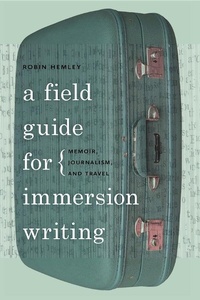
A Field Guide for Immersion Writing
Description

For centuries writers have used participatory experience as a lens through which to better see the world at large and as a means of exploring the self. Considering various types of participatory writing as different strains of one style-immersion writing-Robin Hemley offers new perspectives and practical advice for writers of this nonfiction genre.
Immersion writing can be broken down into the broad categories of travel writing, immersion memoir, and immersion journalism. Using the work of such authors as Barbara Ehrenreich, Hunter S. Thompson, Ted Conover, A. J. Jacobs, Nellie Bly, Julio Cortazar, and James Agee, Hemley examines these three major types of immersion writing and further identifies the subcategories of the quest, the experiment, the investigation, the infiltration, and the reenactment. Included in the book are helpful exercises, models for immersion writing, and a chapter on one of the most fraught subjects for nonfiction writers-the ethics and legalities of writing about other people.
A Field Guide for Immersion Writing recalibrates and redefines the way writers approach their relationship to their subjects. Suitable for beginners and advanced writers, the book provides an enlightening, provocative, and often amusing look at the ways in which nonfiction writers engage with the world around them.
A Friends Fund Publication.
More details
Other editions
Additional editions
Person
Content
- Cover
- Contents
- Acknowledgments
- An Introduction to Immersion Writing: Its Similarities and Differences from the Traditional Memoir and Traditional Journalism
- In Defense of the Vertical Pronoun
- Forms of Immersion
- CHAPTER ONE: Immersion Memoir
- The Reenactment
- The Experiment
- The Infiltration
- The Investigation
- The Quest
- Exercises
- CHAPTER TWO: Immersion Journalism
- The Investigation
- The Reenactment
- The Quest
- The Experiment
- The Infiltration
- Exercises
- CHAPTER THREE: Travel Writing
- The Infiltration
- The Quest
- The Reenactment
- The Investigation or Forensic Journey
- The Experiment
- Exercises
- CHAPTER FOUR: Ethical and Legal Considerations
- Ethics
- Writing about Family and Friends
- Writing about Others
- Exercises
- CHAPTER FIVE: Legwork
- The Proposal
- Magazine Proposals
- A Few Words on the Interview
- The Proposal Reconsidered
- Exercises
- Conclusion: Say What You See
- For Further Reading
