

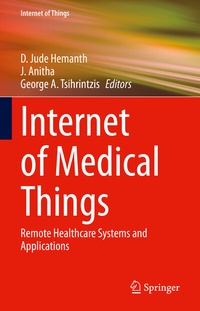
Internet of Medical Things
Description

More details
Other editions
Additional editions
Persons
D. Jude Hemanth, is an Associate Professor in the Electronics and Communications Engineering Department at Karunya University. He received his BE degree in electronics and communications from Bharathiar University, an ME degree in communication systems from Anna University, and his PhD from Karunya University. His research areas include computational intelligence and image processing. Dr. Hemanth has authored more than 130 research papers in international journals and conference proceedings, and has a Cumulative Impact Factor of more than 160. He is the author of the book Artificial Intelligence Techniques for Medical Image Analysis (VDM-Verlag) and editor of 33 books published with Elsevier, Springer, IET, and IOS Press. He serves as an associate editor with Journal of Intelligent and Fuzzy Systems, as an editorial board member and guest editor with a number of international journals, and as series editor of the "Biomedical Engineering" book series (Elsevier). He has delivered more than 100 Keynote lectures at international conferences and workshops, and holds professional membership with IEEE Technical Committee on Neural Networks (IEEE Computational Intelligence Society) and IEEE Technical Committee on Soft Computing (IEEE Systems, Man and Cybernatics Society). Dr. Hemanth also serves as "Research Scientist" of the Computational Intelligence and Information Systems (CI2S) Lab, Argentina, AI Lab, University of Craivo, Romania and RIADI Lab, Tunisia.
J. Anitha, is an Associate Professor in the Electronics and Communications Engineering Department at Karunya University. Her research areas include soft computing, biomedical image processing, and optimization techniques. Dr. Anitha received her BE degree in electronics and communications engineering from Bharathiar University, a ME degree in applied electronics from Anna University, and her PhD from Karunya University. She has published more than 100 research papers in the areaof biomedical engineering
George A. Tsihrintzis , is a Professor in the Department of Informatics at the University of Piraeus, where he is also the Director of the Graduate Program of Study in Advanced Computing and Informatics Systems. He graduated from the National Technical University of Athens with a degree in electrical engineering, followed by an MSc and PhD in electrical and computer engineering from Northeastern University, Boston. His research interests include pattern recognition, decision theory, and statistical signal processing and their applications in multimedia interactive services, user modeling, knowledge-based software systems, human-computer interaction and information retrieval. Dr. Tsihrintzis has authored or co-authored over 300 research publications in these areas, which have appeared in many international journals, book chapters, and conference proceedings, and has served as the principal investigator or co-investigator in several R&D projects.
