

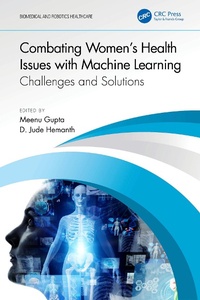
Combating Women's Health Issues with Machine Learning
Challenges and Solutions
1st Edition
Published on 23. October 2023
250 pages
978-1-000-96468-4 (ISBN)
Description

The main focus of this book is the examination of women's health issues and the role machine learning can play as a solution to these challenges. This book will illustrate advanced, innovative techniques/frameworks/concepts/machine learning methodologies, enhancing the future healthcare system. Combating Women's Health Issues with Machine Learning: Challenges and Solutions examines the fundamental concepts and analysis of machine learning algorithms.
The editors and authors of this book examine new approaches for different age-related medical issues that women face. Topics range from diagnosing diseases such as breast and ovarian cancer to using deep learning in prenatal ultrasound diagnosis. The authors also examine the best machine learning classifier for constructing the most accurate predictive model for women's infertility risk. Among the topics discussed are gender differences in type 2 diabetes care and its management as it relates to gender using artificial intelligence. The book also discusses advanced techniques for evaluating and managing cardiovascular disease symptoms, which are more common in women but often overlooked or misdiagnosed by many healthcare providers.
The book concludes by presenting future considerations and challenges in the field of women's health using artificial intelligence. This book is intended for medical researchers, healthcare technicians, scientists, programmers and graduate-level students looking to understand better and develop applications of machine learning/deep learning in healthcare scenarios, especially concerning women's health conditions.
The editors and authors of this book examine new approaches for different age-related medical issues that women face. Topics range from diagnosing diseases such as breast and ovarian cancer to using deep learning in prenatal ultrasound diagnosis. The authors also examine the best machine learning classifier for constructing the most accurate predictive model for women's infertility risk. Among the topics discussed are gender differences in type 2 diabetes care and its management as it relates to gender using artificial intelligence. The book also discusses advanced techniques for evaluating and managing cardiovascular disease symptoms, which are more common in women but often overlooked or misdiagnosed by many healthcare providers.
The book concludes by presenting future considerations and challenges in the field of women's health using artificial intelligence. This book is intended for medical researchers, healthcare technicians, scientists, programmers and graduate-level students looking to understand better and develop applications of machine learning/deep learning in healthcare scenarios, especially concerning women's health conditions.
More details
Series
Edition
1. Auflage
Language
English
Place of publication
London
United Kingdom
Publishing group
Taylor & Francis Ltd
Target group
College/higher education
Professional and scholarly
Illustrations
36 Tables, black and white; 23 Line drawings, color; 4 Line drawings, black and white; 40 Halftones, color; 12 Halftones, black and white; 63 Illustrations, color; 16 Illustrations, black and white
ISBN-13
978-1-000-96468-4 (9781000964684)
Copyright in bibliographic data and cover images is held by Nielsen Book Services Limited or by the publishers or by their respective licensors: all rights reserved.
Schweitzer Classification
Other editions
Additional editions
D. Hemanth | Meenu Gupta
Combating Women's Health Issues with Machine Learning
Challenges and Solutions
Book
04/2025
1st Edition
CRC Press
€76.50
Shipment within 10-20 days
D. Hemanth | Meenu Gupta
Combating Women's Health Issues with Machine Learning
Challenges and Solutions
Book
10/2023
1st Edition
CRC Press
€174.50
Shipment within 10-20 days
Persons
Meenu Gupta is Associate Professor in the UIE-CSE Department at Chandigarh University, India. She completed her PhD in Computer Science and Engineering with an emphasis on Traffic Accident Severity Problems from Ansal University, India, in 2020. She has more than 14 years of teaching experience. Her research areas cover machine learning, intelligent systems and data mining, with a specific interest in artificial intelligence, image processing and analysis, smart cities, data analysis and human/brain-machine interaction (BMI). She has edited five books and authored four engineering books. She reviews several journals, including Big Data, CMC, Scientific Reports and TSP. She is a life member of ISTE and IAENG. She has authored or co-authored more than 30 book chapters and over 80 papers in refereed international journals and conferences.
D. Jude Hemanth is Associate Professor in the Department of ECE at Karunya University, India. He also holds the "Visiting Professor" position in the Faculty of Electrical Engineering and Information Technology at the University of Oradea, Romania. He received his BE degree in ECE from Bharathiar University, India, in 2002, his ME degree in Communication Systems from Anna University, India, in 2006, and his PhD from Karunya University, India, in 2013. His research areas include computational intelligence and image processing, communication systems, biomedical engineering, robotics and healthcare, computational intelligence and information systems, and artificial intelligence. He is also an editor of the Neuroscience Informatics Journal.
D. Jude Hemanth is Associate Professor in the Department of ECE at Karunya University, India. He also holds the "Visiting Professor" position in the Faculty of Electrical Engineering and Information Technology at the University of Oradea, Romania. He received his BE degree in ECE from Bharathiar University, India, in 2002, his ME degree in Communication Systems from Anna University, India, in 2006, and his PhD from Karunya University, India, in 2013. His research areas include computational intelligence and image processing, communication systems, biomedical engineering, robotics and healthcare, computational intelligence and information systems, and artificial intelligence. He is also an editor of the Neuroscience Informatics Journal.
Content
1. Role of Machine Learning in Women's Health: A Review Analysis. 2. Predicting Anxiety, Depression and Stress in Women Using Machine Learning Algorithms. 3. Gender-based Analysis of the Impact of Cardiovascular Disease Using Machine Learning: A Comparative Analysis. 4. Lifestyle and Dietary Management Associated With Chronic Diseases in Women Using Deep Learning. 5. Gender Differences in Diabetes Care and Management using AI. 6. Prenatal Ultrasound Diagnosis Using Deep Learning Approaches. 7. Deep Convolutional Neural Network for the Prediction of Ovarian Cancer. 8. Risk Prediction and Diagnosis of Breast Cancer using ML Algorithms. 9. Comparative Analysis of Machine Learning Algorithms to Diagnose Polycystic Ovary Syndrome. 10. A Comparative Analysis of Machine Learning Approaches in Endometrial Cancer. 11. Machine Learning Algorithm-Based Early Prediction of Diabetes: A New Feature Selection Using Correlation Matrix with Heat Map. 12. Analyzing Factors for Improving Pregnancy Outcomes Using Machine Learning. 13. Future Consideration and Challenges in Women's Health Using AI.
