

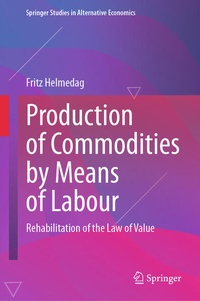
Production of Commodities by Means of Labour
Description

This book revitalises the labour theory of value as a framework for determining production prices and explores its implications for economic theory and policy. Through an in-depth review of economists such as Adam Smith, David Ricardo, Karl Marx, and Piero Sraffa, it uncovers that the profit distribution in proportion to material costs generally prevents the division of labour between separate industries. Instead, it reveals that profit sharing in relation to the labour input - the original productive power - is the only consistent method to establish an equilibrium under conditions of 'free' competition. In addition, profit maximisation in the vertically integrated wage sector, which satisfies demand financed out of wages, leads to a 100 % rate of profit (or rate of exploitation). The associated real unit labour costs amount to 50 %. The remnant 'luxury' department must adapt to this level. Empirical evidence confirms this finding. The author demonstrates that economic theory grounded upon the law of value can offer welfare-enhancing policies. This book will intrigue scholars and students of economics, as well as anyone interested in economic theory and the history of economic thought.
More details
Other editions
Additional editions
Person
Fritz Helmedag has been Full Professor of Economics at Chemnitz University of Technology since March 1993. His research interests encompass competition economics, theories of production, value, and capital, employment, and the history of economic thought.
Content
Chapter 1. Value theory as basic research in economics.- Chapter 2. The classical theory of value: criticism and counter-criticism.- Chapter 3. Production of commodities and the law of value.
