

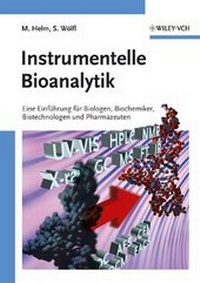
Instrumentelle Bioanalytik
Einführung für Biologen, Biochemiker, Biotechnologen und Pharmazeuten
1st Edition
Published on 6. December 2013
VIII, 230 pages
978-3-527-66204-3 (ISBN)
Description

Aus den modernen Biowissenschaften, der Pharmazie und Medizin ist die instrumentelle Bioanalytik heute nicht mehr wegzudenken. Diese Disziplinen sind inzwischen ganz wesentlich charakterisiert durch immer leistungsstärkere Analysemethoden, die Vorgänge auf molekularer Ebene im Detail sichtbar machen können.
Dieses Buch vermittelt dem Leser auf leicht verständliche und prägnante Weise Grundlagen, Anwendungsmöglichkeiten und auch Grenzen der einzelnen bioanalytischen Techniken und versetzt ihn so in die Lage, kompetent über die Anwendung einer bestimmten Methode für ein gegebenes Problem zu entscheiden.
Jedes Kapitel wird dabei durch praktische Beispiele abgerundet, die typische Fragestellungen illustrieren und mit den jeweiligen Techniken gelöst werden können.
Das Buch wendet sich an Studenten, Diplomanden und Doktoranden der Biotechnologie, Pharmazie, Biologie, Biochemie, Biophysik und Medizin.
Dieses Buch vermittelt dem Leser auf leicht verständliche und prägnante Weise Grundlagen, Anwendungsmöglichkeiten und auch Grenzen der einzelnen bioanalytischen Techniken und versetzt ihn so in die Lage, kompetent über die Anwendung einer bestimmten Methode für ein gegebenes Problem zu entscheiden.
Jedes Kapitel wird dabei durch praktische Beispiele abgerundet, die typische Fragestellungen illustrieren und mit den jeweiligen Techniken gelöst werden können.
Das Buch wendet sich an Studenten, Diplomanden und Doktoranden der Biotechnologie, Pharmazie, Biologie, Biochemie, Biophysik und Medizin.
Reviews / Votes
"Die Erstauflage ist didaktisch übersichtlich gegliedert und auf dem Stand der Technik...Die Autoren sind um das Wesentliche, ein prinzipielles Verständnis einzelner Methoden bemüht."Chemiereport.at
More details
Other editions
Additional editions
Mark Helm | Stefan Wölfl
Instrumentelle Bioanalytik
Einführung für Biologen, Biochemiker, Biotechnologen und Pharmazeuten
Book
11/2006
1st Edition
Wiley-Blackwell
€48.90
Article exhausted; check different version
Persons
Mark Helm, Jahrgang 1969, studierte Chemie an der Julius-Maximilians-Universität in Würzburg und promovierte 1999 an der Université Louis Pasteur in Straßburg im Fach Molekularbiologie. Nach einem zweijährigen Aufenthalt im Department of Biology am California Institut of Technology in Pasadena forschte er ein Jahr am Institut für Biochemie der Freien Universität Berlin. Seit 2002 ist er Forschungsgruppenleiter am Institut für Pharmazie und Molekulare Biotechnologie der Ruprecht-Karls-Universität Heidelberg, wo er vor allem Instrumentelle Analytik und Bioanalytik lehrt.
Stefan Wölfl, Jahrgang 1959, studierte Pharmazie an der Freien Universität Berlin (Approbation als Apotheker 1985) und promovierte dort 1990 im Fach Biochemie. Nach vier Jahren Forschung als Postdoc am Massachusetts Institute of Technology in Cambridge, USA, arbeitete Stefan Wölfl als Forschungsgruppenleiter am Hans-Knöll-Institut für Naturstoffforschung und am Klinikum der Friedrich-Schiller-Universität Jena. Seit 2003 ist Stefan Wölfl Professor für Pharmazeutische Biologie mit Ausrichtung Bioanalytik und Molekularbiologie am Institut für Pharmazie und Molekulare Biotechnologie der Ruprecht-Karls-Universität Heidelberg und lehrt in den Studiengängen Pharmazie und Molekulare Biotechnologie.
Stefan Wölfl, Jahrgang 1959, studierte Pharmazie an der Freien Universität Berlin (Approbation als Apotheker 1985) und promovierte dort 1990 im Fach Biochemie. Nach vier Jahren Forschung als Postdoc am Massachusetts Institute of Technology in Cambridge, USA, arbeitete Stefan Wölfl als Forschungsgruppenleiter am Hans-Knöll-Institut für Naturstoffforschung und am Klinikum der Friedrich-Schiller-Universität Jena. Seit 2003 ist Stefan Wölfl Professor für Pharmazeutische Biologie mit Ausrichtung Bioanalytik und Molekularbiologie am Institut für Pharmazie und Molekulare Biotechnologie der Ruprecht-Karls-Universität Heidelberg und lehrt in den Studiengängen Pharmazie und Molekulare Biotechnologie.
Content
Vorwort
SPEKTROSKOPIE
Physikalische Grundlagen
SPEKTROSKOPISCHE METHODEN GEORDNET NACH ABSTEIGENDER ENERGIE
UV-VIS und Fluoreszenz
Mikrowellen, IR und Raman
NMR
NICHTSPEKTROSKOPISCHE METHODEN ELEKTROMAGNETISCHER STRAHLUNG
Kristallographie
Polarimetrie
TRENNUNGSMETHODEN
Chromatographie
Elektrophorese
MASSENSPEKTROSKOPIE
BIOSENSOREN UND BIOLOGISCHE SENSOREN
Biosensoren
Biologische Sensoren, Enzymreaktionen, zelluläre Biosensoren
SPEKTROSKOPIE
Physikalische Grundlagen
SPEKTROSKOPISCHE METHODEN GEORDNET NACH ABSTEIGENDER ENERGIE
UV-VIS und Fluoreszenz
Mikrowellen, IR und Raman
NMR
NICHTSPEKTROSKOPISCHE METHODEN ELEKTROMAGNETISCHER STRAHLUNG
Kristallographie
Polarimetrie
TRENNUNGSMETHODEN
Chromatographie
Elektrophorese
MASSENSPEKTROSKOPIE
BIOSENSOREN UND BIOLOGISCHE SENSOREN
Biosensoren
Biologische Sensoren, Enzymreaktionen, zelluläre Biosensoren
