

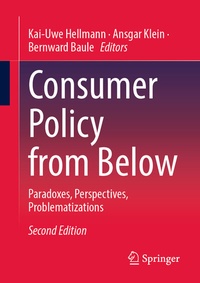
Consumer Policy from Below
Description

Since its existence in the 1950s, consumer policy in Germany has been understood and pursued primarily as a bundle of actions and measures initiated and institutionalised by the state. In many cases, the state has also issued corresponding mandates and set up support models, which has created the impression that we are basically dealing with a 'consumer policy from above' imposed by macro-politics. Not that there have not been repeated attempts in the past decades to give impetus to consumer policy from the middle of civil society - often in the form of small citizens' initiatives. And in recent years in particular, a number of new consumer organisations have emerged which operate much closer to the grass roots. Nevertheless, the impression seems to have taken root among the large, government-related 'players' in the field, who have been in the 'business' for decades, not to mention government-internal consumer policy, that consumer policy concerns a policy field that is essentiallyordered by a collaboration of the state on the one hand, and consumer protection organisations representing all consumers equally on the other, while the many small consumer initiatives, not even started by individual committed consumers, regularly fall behind in comparison. This perspective refers largely to the view of and from the centre of politics. This volume is intended to go some way towards countering the institutionally prevailing impression that, in principle, there is only 'consumer policy from above' that is really effective and assertive.
The translation was done with the help of artificial intelligence. A subsequent human revision was done primarily in terms of content.
More details
Other editions
Additional editions
Persons
Apl. Prof. Dr. Kai-Uwe Hellmann teaches consumer and economic sociology at the Institute of Sociology at the Technical University of Berlin.
PD Dr. Ansgar Klein is Managing Director of the Federal Network for Civic Engagement (BBE).
Bernward Baule worked at the Federal Ministry of Justice and Consumer Protection with a focus on consumer research/consumer education and is a freelance author.
Content
The responsible consumer as an outdated model? - Political consumption and political participation.- Responsibility and accountability.- The cultural-moral dimension of consumption.- Actors, activists, initiatives, organizations and associations.
