

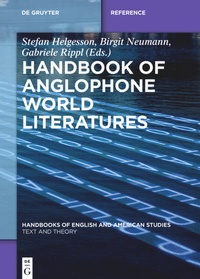
Handbook of Anglophone World Literatures
Description

The Handbook of Anglophone World Literatures is the first globally comprehensive attempt to chart the rich field of world literatures in English. Part I navigates different usages of the term 'world literature' from an historical point of view. Part II discusses a range of theoretical and methodological approaches to world literature. This is also where the handbook's conceptualisation of 'Anglophone world literatures' - in the plural - is developed and interrogated in juxtaposition with proximate fields of inquiry such as postcolonialism, translation studies, memory studies and environmental humanities. Part III charts sociological approaches to Anglophone world literatures, considering their commodification, distribution, translation and canonisation on the international book market. Part IV, finally, is dedicated to the geographies of Anglophone world literatures and provides sample interpretations of literary texts written in English.
Reviews / Votes
"Diese selbstbewusst-bescheidene Heterogenität, Dynamik und Unabgeschlossenheit rückt das Handbuch der anglophonen Weltliteraturen der von Verlagen - und so auch von De Gruyters Reihe Handbooks of English and American Studies, Text and Theory - oftmals eingeforderten und nur selten erreichten breiten Zielgruppenansprache - Bachelorstudierende in den ersten Semestern ebenso wie erfahrene Wissenschaftler*innen - schon sehr nahe. Es dürfte, wenn nicht für alle, so doch für sehr viele Weltliteraturinteressierte etwas dabei sein; nicht zuletzt auch für jene traditionellen Komparatist*innen, die mit Weltliteraturen in mehreren Sprachen arbeiten und der Anglisierung der Welt höchst skeptisch gegenüberstehen." Sandra Folie in: literaturkritik.de, https://literaturkritik.de/rippl-neumann-helgesson-handbook-of-anglophone-world-literatures,27574.html (11.02.2021)More details
Other editions
Additional editions
Persons
Stefan Helgesson , University of Stockholm, Birgit Neumann , Heinrich Heine University, Düsseldorf; Gabriele Rippl, University of Berne.
Content
- Intro
- Editors' Preface
- Contents
- 0 Introduction
- Part I: Historical Approaches - Genealogies of World Literatures
- 1 The Beginnings of the Concept (Goethe, Marx, Said) - Readings from a Postcolonial Perspective
- 2 Re-Reading Classical Approaches from a Postcolonial Perspective: Pascale Casanova, Franco Moretti, David Damrosch
- 3 Macaulay's Magic Hat: The Colonial Education System and the Canon of World Literature
- 4 The King's English and the Mother Tongue
- 5 Rethinking English Studies
- Part II: Concepts and Methods of Anglophone World Literatures
- 6 Global Literature, World Literature and Worlding Literature: Some Conceptual Differences
- 7 Barbarians: Cosmopolitanism Beyond the Center-Periphery Model
- 8 Anglophone World Literatures and World Ecologies (Environmental Humanities)
- 9 Anglophone World Literatures and Transcultural Memory
- 10 Anglophone World Literatures and Translation
- 11 Comparative Literature
- 12 Genres of Anglophone World Literatures
- 13 Decolonizing World Literature through Orality
- 14 Intermediality and Remediation
- Part III: Sociological Approaches - Distribution, Reception and Translation of Anglophone World Literature
- 15 Marketing Anglophone World Literatures
- 16 Canons and Canonicity in Anglophone Literature
- 17 Teaching Anglophone World Literature
- 18 Anglophone World Literatures, the Internet and the Digital Humanities
- Part IV: Literary Worlds - Locations and Orientations
- 19 Britain
- 20 Ireland
- 21 USA
- 22 Canada
- 23 The Oceans
- 24 The Caribbean
- 25 Southern Africa
- 26 West Africa
- 27 East Africa
- 28 South Asia
- 29 Southeast Asia (Hong Kong and Singapore)
- 30 Australia
- 31 New Zealand Literature and the World
- Name Index
- Subject Index
- List of Contributors
