

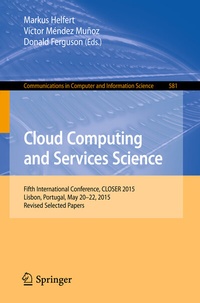
Cloud Computing and Services Science
5th International Conference, CLOSER 2015, Lisbon, Portugal, May 20-22, 2015, Revised Selected Papers
Published on 5. February 2016
XIV, 299 pages
978-3-319-29582-4 (ISBN)
Description

This book constitutes the thoroughly refereed proceedings of the 5th International Conference on Cloud Computing and Services Science, CLOSER 2015, held in Lisbon, Portugal, in May 2015.
The 14 revised full papers presented together with one invited paper were selected from 146 paper submissions. The papers focus on the following topics: cloud computing fundamentals; services science foundations for cloud computing; cloud computing platforms and applications; cloud computing enabling technologies; and mobile cloud computing services.
More details
Series
Edition
1st ed. 2016
Language
English
Place of publication
Cham
Switzerland
Publishing group
Springer International Publishing
Target group
Professional and scholarly
Product notice
Reflowable
Illustrations
XIV, 299 p. 91 illus.
File size
21,82 MB
ISBN-13
978-3-319-29582-4 (9783319295824)
DOI
10.1007/978-3-319-29582-4
Schweitzer Classification
Other editions
Additional editions
Markus Helfert | Víctor Méndez Muñoz | Donald Ferguson
Cloud Computing and Services Science
5th International Conference, CLOSER 2015, Lisbon, Portugal, May 20-22, 2015, Revised Selected Papers
Book
02/2016
Springer
€53.49
Shipment within 10-15 days
Content
- Intro
- Preface
- Organization
- Contents
- Invited Paper
- Cloud Computing at the Edges
- 1 Introduction and Overview
- 2 Related Approaches
- 3 Common Themes
- 3.1 Architecture and Deployment
- 3.2 Virtualisation
- 3.3 Data Migration and Management
- 4 Business Models
- 5 Application Scenarios
- 6 Conclusion
- References
- Papers
- Scalable and Cost-Efficient Algorithms for Reliable and Distributed Cloud Storage
- 1 Introduction
- 1.1 Paper Contributions and Structure
- 2 Related Work
- 3 System Model
- 3.1 Data Placement Cost Minimization: B-Matching Formulation
- 3.2 Data Placement and Network Latency Minimization: Commodity Flow Modeling
- 3.3 Data Replication Algorithm
- 3.4 Data Chunk Splitting
- 4 Numerical Results
- 4.1 Simulation Environment
- 4.2 Performance Evaluation
- 5 Summary and Future Work
- References
- Accountability Through Transparency for Cloud Customers
- 1 Introduction
- 2 Related Work
- 3 Method
- 4 Results
- 5 Transparency Tools
- 5.1 The Data Track Tool
- 5.2 Visualizing Data Disclosures
- 5.3 User Evaluations of the Data Track's UI
- 6 Discussion
- 7 Conclusions
- A List of Requirements from Transparency Interviews
- A.1 What is Possible to do with the Data
- A.2 Conformance to Data Agreement
- A.3 Data Handling
- A.4 Value Chain
- A.5 Multi-tenant Services
- A.6 Protection of the Data
- A.7 Decisions
- A.8 Correction of the Data
- References
- Towards a Standardized Quality Assessment Framework for OCCI-Controlled Cloud Infrastructures
- Abstract
- 1 Introduction
- 2 Toward a Standardized Cloud Quality Assessment Framework
- 2.1 NIST CC Program
- 2.2 ETSI CSC
- 3 ETSI NFV, SDN and the Cloud
- 4 OCCI
- 5 OCCI-Related Effort
- 5.1 OCCI Technical Versatility
- 5.2 OCCI in Large Infrastructures
- 6 TTCN-3
- 7 TTCN-3 Related Effort
- 7.1 TTCN-3 Development
- 7.2 TTCN-3 in the ETSI TC MTS
- 8 TTCN-3 and OCCI
- 8.1 TTCN-3 and OCCI Mapping
- 8.2 TTCN-3 and ``Bonfire OCCI''
- 9 Summary and Future Work
- Acknowledgements
- References
- Re-provisioning of Cloud-Based Execution Infrastructure Using the Cloud-Aware Provenance to Facilitate Scientific Workflow Execution Reproducibility
- 1 Introduction
- 2 Related Work
- 3 Requirements for Workflow Reproducibility on Cloud
- 4 ReCAP: Workflow Reproducibility Using Cloud-Aware Provenance
- 4.1 Cloud Usage Scenarios
- 4.2 Static Mapping Approach
- 4.3 Eager Mapping Approach
- 4.4 Workflow Reproducibility Using ReCAP
- 4.5 Workflow Output Comparison
- 5 Results and Discussion
- 6 Conclusion and Future Direction
- References
- Security and Privacy Preservation of Evidence in Cloud Accountability Audits
- 1 Introduction
- 2 Related Work
- 3 Insynd
- 4 Audit Agent System
- 4.1 Privacy and Accountability Cloud Audit System Actors
- 4.2 Architectural Components Audit Agent System
- 5 Audit Evidence Storage Requirements
- 5.1 Requirements of Digital Evidence
- 5.2 Privacy Requirements
- 6 Secure Evidence Storage Architecture
- 6.1 Architecture
- 6.2 Identity Management and Key Distribution
- 7 Evaluation
- 7.1 Scenario
- 7.2 Implementation
- 7.3 Threat Model
- 7.4 Requirements Evaluation
- 7.5 Scalability
- 8 Conclusion and Future Work
- References
- Using Model-Driven Development to Support Portable PaaS Applications
- 1 Introduction
- 2 Background
- 2.1 The Lock-in Problem
- 2.2 Types of Portability
- 2.3 Model-Driven Engineering (MDE)
- 2.4 A Model-Driven Approach for Cloud PaaS Portability
- 3 Persistence in PaaS
- 3.1 Google App Engine
- 3.2 Windows Azure
- 3.3 Difficulties in Conciliating both Persistence Models
- 4 Supporting Multiple Persistence Models Using MDE
- 4.1 Generating Persistence Code for GAE
- 4.2 Generating Persistence Code for Azure
- 5 Evaluation
- 5.1 Planning
- 5.2 Execution
- 5.3 Data Analysis
- 5.4 Threats to Validity
- 6 Related Work
- 7 Concluding Remarks and Future Work
- References
- LS-ADT: Lightweight and Scalable Anomaly Detection for Cloud Datacentres
- 1 Introduction
- 2 Background and Related Work
- 2.1 Anomaly Detection Challenges
- 2.2 Console Log Based Anomaly Detection
- 2.3 System Metric Based Anomaly Detection
- 3 LADT Architecture
- 3.1 Metrics Data Monitoring
- 3.2 Metrics Data Analysis
- 4 LADT Hypothesis and Algorithm
- 4.1 LFD: The Baseline Method
- 4.2 LADT Hypothesis
- 4.3 LADT Algorithm
- 4.4 Console Log Analysis
- 5 Experimental Evaluation
- 5.1 Experimental Set-Up
- 5.2 Results and Discussion
- 5.3 Textual Log Analysis
- 5.4 LADT Overhead
- 5.5 Further Analysis
- 6 Conclusion and Future Work
- References
- Performance and Cost Trade-Off in IaaS Environments: A Scientific Workflow Simulation Environment Case Study
- 1 Introduction
- 2 Motivation and Problem Statement
- 3 The OPAL Simulation Environment
- 4 Experiments
- 4.1 Methodology
- 4.2 Setup
- 4.3 Evaluation Results
- 4.4 Discussion
- 5 Related Works
- 6 Conclusion and Future Work
- References
- A Practical Evaluation of Searchable Encryption for Data Archives in the Cloud
- 1 Introduction
- 2 Related Work
- 3 The Z-IDX Scheme
- 3.1 Bloom Filters
- 3.2 Gohs Secure Indexes
- 4 Searchable Encryption in MongoDB
- 4.1 Selection of a Database System
- 4.2 Extended MongoDB Commands
- 4.3 Architecture and Implementation
- 5 Performance Evaluation
- 5.1 Filter Blinding vs. Performance
- 5.2 Memory Footprint of Z-IDX Filters
- 5.3 Query Performance
- 5.4 Implications for Practical Use
- 6 Security
- 6.1 Threats to Keyword Confidentiality
- 6.2 Attacks on the Client
- 6.3 Network Data Sniffing
- 6.4 Attacks on the Server
- 6.5 Implications for Practical Use
- 7 Conclusion
- References
- High Level Model Checker Based Testing of Electronic Contracts
- 1 Introduction
- 2 Background
- 2.1 ROP Ontology
- 2.2 Choreography of Interaction
- 2.3 Electronic Contracts
- 2.4 Contract Compliance Within the CCC Monitor
- 2.5 Exception Handling
- 3 Model Checker Based Testing Framework
- 3.1 EPROMELA Interaction Model
- 3.2 Model Construction and Verification
- 3.3 The LTL Manager
- 3.4 Generating the Test Sequences
- 3.5 Sequence Parsing
- 3.6 Testing the Electronic Contract
- 3.7 Testing None Compliant Events
- 3.8 Accounting for Exceptional Outcome Events
- 4 Related Work
- 5 Conclusion and Future Work
- References
- Streamlining APIfication by Generating APIs for Diverse Executables Using Any2API
- 1 Introduction
- 2 Problem Statement and Use Case
- 2.1 Use Case: Deployment Automation
- 2.2 Motivating Scenario: Facebook App
- 3 APIfication Method
- 4 APIfication Framework
- 5 Validation and Evaluation
- 5.1 Any2API Implementation
- 5.2 Tests
- 5.3 Measurements
- 5.4 Deployment Automation Case Study
- 6 Further Use Cases
- 6.1 Cyberinfrastructure and e-Science
- 6.2 Treat API Endpoints as Executables
- 6.3 API Libraries
- 6.4 Microservice Architectures
- 7 Related Work
- 8 Conclusion
- References
- Hybrid TOSCA Provisioning Plans: Integrating Declarative and Imperative Cloud Application Provisioning Technologies
- 1 Introduction
- 2 State of the Art Analysis
- 2.1 The Declarative Flavor
- 2.2 The Imperative Flavor
- 2.3 Combination Approaches
- 3 A Hybrid Modelling Concept
- 3.1 Declarative Provisioning Activities
- 3.2 Internal Data Handling
- 4 Realization Using BPEL
- 5 Accessing External Data Based on TOSCA
- 5.1 An Overview of TOSCA
- 5.2 Referencing Properties in Hybrid TOSCA Provisioning Plans
- 5.3 Illustration of the Concept
- 5.4 Extending BPEL by TOSCA Property References
- 6 Standards-Based Prototype
- 7 Evaluation
- 7.1 Limitations
- 8 Conclusion
- References
- An Analysis of Power Consumption in Mobile Cloud Computing
- 1 Introduction
- 1.1 Paper Organization
- 2 Current Approaches for Power Saving in Mobile Cloud Computing
- 2.1 Cloudlets
- 2.2 Context-Aware Offloading
- 3 Mobile Cloud Gaming
- 4 Cellular-Based vs. WiFi-Based Mobile Cloud Gaming
- 4.1 Power Consumption and Throughput
- 4.2 Latency
- 4.3 Cost
- 5 Power Consumption Trends in Modern Mobile GPUs
- 6 Power Consumption Trends in Modern Notebook NICs
- 7 Graphics-Intensive Applications: GPUs vs. NICs
- 7.1 Scenario 1: Gaming Using the Mobile Device's GPU
- 7.2 Scenario 2: Mobile Cloud Gaming
- 8 Mobile Cloud Gaming Using Smartphones
- 8.1 Power Consumption of GPU-Based Gaming on Smartphones
- 8.2 Power Consumption of Cloud-Based Gaming on Smartphones
- 9 Conclusion
- References
- Using Satellite Execution to Reduce Latency for Mobile/Cloud Applications
- 1 Introduction
- 2 Background
- 3 Dapper
- 3.1 Implementation
- 4 Evaluation
- 5 Related Work
- 6 Conclusion
- References
- Author Index
