

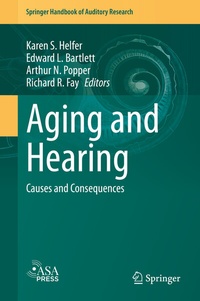
Aging and Hearing
Description

Since the first edition of the Aging Auditory System volume (in 2009), there has been a tremendous amount of research in basic, translational, and clinical sciences related to age-related changes in auditory system structure and function. The new research has been driven by technical and conceptual advances in auditory neuroscience at multiple levels ranging from cells to cognition. The chapters in Aging and Hearing: Causes and Consequences span a broad range of topics and appeal to a relatively wide audience. Our goal in this volume is to put together state-of-the-art discussions about new developments in aging research that will appeal to a broad audience, serving as an important update on the current state of research on the aging auditory system. This update includes not only the recent research, but also consideration of how human and animal studies or translational and basic research are working in tandem to advance the field. This new edition is a natural complement to the previous SHAR volume on the aging auditory system edited by Gordon-Salant, Frisina, Popper, and Fay.
The target audience for this volume will be graduate students, researchers, and academic faculty from a range of disciplines (psychology, hearing science/audiology, physiology, neuroscience, engineering). It also will appeal to clinical audiologists as well as to researchers working in the hearing device industry. Individuals who attend conferences sponsored by the Association for Research in Otolaryngology, Acoustical Society of America, Auditory Cognitive Neuroscience Society, American Auditory Society, Society for Neuroscience, American Speech, Language and Hearing Association, and the American Academy of Audiology (among others) are likely to find value in the volume.
More details
Other editions
Additional editions
Persons
Dr. Karen S. Helfer is Professor and Chair of the Communication Disorders department at the University of Massachusetts Amherst. She received her Ph.D. in Hearing Science from Northwestern University. Her research program (which is funded by NIDCD) focuses on identifying age-related changes in speech understanding.
Dr. Edward L. Bartlett is a Professor in Biological Sciences and Biomedical Engineering at Purdue University. He received his Ph.D. in Neuroscience from the Neuroscience Training Program at the University of Wisconsin-Madison. His research program focuses on neural processing in the central auditory system, including diagnostics and changes in neural processing underlying age-related hearing deficits.
Drs. Helfer and Bartlett are both productive researchers in the field of age-related auditory changes. Dr. Helfer's lab is devoted to measuring hearing and cognitive changes in humans via behavioral research, while Dr. Bartlett uses mainly rodent models to investigate population, circuit and cellular changes with aging. Dr. Arthur N. Popper is Professor Emeritus and research professor in the Department of Biology at the University of Maryland, College Park.Dr. Richard R. Fay is Distinguished Research Professor of Psychology at Loyola, Chicago.
Content
Ch 1: Listening to All Voices: Interdisciplinary Approaches to Understanding Hearing in Aging.- Ch 2: Genetic and Molecular Aspects of the Aging Auditory System.- Ch 3: The Aging Cochlea and Auditory Nerve.- Ch 4: Age-Related Changes in the Auditory Brainstem and Inferior Colliculus .- Ch 5: Age related changes in the primate auditory cortex.- Ch 6: The Aging Auditory System: Electrophysiology.- Ch 7: Age-Related Changes in Segregation of Sound Sources.- Ch 8: Causes and Consequences of Age-Related Hearing Loss.- Ch 9: Age-Related Changes in Speech Understanding: Peripheral versus Cognitive Influences.- Ch 10: Aging, Hearing Loss, and Listening Effort: Imaging Studies of the Aging Listener.- Ch 11: Functional Consequences of Impaired Hearing in Older Adults and Implications for Intervention.- Ch 12: Emerging Clinical Translational Treatment Strategies for Age-Related Hearing Loss.
