

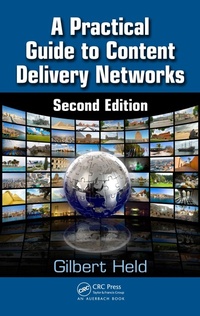
A Practical Guide to Content Delivery Networks
2nd Edition
Published on 12. October 2010
304 pages
978-1-4398-3589-0 (ISBN)
Description

Following in the tradition of its popular predecessor, A Practical Guide to Content Delivery Networks, Second Edition offers an accessible and organized approach to implementing networks capable of handling the increasing data requirements of today'salways on mobile society. Describing how content delivery networks (CDN) function, it provides an understanding of Web architecture, as well as an overview of the TCP/IP protocol suite.
The book reports on the development of the technologies that have evolved over the past decade as distribution mechanisms for various types of Web content. Using a structural and visual approach, it provides step-by-step guidance through the process of setting up a scalable CDN.
Supplies a clear understanding of the framework and individual layers of design, including caching and load balancing
Describes the terminology, tactics, and potential problems when implementing a CDN
Examines cost-effective ways to load balance web service layers
Explains how application servers connect to databases and how systems will scale as volume increases
Illustrates the impact of video on data storage and delivery, as well as the need for data compression
Covers Flash and the emerging HTML5 standard for video
Highlighting the advantages and disadvantages associated with these types of networks, the book explains how to use the networks within the Internet operated by various ISPs as mechanisms for effectively delivering Web server based information. It emphasizes a best-of-breed approach to building your network to allow for an effective CDN to be built on practically any budget. To help you get started, this vendor-neutral reference explains how to code Web pages to optimize the delivery of various types of media. It also includes examples of successful approaches, from outsourcing to do it yourself.
The book reports on the development of the technologies that have evolved over the past decade as distribution mechanisms for various types of Web content. Using a structural and visual approach, it provides step-by-step guidance through the process of setting up a scalable CDN.
Supplies a clear understanding of the framework and individual layers of design, including caching and load balancing
Describes the terminology, tactics, and potential problems when implementing a CDN
Examines cost-effective ways to load balance web service layers
Explains how application servers connect to databases and how systems will scale as volume increases
Illustrates the impact of video on data storage and delivery, as well as the need for data compression
Covers Flash and the emerging HTML5 standard for video
Highlighting the advantages and disadvantages associated with these types of networks, the book explains how to use the networks within the Internet operated by various ISPs as mechanisms for effectively delivering Web server based information. It emphasizes a best-of-breed approach to building your network to allow for an effective CDN to be built on practically any budget. To help you get started, this vendor-neutral reference explains how to code Web pages to optimize the delivery of various types of media. It also includes examples of successful approaches, from outsourcing to do it yourself.
Reviews / Votes
Held, a networking expert and lecturer, presents this guide to the principles of content delivery networks (CDN). Built to provide multiple, easily accessible nodes for dispensing high bandwidth content (web video for instance) without overloading internet backbone capacities, CDNs help reduce the bottlenecks that occur when popular content resides on a single over-accessed server. This volume begins with an overview of client and server models of information networking and the TCP/IP Internet protocols and proceeds through an examination of the CDN model, caching and load balancing and concludes with a discussion of CDN in an enterprise setting and web hosting options with CDN. Intended for network architects and server administrators, this second edition includes extended information on web video including Flash and new HTML 5 standards.-In Research Book News, booknews.com, February 2011More details
Edition
2nd edition
Language
English
Place of publication
Baton Rouge
United States
Publishing group
Taylor & Francis Inc
Target group
Professional and scholarly
Multimedia service providers (telecom), Internet designers, developers, administrators, network engineers, designers, and systems administrators.
Edition type
Revised edition
Illustrations
78 s/w Abbildungen, 36 s/w Tabellen
78 b/w images and 36 tables
ISBN-13
978-1-4398-3589-0 (9781439835890)
Copyright in bibliographic data and cover images is held by Nielsen Book Services Limited or by the publishers or by their respective licensors: all rights reserved.
Schweitzer Classification
Other editions
Additional editions
Gilbert Held
A Practical Guide to Content Delivery Networks
Book
09/2018
2nd Edition
CRC Press
€89.00
Shipment within 10-20 days
Gilbert Held
A Practical Guide to Content Delivery Networks
Book
10/2010
2nd Edition
CRC Press
€126.80
Shipment within 15-20 days
Person
Gilbert Held is an award winning author, lecturer and educator. Gil graduated from Pennsylvania Military College, earning a BS in Electrical Engineering. In 1966 Gil earned a MSEE degree from the New York University School of Engineering and Science, and received an MSTM and MBA degrees from The American University in Washington, DC.
Gil was Chief of Data Communications for the US Office of Personnel Management for 20 years, until a reorganization and consolidation of data centers resulted in the closing of the Macon Data Center. Gil remained on staff in Macon and was tasked with developing OPM's Web presence on the Internet and was responsible for designing, acquiring and constructing OPM's presence on the Internet for which he received the Directors Award.
Between 1977 and the present Gil has authored over 100 technical books covering personal computing, data communications and business In addition, Gil authored over 500 technical articles and for 17 years has served as the Editor in Chief of the Wiley International Journal of Network Management. In recognition of his excellence in writing Gil twice was awarded the Interface Karp award. Gil has also received a variety of awards ranging from various charities to different publishers, such as Federal Week which considered him as one of the top 50 persons in Government and Academia.
In addition to authoring books, Gil has taught 14 different graduate level courses and was selected by the Vice President to represent the United States at the Popov Conference in Moscow and represented the United States at the Jerusalem Conference on Information Technology. Gil has appeared on the NBC Evening News and his technical book sales have exceeded a million copies.
Gil was Chief of Data Communications for the US Office of Personnel Management for 20 years, until a reorganization and consolidation of data centers resulted in the closing of the Macon Data Center. Gil remained on staff in Macon and was tasked with developing OPM's Web presence on the Internet and was responsible for designing, acquiring and constructing OPM's presence on the Internet for which he received the Directors Award.
Between 1977 and the present Gil has authored over 100 technical books covering personal computing, data communications and business In addition, Gil authored over 500 technical articles and for 17 years has served as the Editor in Chief of the Wiley International Journal of Network Management. In recognition of his excellence in writing Gil twice was awarded the Interface Karp award. Gil has also received a variety of awards ranging from various charities to different publishers, such as Federal Week which considered him as one of the top 50 persons in Government and Academia.
In addition to authoring books, Gil has taught 14 different graduate level courses and was selected by the Vice President to represent the United States at the Popov Conference in Moscow and represented the United States at the Jerusalem Conference on Information Technology. Gil has appeared on the NBC Evening News and his technical book sales have exceeded a million copies.
Content
Introduction to content delivery networking. Client-Server models. Understanding TCP/IP. The CDN model. Caching and load balancing. The CDN enterprise model. Web hosting options.
