

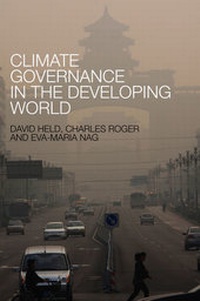
Climate Governance in the Developing World
Description

In this book, an international group of scholars seeks to address these questions by analyzing the experiences of twelve states from across Asia, the Americas and Africa. The authors map the evolution of climate policies in each country and examine the complex array of actors, interests, institutions and ideas that has shaped their approaches. Offering the most comprehensive analysis thus far of the unique challenges that developing countries face in the domain of climate change, Climate Governance in the Developing World reveals the political, economic and environmental realities that underpin the pledges made by developing states, and which together determine the chances of success and failure.
More details
Other editions
Additional editions
Persons
Eva-Maria Nag is the Executive Editor of Global Policy at the London School of Economics and Political Science.
Charles Roger is a PhD student at the University of British Columbia and Liu Scholar at the Liu Institute for Global Issues.
Content
Preface xi
Abbreviations xiii
1. Editors' Introduction: Climate Governance in theDeveloping World 1
David Held, Charles Roger and Eva-Maria Nag
Part I Asia
2. A Green Revolution: China's Governance of Energy andClimate Change 29
David Held, Charles Roger and Eva-Maria Nag
3. The Evolution of Climate Policy in India: Poverty and GlobalAmbition in Tension 53
Aaron Atteridge
4. The Dynamics of Climate Change Governance in Indonesia72
Budy P. Resosudarmo, Fitrian Ardiansyah and LucentezzaNapitupulu
5. Low Carbon Green Growth and Climate Change Governance inSouth Korea 91
Jae-Seung Lee
Part II Americas
6. Discounting the Future: The Politics of Climate Change inArgentina 113
Matías Franchini and Eduardo Viola
7. Controlling the Amazon: Brazil's Evolving Response toClimate Change 134
David Held, Charles Roger and Eva-Maria Nag
8. Making 'Peace with Nature': Costa Rica'sCampaign for Climate Neutrality 155
Robert Fletcher
9. A Climate Leader? The Politics and Practice of ClimateGovernance in Mexico 174
Simone Pulver
Part III Africa
10. Resources and Revenues: The Political Economy of ClimateInitiatives in Egypt 199
Jeannie Sowers
11. Ethiopia's Path to a Climate-Resilient Green Economy218
David Held, Charles Roger and Eva-Maria Nag
12. Reducing Climate Change Vulnerability in Mozambique: FromPolicy to Practice 238
Angus Hervey and Jessica Blythe
13. Reaching the Crossroads: The Development of ClimateGovernance in South Africa 258
Lesley Masters
Index 277
Contributors
Fitrian Ardiansyah has over fifteen years’ experience in the fields of natural resource management, climate change and energy. At present, he is finalizing his doctoral research at the Crawford School of Public Policy at the Australian National University. He is also the Program Development Director for Pelangi Indonesia and Fellow at the International League of Conservation Writers. In previous years, he was a Program Director for Climate and Energy (WWF-Indonesia) and an expert member of the Indonesia Forest Climate Alliance and the Indonesian Official Delegates to the United Nations Framework Convention on Climate Change. He has received Australian Leadership and Allison Sudradjat Awards from the Government of Australia.
Aaron Atteridge is a Research Fellow at the Stockholm Environment Institute in Sweden. His work focuses on different aspects of climate policy, with a particular emphasis on understanding the interaction between international policy processes and the needs of developing countries. This includes analysis of climate politics in different countries and of climate finance, as well as the development of guidance on national adaptation planning and the examination of traditional biomass energy economies in developing countries. Among his previous roles, he has worked as a Senior Policy Officer on climate change and energy issues for the New South Wales government in Australia.
Jessica Blythe is a PhD candidate in the Department of Geography at the University of Victoria, Canada. She investigates the dynamics of change in social-ecological systems and has worked with fishing communities in southern Africa since 2004. Her current research explores how coastal communities respond to environmental change in Mozambique in order to contribute to the development of adaptive actions that promote human well-being and ecological health.
Robert Fletcher is Associate Professor of Natural Resources and Sustainable Development in the Department of Environment, Peace, and Security at the United Nations mandated University for Peace in Costa Rica. His research interests include climate change, conservation, development, ecotourism, environmental governance, globalization, and resistance and social movements. He has conducted field research concerning these topics in a number of sites in North, Central and South America.
Matías Franchini is a member of the Brazilian Research Network on International Relations and Climate Change at the University of Brasilia, and a member of the Department of Environment at the University of La Plata, Argentina. He is a PhD candidate and holds an MA in International Relations from the University of Brasilia. His main research interests are climate change, global environmental governance and Latin American studies. With Eduardo Viola and Thaís Ribeiro, he is co-author of Sistema Internacional de Hegemonia Conservadora: Democracia e Governança Global na era da Crise Climática (International System with Conservative Hegemony) (2012).
David Held is Master of University College, Durham, and Professor of Politics and International Relations at Durham University, UK. Among his most recent publications are Gridlock: Why Global Cooperation is Failing When We Need It Most (2013), The Governance of Climate Change (2011), Cosmopolitanism: Ideals and Realities (2010), Globalisation/ Anti-Globalisation (2007), Models of Democracy (2006), Global Covenant (2004), Global Transformations: Politics, Economics and Culture (1999) and Democracy and the Global Order: From the Modern State to Cosmopolitan Governance (1995). His main research interests include the study of globalization, changing forms of democracy and the prospects of regional and global governance. He is a Director of Polity Press, which he co-founded in 1984, and General Editor of Global Policy.
Angus Hervey is a PhD candidate and Ralph Miliband Scholar at the London School of Economics and Political Science, UK. He is an expert on environmental issues in southern Africa, and has published a number of articles on land use change, deforestation and the impacts of climate change in the region. With David Held and Marika Theros, he is co-editor of The Governance of Climate Change: Science, Economics, Ethics and Politics (2011).
Jae-Seung Lee is a Professor in the Division of International Studies, Korea University. He is currently an Editor-in-Chief of Korea Review of International Studies and Vice-Director of the Institute of Sustainable Development. He also serves as a member of the Policy Advisory Board of the Presidential Secretariat (Foreign and Security Affairs). During the year 2011–12, he joined the Walter H. Shorenstein Asia-Pacific Research Center and the Center for East Asian Studies of Stanford University as a visiting scholar. He holds a BA in political science from Seoul National University and an MA (1993) and PhD in political science from Yale University.
Lesley Masters is a Senior Researcher within the foreign policy and diplomacy programme of the Institute for Global Dialogue (IGD) at the University of South Africa. Her research focuses on environmental diplomacy, South Africa’s foreign policy, the international politics of climate change and the governance of natural resources. She holds a PhD in International Relations from the University of Leicester, UK, and joined the IGD as a researcher in 2008 as part of its Multilateral Programme.
Eva-Maria Nag received her PhD on Indian political thought from the London School of Economics and Political Science (LSE), UK. She has taught undergraduate and postgraduate courses on political theory, ethics and public administration, and South and East Asian politics at the LSE, the School of Oriental and African Studies, King’s College London and the American University in London, UK. She has also worked on global corporate issues with the Bertelsmann Foundation (Germany) and Tomorrow’s Company (UK). She is one of the founding editors of Global Policy, an innovative and interdisciplinary journal bringing together world-class academics and leading practitioners to analyse both public and private solutions to global problems and issues. She is also a Visiting Fellow at the School of Government and International Affairs, Durham University, UK, where she works on comparative political thinking.
Lucentezza Napitupulu is an Affiliated Lecturer and Researcher in the Department of Economics, University of Indonesia. Having worked in climate change policy for the last eight years, she has provided consulting services for numerous stakeholders, including the Ministry of Environment and Ministry of Finance in Indonesia. She holds a Master’s degree in Economics from North Carolina State University, USA, and is currently pursuing her PhD in Environmental Science at the Autonomous University of Barcelona, Spain. Her research interests are in environmental management and community governance.
Simone Pulver is Assistant Professor of Environmental Studies at the University of California (UC), Santa Barbara, USA. She received her doctorate in Sociology from UC Berkeley and also holds an MA in Energy and Resources from UC Berkeley, as well as a BA in Physics from Princeton University, USA. Her research investigates organizational responses to environmental challenges. She has been analysing international climate politics for the past fifteen years, with a particular focus on transnational corporations and developing economies. Before joining UC Santa Barbara in 2009, she was the Joukowsky Family Assistant Research Professor at Brown University’s Watson Institute for International Studies, USA.
Budy P. Resosudarmo is an Associate Professor and Head of the Indonesia Project at the Arndt-Corden Department of Economics, Crawford School of Public Policy at the Australian National University. His research interests include determining the economy-wide impact of environmental policies and understanding the political economy of natural resource utilization. In 2005, he edited The Politics and Economics of Indonesia’s Natural Resources, and in 2009, he co-edited Working with Nature against Poverty: Development, Resources and the Environment in Eastern Indonesia. He received his PhD in Development Economics from Cornell University, USA.
Charles Roger is a PhD student at the University of British Columbia and Liu Scholar at the Liu Institute for Global Issues, Canada. His research focuses on transnational governance, global environmental politics and international political economy. He holds a BA from Concordia University, in Montreal, Canada, and an MSc from the London School of Economics and Political Science, UK. His research has been supported by the Liu Institute for Global Issues, the Centre for International Governance Innovation, the Research Center for Chinese Politics and Business, and the Social Sciences and Humanities Research Council of Canada.
Jeannie Sowers is Associate Professor of Political Science at the University of New Hampshire, USA. Her research focuses on the politics of environment and development in the Middle East and North Africa. She is the author of Environmental Politics in Egypt: Activists, Experts, and the State (2013) and co-editor of The Journey to Tahrir: Revolution, Protest, and Social Change in Egypt (2012). She has published articles in Climatic Change, Development and Change, Journal of Environment and Development and Middle East Report and is on the editorial boards...
