

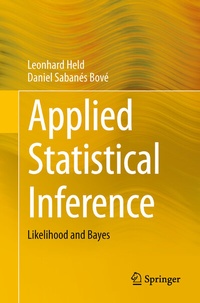
Applied Statistical Inference
Description

This book covers modern statistical inference based on likelihood with applications in medicine, epidemiology and biology. Two introductory chapters discuss the importance of statistical models in applied quantitative research and the central role of the likelihood function. The rest of the book is divided into three parts. The first describes likelihood-based inference from a frequentist viewpoint. Properties of the maximum likelihood estimate, the score function, the likelihood ratio and the Wald statistic are discussed in detail. In the second part, likelihood is combined with prior information to perform Bayesian inference. Topics include Bayesian updating, conjugate and reference priors, Bayesian point and interval estimates, Bayesian asymptotics and empirical Bayes methods. Modern numerical techniques for Bayesian inference are described in a separate chapter. Finally two more advanced topics, model choice and prediction, are discussed both from a frequentist and a Bayesian perspective.
A comprehensive appendix covers the necessary prerequisites in probability theory, matrix algebra, mathematical calculus, and numerical analysis.
Reviews / Votes
From the book reviews:
"The book by Leonhard Held and Daniel Sabanés Bové is highly recommended for anyone who is interested in acquainting themselves with or extending their knowledge of likelihood-based and Bayesian inference. This will certainly include Bachelor and Master students with a quantitative focus, but also researchers who are interested in getting to know the background of many modern inferential procedures in more detail." (Thomas Kneib, Biometrical Journal, October, 2014)
"Modern statistical techniques for likelihood and Bayesian approaches are presented in detail throughout the book. . The intended audience is formed by students in bioinformatics, biomathematics, etc., but a large audience could be interested in this book." (Marina Gorunescu, zbMATH, Vol. 1281, 2014)
More details
Other editions
Additional editions
Persons
Leonhard Held is a Professor of Biostatistics at the University of Zurich, Switzerland. He has served as Editor or Associate Editor for Biometrical Journal, Biostatistics and Applied Statistics (JRSSC). He has published several books and numerous articles in statistical methodology, applied statistics and biomedical research. He teaches undergraduate and graduate-level courses in Biostatistics and Medical Statistics.
Daniel Sabanés Bové wrote his PhD thesis in Statistics at the University of Zurich under the supervision of Leonhard Held. He received the Bernd-Streitberg young researcher award from the German Region of the International Biometrical Society.
Content
Introduction. - Likelihood. - Elements of Frequentist Inference. -Frequentist Properties of the Likelihood. - Likelihood Inference in Multiparameter Models. - Bayesian Inference. - Model Selection. -Numerical Methods for Bayesian Inference. - Prediction. - Probabilities, Random Variables and Distributions. - Some Results from Matrix Algebra and Calculus. - Some Numerical Techniques.
