

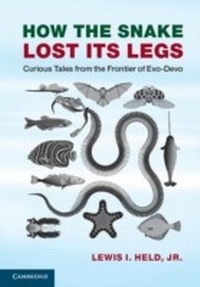
How the Snake Lost its Legs
Curious Tales from the Frontier of Evo-Devo
1st Edition
Published on 31. December 2013
978-1-107-77698-2 (ISBN)
Description

How did the zebra really get its stripes, and the giraffe its long neck? What is the science behind camel humps, leopard spots, and other animal oddities? Such questions have fascinated us for centuries, but the expanding field of evo-devo (evolutionary developmental biology) is now providing, for the first time, a wealth of insights and answers. Taking inspiration from Kipling's 'Just So Stories', this book weaves emerging insights from evo-devo into a narrative that provides startling explanations for the origin and evolution of traits across the animal kingdom. Held's unique and engaging style makes this narrative both enlightening and entertaining, guiding students and researchers through even complex concepts and encouraging a fuller understanding of the latest developments in the field. The first five chapters cover the first bilaterally symmetric animals, flies, butterflies, snakes, and cheetahs. A final chapter surveys recent results about a menagerie of other animals.
Reviews / Votes
'In How the Snake Lost its Legs, Professor Held describes the key concepts that are at the foundation of evo/devo, in a language that is clear and simple as well as scientifically accurate, and in a manner that is sure to captivate the curious reader. In the second half of the book, he unveils a series of 'Just So' stories, a mixture of fascinating vignettes providing insights into what we now know about the evolution of various creatures, and teasing explorations of what remains to be learned. The book is a wonderful introduction to the field.' Cliff Tabin, Harvard Medical School 'Professor Held has created a remarkable work of scholarship, notable for its accessibility, readability, and breadth with an overall welcoming tone that is reminiscent of those memorable professors who make the complex approachable through their lectures ... The book works on several levels, suitable for sampling as well as for an entire read. The concluding 'bestiary' celebrates the diversity of life and the vast array of questions that await answers. Students in particular will benefit from the book's presentation of multiple examples of the changing face of knowledge, how a story can be woven from a careful reading and cross-comparison of the literature, and the power of generating organization schemes (classifications) to help make sense of a complicated body of literature.' Richard L. Blanton, North Carolina State University 'Lewis Held has explicitly not written a 'textbook' - it is much more informal and whimsical than that. He has succeeded admirably in exploring evo-devo through a format akin to Kipling's Just So Stories (there is a fine irony here). He ranges from thoroughly researched topics ... through to intriguing snippets ... A wealth of information and ideas is conveyed with rigour, clarity and wit, and the text is supported by excellent, distinctive figures and by generous reference to the research literature. This remarkable book is a real 'page-turner' and it is likely to both inform and enchant all of us interested in biological diversity and how it arises.' Vernon French, University of Edinburgh 'No single research study can convey what Lewis Held's new book does: demonstrate the richness of evolutionary developmental biology as a way to understand major transitions in evolution and their mechanistic underpinnings. This is a must-have resource for anyone who is teaching or learning or simply interested in evolutionary biology.' Guenter P. Wagner, Yale University '... accessible to any reader interested in evolutionary biology while also satisfying the more expert 'evo-devotees' willing to explore the depicted topics in depth.' Arnaud Martin, Evolution and Development 'This is not a textbook, but delivers a wealth of information, much more so than any research study, with excellent figures and generous reference to scientific literature.' Elspeth Houlding, The Biologist '... a smorgasbord of developmental phenomena with titles echoing Rudyard Kipling throughout. Five chapters deal with bilaterians, flies, butterflies, snakes, and cheetahs, each of them addressing a handful of interesting questions. ... this book is filled with superb diagrams and illustrations. There's a seven-page glossary of 36 important evo-devo terms. And 2526 citations!' Mark Terry, American Biology TeacherMore details
Language
English
Place of publication
Cambridge
United Kingdom
Target group
College/higher education
Professional and scholarly
Illustrations
3 Tables, black and white; 8 Plates, color; 56 Halftones, unspecified
File size
58,27 MB
ISBN-13
978-1-107-77698-2 (9781107776982)
Copyright in bibliographic data and cover images is held by Nielsen Book Services Limited or by the publishers or by their respective licensors: all rights reserved.
Schweitzer Classification
Other editions
Additional editions
Book
01/2014
Cambridge University Press
€77.40
Shipment within 15-20 days
Book
01/2014
Cambridge University Press
€135.90
Shipment within 15-20 days
Person
Lewis I. Held, Jr is Associate Professor of Biology at Texas Tech University, Lubbock, Texas, USA. He has taught developmental biology and human embryology to pre-medical students for 27 years, and received the 2010 Professing Excellence Award and the 1995 President's Excellence in Teaching Medal (Texas Tech University). He is also the author of Quirks of Human Anatomy (Cambridge, 2009), Imaginal Discs (Cambridge, 2002) and Models for Embryonic Periodicity (1992).
Content
Preface; 1. The first two-sided animal; 2. The fly; 3. The butterfly; 4. The snake; 5. The cheetah; 6. An evo-devo bestiary; Epilogue; Glossary; References; Index.
