

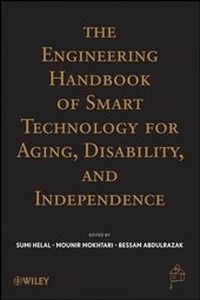
The Engineering Handbook of Smart Technology for Aging, Disability and Independence
Description

Reviews / Votes
"This text is a resource for researchers, professionals, andgraduate students in computer science, rehabilitation science, andclinical engineering." (IEEE Microwave Magazine, June2009) "This handbook contains 49 papers, each approximately 20 pagesin length. The eight-part volume covers introductory papers andpolicies, user needs and assistive technology, man-machineinteraction, robot aids, user mobility, smart environmentaltechnology, smart infrastructural applications, and standards andguidelines in design. Taken as a whole, the work offers a goodintroduction and survey of the needs and available technologicalremediation for the elderly and the disabled. The back cover of thevolume includes the following statement: "This book is anindispensable resource for researchers and professionals incomputer science, rehabilitation science, and clinical engineering.It also serves as a valuable textbook for graduate students in theaforementioned fields." However, this book is too much of ahodge-podge to be used for academic course work, and it lacks thecontent to be of much use to researchers and professionals incomputer science. Summing Up: Recommended. Medical librariesserving professionals and practitioners." - A.M. Strauss, Vanderbilt University (CHOICE, March2009)More details
Other editions
Additional editions
Persons
Content
Preface.
Author Biography.
Contributors.
Introduction to the book (Sumi Helal, Mounir Mokhtari, Bessam Abdulrazak and Mark Schmalz).
PART I: DEFINITIONS, CLASSIFICATIONS, AND POLICIES.
Chapter 1: Technology for Successful Aging and Disabilities (Amol Karmarkar, Eliana Chavez and Rory A. Cooper).
Chapter 2: International Policy Context of Technologies for Disabilities: An Analytical Framework (Rene Jahiel).
Chapter 3: Technology for Individuals with Disabilities: Government and Market Policies (Katherine D. Seelman).
Chapter 4: Assistive Technology and the International Classification of Functioning, Disability and Health (Jerome Bickenbach).
Chapter 5: Technology for Integration of Students with Disabilities in Higher Education (Marci Kinas Jerome, Kristine Neuber, Brianna Stegall, Anna Emenova and Michael Behrmann).
Chapter 6: ISO 9999 Assistive Products for Persons with Disability - Classification and Terminology (Ir. Theo Bougie).
PART II: USERS, NEEDS, AND ASSISTIVE TECHNOLOGY.
Chapter 7: Low Tech Assistive Technology (Kathleen Laurin and Jill Sherman).
Chapter 8: People with Visual Disabilities (John Gill and Linda Newson).
Chapter 9: Assistive Devices for People with Visual Impairments (John Gill).
Chapter 10: Assistive Devices for People with Hearing Loss (Matthew H. Bakke).
Chapter 11: People with Cognitive Disabilities (Mary Kay Rizzolo and David Braddock).
Chapter 12: Assistive Devices for People with Cognitive Impairments (Hélène Pigot, Jérémy Bauchet and Sylvain Giroux).
PART III: HUMAN-MACHINE INTERACTION & ALTERNATIVE COMMUNICATION.
Chapter 13: Computer Access in the Workplace (Karen Milchus and Carrie Bruce).
Chapter 14: Platforms & Operating Systems Accessibility (Barry Feigenbaum and Kip Harris).
Chapter 15: Voice Interactive Systems (Rudzionis Algimantas, Kastytis Ratkevicius and Vytautas Rudzionis).
Chapter 16: The Communication Assistant (Alternative Communication) (Leanne West).
Chapter 17: Wearable Systems Design Issues for Aging or Disabled Users (Maribeth Gandy, Tracy Westeyn, Helene Brashear and Thad Starner).
Chapter 18: Tactile Displays (Stephen A. Brewster, Steven A. Wall, Lorna M. Brown and Eve E. Hoggan).
PART IV: ASSISTIVE ROBOTICS.
Chapter 19: Assistive Robotics for Independent Living (Bessam Abdulrazak and Mounir Mokhtari).
Chapter 20: Mobile Platform-Based Assistive Robot Systems (Zeungnam Bien, Dae-Jin Kim, Kwang-Hyun Park, Jin-Woo Jung, Jin-Oh Kim, Myung Jin Chung and Pyung-Hun Chang).
Chapter 21: Robot Therapy at Elderly Institution - Effects of Long-Term Interaction with Seal Robots (Takanori Shibata and Kazuyoshi Wada).
Chapter 22: Prostheses - Human Limbs and Their Artificial Replacements (Richard F. ff. Weir).
PART V: USER MOBILITY.
Chapter 23: Wheelchairs within the Context of Smart House Design (Dimitar Stefanov).
Chapter 24: People with Special Needs and Traffic Safety (Nahid Shahmehri, Ioan CHISALITA and Iohan Aberg).
Chapter 25: Blind Navigation and the Role of Technology (Nicholas Giudice and Gordon Legge).
Chapter 26: Walker Systems (Andrew Rentschler).
Chapter 27: Accessible Public Transportation Services in America (Katharine M. Hunter-Zaworski).
Chapter 28: Transportation Services in Europe (Isabelle Dussutour).
Chapter 29: Transportation Services in Asia (Joseph Kwan and Eric W.C. Tam).
PART VI: TECHNOLOGIES FOR SMART ENVIRONMENTS.
Chapter 30: Modeling the Well-Being of Older People (Andrew Sixsmith).
Chapter 31: Context Awareness (Jadwiga Indulska and Karen Henricksen).
Chapter 32: Middleware for Smart Spaces (Daqing Zhan,g Tao Gu and Manli Zhu).
Chapter 33: Privacy, Security and Safety Technologies (Abdallah M'hamed).
Chapter 34: Automated Medication Management Devices (RJ Davies, Christopher Nugent, DD Finlay, D Craig and ND Black).
Chapter 35: Virtual Companions (Nahid Shahmehri, Johan berg and Dennis Maciuszek).
Chapter 36: Textile Sensing & e-Textile (Smart Textile) (Rita Paradiso, Nicola Taccini and Giannicola Loriga).
Part VII: Smart Environments and Cyberinfrastructures.
Chapter 37: The Gator Tech Smart House: A Programmable Pervasive Space (Sumi Helal).
Chapter 38: Health Application & Telecare (Mathijs Soede, Frank Vlaskamp and Charles Willems).
Chapter 39: Immersive Tele-Care for Assisting People with Special Needs (Sumi Helal and Bessam Abdulrazak).
Chapter 40: Smart Systems in Personal Transportation (Aaron Steinfeld).
Chapter 41: Tools for Studying Novel Proactive HealthCare Applications for Places of Living (Stephen Intille and Kent Larson).
Chapter 42: Algorithms for Smart Spaces (Diane J. Cook, G. Michael Youngblood and Gaurav Jain).
PART VIII: EMERGING STANDARDS, GUIDELINES & DESIGN METHODS.
Chapter 43: User-Sensitive Design for Older and Disabled People (Alan Newell).
Chapter 44: Universal Design/Design for All: Practice and Method (Edward H Steinfeld).
Chapter 45: Design for Well-Being (Andreas Larsson and Tobias Larsson).
Chapter 46: Technology Evaluation within Health and Social Care (Suzanne Martin, George Kernohan, Bernadette Mc Creight and Christopher Nugent).
Chapter 47: Usability in Designing Assistive Technologies (Jean-Claude SPERANDIO and Marion Wolff).
Chapter 48: Smart Home and Health Telematics: Standards for and with Users (Milan Erbes).
Chapter 49: ICT Standardization for Elderly and People with Disabilities in Japan (Hajime Yamada).
Index.
