

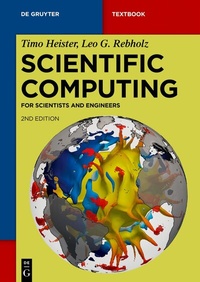
Scientific Computing
Description

Scientific Computing for Scientists and Engineers is designed to teach undergraduate students relevant numerical methods and required fundamentals in scientific computing.
Most problems in science and engineering require the solution of mathematical problems, most of which can only be done on a computer. Accurately approximating those problems requires solving differential equations and linear systems with millions of unknowns, and smart algorithms can be used on computers to reduce calculation times from years to minutes or even seconds. This book explains: How can we approximate these important mathematical processes? How accurate are our approximations? How efficient are our approximations?
Scientific Computing for Scientists and Engineers covers:
- An introduction to a wide range of numerical methods for linear systems, eigenvalue problems, differential equations, numerical integration, and nonlinear problems;
- Scientific computing fundamentals like floating point representation of numbers and convergence;
- Analysis of accuracy and efficiency;
- Simple programming examples in MATLAB to illustrate the algorithms and to solve real life problems;
- Exercises to reinforce all topics.
More details
Other editions
Additional editions
Persons
Timo Heister is an Associate Professor of Mathematical and Statistical Sciences at Clemson University, USA. He is an applied mathematician and a computational scientist researching numerical methods for PDEs using the Finite Element Method including massively parallel computations.
Leo Rebholz is a Professor of Mathematical and Statistical Sciences at Clemson University. He works on development and analysis of discretization methods and solvers for nonlinear partial differential equations arising from physics. He has published 4 books and over 100 journal articles in applied and computational mathematics.
