

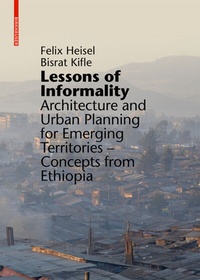
Lessons of Informality
Description

Provisorisch gebaute Behausungen wie etwa Wellblechhütten sind in den Metropolen Afrikas, Asiens und Lateinamerikas allgegenwärtig. Oft kritisiert für die unhygienischen Lebensumstände, gelten diese ungeplant entstandenen Siedlungengleichwohl als vielschichtiges Element auf dem Weg zu einer resilienten Stadt.
Solch urbane "Informalität" ist typisch für Schwellenländer, in denen heute ca. 68 % der Weltbevölkerung leben. Sie wird hier exemplarisch an Äthiopien und insbesondere Addis Abeba analysiert. Neben Ansätzen für den Wohnungsbau stellt das Buch auch ökonomische Strukturen vor: Mikrokreditwesen, "bottom-up"-Versicherungssysteme oder Berufe wie der "Kuré-Yalew" (Müllsammler), der im Sinne des "Urban Mining" einen wertvollen Beitrag zur Wiederverwendung von Abfallstoffen leistet.
More details
Other editions
Additional editions
Persons
Felix Heisel , ETH Zürich
Bisrat Kifle , Chair of Architecture & Design, EiABC, Addis Ababa.
Content
- Intro
- Contents
- Preface: From documentaries to architectural strategies
- Introduction: Informality in emerging territories
- Space creation and a sense of responsibility
- Housing in an informally grown city
- Landownership and the leasehold system
- A "new" Addis Ababa
- The ruralization of urban centres in Ethiopia Heyaw Terefe
- Social, cultural and traditional context
- Social dynamics and development
- Persisting meaning and evolving spaces
- Bottom-up insurance systems
- Self-employment as economic empowerment
- The economic importance of recycling
- Microeconomies, a formalized strategy
- Addis Ababa, a rental city
- City preservation through tourism
- Paradigm shifts in urban strategies
- From density to intensity
- Materializing informality
- Building laws for innovation
- Decentralized infrastructural systems
- Spatial dialogic
- _Spaces / The documentary series
- Editors and contributors
- Acknowledgements
- Illustration credits
