

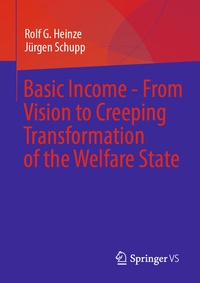
Basic Income - From Vision to Creeping Transformation of the Welfare State
Description

The present publication constitutively expands the field of discourse on the topic of basic income and explores the possibilities of its introduction as well as the opportunities and risks. Although all visionary proposals for an unconditional basic income (BGE) have so far not been implemented politically, at least in democratically constituted welfare states, the question of implementation or the conditions for success and the identification of possible blockades have only been dealt with marginally. Recent publications on a BGE also show this political-institutional "blindness" and do not address enough the reasons for the failure so far. Without a transfer strategy, however, the idea will fail in Germany due to such implementation naivety. In this book, therefore, the state of the debate on basic income is developed further to the extent that it is integrated into welfare-state development processes and current challenges for the "safeguarding of social security". In addition, a social-scientific classification of hitherto visionary guarantee elements of a basic income model is undertaken, linking up with the "silent" change to a socially investing state.
More details
Other editions
Additional editions
Persons
Prof. Dr. Rolf G. Heinze was Chair of General Sociology, Work and Economics at the Faculty of Social Sciences at Ruhr-Universität Bochum (RUB) from 1988 to 2021; since the summer semester of 2021, he has been Senior Professor there and continues to be Managing Scientific Director of the Institute of Housing, Real Estate, Urban and Regional Development (InWIS) at RUB.
Prof. Dr. Jürgen Schupp is a Senior Research Fellow at the German Institute for Economic Research (DIW) Berlin in the Socio-Economic Panel (SOEP) department and teaches sociology at Freie Universität Berlin.
