

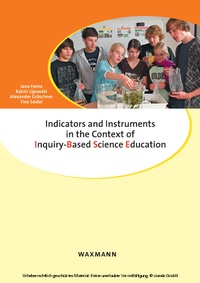
Indicators and Instruments in the Context of Inquiry-Based Science Education
1st Edition
Published in 2012
428 pages
978-3-8309-7594-6 (ISBN)
Description

This report documents indicators and instruments in the context of inquiry-based science education (IBSE). It is embedded in a project that aims at disseminating inquiry-based science teaching on a large scale across Europe.
Recent research about IBSE is rather specific to individual research questions and focuses on single aspects of IBSE. Furthermore, the instruments and indicators underlying the different studies are predominately not systematically covered. In this report single indicators and instruments in the context of science education are brought together. Thereby a coherent database and a link to different research results are presented.
The indicators and instruments in this report originate from a systematic literature review about IBSE from 2005-2009. To receive a comprehensive picture about research on IBSE the scope of this review contains instructional aspects (1), implementation areas of politics/stakeholders (2) and teacher education and teacher professional development (3).
This report contributes to supplying a systematic overview about instruments and indicators in the field of IBSE. It addresses researchers, politicians and stakeholders, teacher educators and teachers who are interested in methods of research and dissemination in the context of science education and IBSE.
Recent research about IBSE is rather specific to individual research questions and focuses on single aspects of IBSE. Furthermore, the instruments and indicators underlying the different studies are predominately not systematically covered. In this report single indicators and instruments in the context of science education are brought together. Thereby a coherent database and a link to different research results are presented.
The indicators and instruments in this report originate from a systematic literature review about IBSE from 2005-2009. To receive a comprehensive picture about research on IBSE the scope of this review contains instructional aspects (1), implementation areas of politics/stakeholders (2) and teacher education and teacher professional development (3).
This report contributes to supplying a systematic overview about instruments and indicators in the field of IBSE. It addresses researchers, politicians and stakeholders, teacher educators and teachers who are interested in methods of research and dissemination in the context of science education and IBSE.
More details
Other editions
Additional editions
Jana Heinz | Katrin Lipowski | Alexander Gröschner
Indicators and Instruments in the Context of Inquiry-Based Science Education
Book
03/2012
1st Edition
Waxmann
€68.00
Article exhausted; check different version
Content
1 - Contents [Seite 6]
2 - Preface [Seite 8]
3 - 1. Introduction [Seite 10]
3.1 - 1.1 Literature Search [Seite 11]
3.2 - 1.2 Classification and Coding [Seite 11]
3.3 - 1.3 Results [Seite 12]
3.4 - 1.4 Discussion [Seite 15]
3.5 - 1.5 Editing the Indicators and Instruments [Seite 16]
3.6 - Acknowledgments [Seite 16]
4 - 2. Policy and School Management [Seite 17]
4.1 - 2.1 Cognitive Measures [Seite 17]
4.2 - 2.2 Affective-Motivational Measures [Seite 19]
4.3 - 2.3 Metacognitive Measures [Seite 27]
5 - 3. Teacher Education [Seite 34]
5.1 - 3.1 Cognitive Measures [Seite 34]
5.2 - 3.2 Affective-Motivational Measures [Seite 35]
5.3 - 3.3 Metacognitive Measures [Seite 80]
6 - 4. Teacher Professional Development [Seite 84]
6.1 - 4.1 Cognitive Measures [Seite 84]
6.2 - 4.2 Affective-Motivational Measures [Seite 85]
6.3 - 4.3 Metacognitive Measures [Seite 101]
7 - 5. Instruction and the Classroom - Teachers [Seite 106]
7.1 - 5.1 Affective-Motivational Measures [Seite 106]
7.2 - 5.2 Metacognitive Measures [Seite 140]
8 - 6. Instruction and the Classroom - Students [Seite 329]
8.1 - 6. 1 Cognitive Measures [Seite 329]
8.2 - 6.2 Affective-Motivational Measures [Seite 365]
8.3 - 6.3 Metacognitive measures [Seite 388]
9 - References [Seite 394]
10 - Index [Seite 400]
11 - List of Measures [Seite 401]
2 - Preface [Seite 8]
3 - 1. Introduction [Seite 10]
3.1 - 1.1 Literature Search [Seite 11]
3.2 - 1.2 Classification and Coding [Seite 11]
3.3 - 1.3 Results [Seite 12]
3.4 - 1.4 Discussion [Seite 15]
3.5 - 1.5 Editing the Indicators and Instruments [Seite 16]
3.6 - Acknowledgments [Seite 16]
4 - 2. Policy and School Management [Seite 17]
4.1 - 2.1 Cognitive Measures [Seite 17]
4.2 - 2.2 Affective-Motivational Measures [Seite 19]
4.3 - 2.3 Metacognitive Measures [Seite 27]
5 - 3. Teacher Education [Seite 34]
5.1 - 3.1 Cognitive Measures [Seite 34]
5.2 - 3.2 Affective-Motivational Measures [Seite 35]
5.3 - 3.3 Metacognitive Measures [Seite 80]
6 - 4. Teacher Professional Development [Seite 84]
6.1 - 4.1 Cognitive Measures [Seite 84]
6.2 - 4.2 Affective-Motivational Measures [Seite 85]
6.3 - 4.3 Metacognitive Measures [Seite 101]
7 - 5. Instruction and the Classroom - Teachers [Seite 106]
7.1 - 5.1 Affective-Motivational Measures [Seite 106]
7.2 - 5.2 Metacognitive Measures [Seite 140]
8 - 6. Instruction and the Classroom - Students [Seite 329]
8.1 - 6. 1 Cognitive Measures [Seite 329]
8.2 - 6.2 Affective-Motivational Measures [Seite 365]
8.3 - 6.3 Metacognitive measures [Seite 388]
9 - References [Seite 394]
10 - Index [Seite 400]
11 - List of Measures [Seite 401]
