

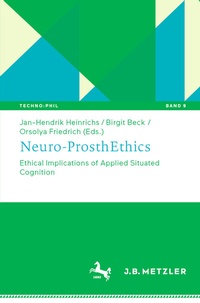
Neuro-ProsthEthics
Description

The volume focusses on the ethical dimensions of the technological scaffold embedding human thought and action, which has been brought to attention of the cognitive sciences by situated cognition theories. There is a broad spectrum of technologies co-realising or enabling and enhancing human cognition and action, which vary in the degree of bodily integration, interactivity, adaptation processes, of reliance and indispensability etc. This technological scaffold of human cognition and action evolves rapidly. Some changes are continuous, some are eruptive. Technologies that use machine learning e.g. could represent a qualitative leap in the technological scaffolding of human cognition and actions. The ethical consequences of applying situated cognition theories to practical cases had yet to find adequate attention and are elucidated in this volume.
More details
Other editions
Additional editions
Persons
Birgit Beck is professor for Ethics and Philosophy of Technology at the Institute of History and Philosophy of Science, Technology, and Literature at Technische Universität Berlin. Her research and teaching interests include ethics and philosophy of technology, bioethics, animal ethics and food ethics.
Orsolya Friedrich is Professor of Philosophy of Medicine and Technology at the Institute of Philosophy at the FernUniversität in Hagen, where she leads an Emmy Noether research group that investigates the characteristics and consequences of novel interactions between humans and machines from a philosophical perspective.
