

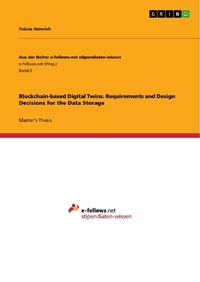
Blockchain-based Digital Twins. Requirements and Design Decisions for the Data Storage
Published on 12. January 2023
128 pages
978-3-346-79268-6 (ISBN)
Description

Master's Thesis from the year 2022 in the subject Computer Science - Miscellaneous, University of Hohenheim, language: English, abstract: The following research goal is the development of design decisions for the blockchain-based storage of digital twin data. The digital twin can be deployed in almost every industry and is able to represent any object, being, process or organisation. The resulting benefits are versatile and can encompass a higher transparency and efficiency, cost reduction, or the enabling of completely new functions such as the virtual commissioning. Digital twins do even contribute to a sustainable industrial production as they enable a corresponding reduction of the primary energy emissions of up to eight percent. Due to this substantial added value, digital twins pertain to the top ten strategic technology trends and are expected to reach a market size of over 48 billion USD by 2026.
The existence of digital twins is strongly dependent on its underlying data, for which reason the data storage is of fundamental importance for the operation of this technology. In the past, the digital twin concept mostly relied upon a traditional storage infrastructure in form of databases or clouds. However, digital twins and its data storage face major challenges, e.g., through a
more and more connected world and therefore an increasing number of potential participants and data volume, or as a consequence of growing data security-related risks. Furthermore, potential digital twin use cases entail varying conditions, for which reason alternative storage solutions must be assessed.
The blockchain technology might constitute a possible alternative to realize the storage of digital twin data. Through the novel and nearly unique characteristics such as immutability, decentralisation, or manipulation safety, blockchains could introduce new opportunities to address digital twin use cases. Those characteristics seem relevant at first sight as the application areas
of digital twins become more manifold- especially as the digital twin concept evolves from a descriptive to a rather actionable approach and include more critical data. How the blockchain technology can actually deal with the requirements for the data storage including the abovementioned challenges must therefore be evaluated in order to facilitate
their interplay and potentially achieve their full potential. Hereby, at first the data storage in digital twins must be understood comprehensively to assess the suitability of their deployment.
More details
Other editions
Additional editions
Tobias Heinrich
Blockchain-based Digital Twins. Requirements and Design Decisions for the Data Storage
Book
12/2022
1st Edition
GRIN Verlag
€47.95
Shipment within 10-15 days
