

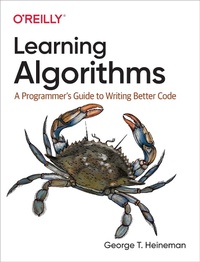
Learning Algorithms
Published on 20. July 2021
280 pages
978-1-4920-9101-1 (ISBN)
Description

When it comes to writing efficient code, every software professional needs to have an effective working knowledge of algorithms. In this practical book, author George Heineman (Algorithms in a Nutshell) provides concise and informative descriptions of key algorithms that improve coding in multiple languages. Software developers, testers, and maintainers will discover how algorithms solve computational problems creatively.Each chapter builds on earlier chapters through eye-catching visuals and a steady rollout of essential concepts, including an algorithm analysis to classify the performance of every algorithm presented in the book. At the end of each chapter, you??ll get to apply what you??ve learned to a novel challenge problem??simulating the experience you might find in a technical code interview.With this book, you will:Examine fundamental algorithms central to computer science and software engineeringLearn common strategies for efficient problem solving??such as divide and conquer, dynamic programming, and greedy approachesAnalyze code to evaluate time complexity using big O notationUse existing Python libraries and data structures to solve problems using algorithmsUnderstand the main steps of important algorithms
More details
Other editions
Additional editions
Book
09/2021
O'Reilly
€74.50
Shipment within 15-20 days
Content
- Intro
- Copyright
- Table of Contents
- Foreword
- Preface
- Who This Book Is For
- About the Code
- Conventions Used in This Book
- O'Reilly Online Learning
- How to Contact Us
- Acknowledgments
- Chapter 1. Problem Solving
- What Is an Algorithm?
- Finding the Largest Value in an Arbitrary List
- Counting Key Operations
- Models Can Predict Algorithm Performance
- Find Two Largest Values in an Arbitrary List
- Tournament Algorithm
- Time Complexity and Space Complexity
- Summary
- Challenge Exercises
- Chapter 2. Analyzing Algorithms
- Using Empirical Models to Predict Performance
- Multiplication Can Be Faster
- Performance Classes
- Asymptotic Analysis
- Counting All Operations
- Counting All Bytes
- When One Door Closes, Another One Opens
- Binary Array Search
- Almost as Easy as p
- Two Birds with One Stone
- Pulling It All Together
- Curve Fitting Versus Lower and Upper Bounds
- Summary
- Challenge Exercises
- Chapter 3. Better Living Through Better Hashing
- Associating Values with Keys
- Hash Functions and Hash Codes
- A Hashtable Structure for (Key, Value) Pairs
- Detecting and Resolving Collisions with Linear Probing
- Separate Chaining with Linked Lists
- Removing an Entry from a Linked List
- Evaluation
- Growing Hashtables
- Analyzing the Performance of Dynamic Hashtables
- Perfect Hashing
- Iterate Over (key, value) Pairs
- Summary
- Challenge Exercises
- Chapter 4. Heaping It On
- Max Binary Heaps
- Inserting a (value, priority)
- Removing the Value with Highest Priority
- Representing a Binary Heap in an Array
- Implementation of Swim and Sink
- Summary
- Challenge Exercises
- Chapter 5. Sorting Without a Hat
- Sorting by Swapping
- Selection Sort
- Anatomy of a Quadratic Sorting Algorithm
- Analyze Performance of Insertion Sort and Selection Sort
- Recursion and Divide and Conquer
- Merge Sort
- Quicksort
- Heap Sort
- Performance Comparison of O(N log N) Algorithms
- Tim Sort
- Summary
- Challenge Exercises
- Chapter 6. Binary Trees: Infinity in the Palm of Your Hand
- Getting Started
- Binary Search Trees
- Searching for Values in a Binary Search Tree
- Removing Values from a Binary Search Tree
- Traversing a Binary Tree
- Analyzing Performance of Binary Search Trees
- Self-Balancing Binary Trees
- Analyzing Performance of Self-Balancing Trees
- Using Binary Tree as (key, value) Symbol Table
- Using the Binary Tree as a Priority Queue
- Summary
- Challenge Exercises
- Chapter 7. Graphs: Only Connect!
- Graphs Efficiently Store Useful Information
- Using Depth First Search to Solve a Maze
- Breadth First Search Offers Different Searching Strategy
- Directed Graphs
- Graphs with Edge Weights
- Dijkstra's Algorithm
- All-Pairs Shortest Path
- Floyd-Warshall Algorithm
- Summary
- Challenge Exercises
- Chapter 8. Wrapping It Up
- Python Built-in Data Types
- Implementing Stack in Python
- Implementing Queues in Python
- Heap and Priority Queue Implementations
- Future Exploration
- Index
- About the Author
- Colophon
